
Samsung Files Patent for Memory That Lets Servers Predict Failures Without Seeing Its Secrets
Samsung's patent application describes a way for a server to predict which parts of a memory chip are about to fail, even though the chip never hands over the readable data behind the prediction.
What Samsung's locked memory error logs do
Imagine a mechanic who has to predict which part of your engine will fail next, but the engine's maker refuses to share the diagnostic logs because they reveal trade secrets. Now imagine the mechanic can run the analysis on a locked box and get back an answer that only the engine itself can read.
That is roughly what Samsung describes for the memory chips inside data center servers. These chips fix small errors on their own, and the logs of those fixes can reveal how the maker's repair tricks work. So the chip locks the sensitive parts of each log with a special kind of encryption that still allows math on the locked data.
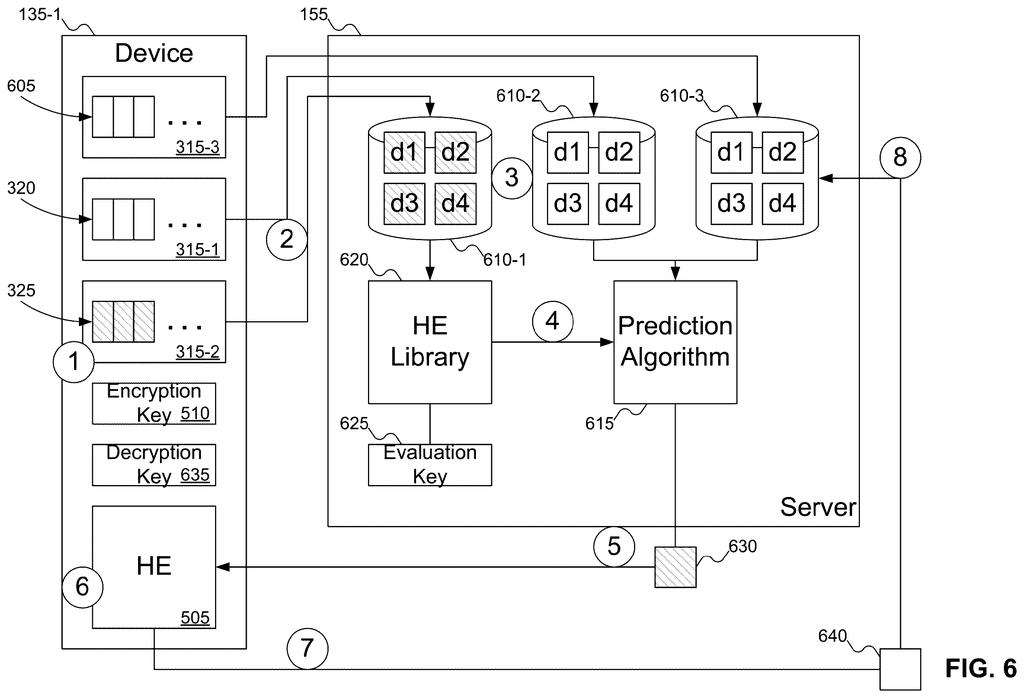
A management server then predicts which locations in memory look risky, without ever reading the logs. It hands back a locked list, the chip opens it with a key that never leaves the chip, and the answer goes out so computers can stop using those spots before they fail.
… a buffer to store a correctable event record, the correctable event record including a first field and a second field, the first field encrypted using a homomorphic encryption (HE) algorithm and an encryption key …
Translation: The memory device keeps track of minor errors in an encrypted format that outsiders cannot read.
How the memory chip decodes the server's answer
The filing bundles three pieces: a memory device, a method that runs on the device, and a method that runs on a management server (the data center machine that tracks which memory is healthy). The device is described mainly as a Compute Express Link (CXL) device, a fast connection standard that lets servers share pools of memory.
When the device fixes a minor error on its own, it writes a correctable event record into a small holding area called a buffer. A built-in engine then applies homomorphic encryption (a scheme that lets someone do math on scrambled data and get a scrambled answer that unscrambles correctly) to at least one field. The key stays local to the device. Less sensitive fields can stay readable.
- The server requests the locked records through a mailbox (a message slot the device uses to talk to management software).
- It runs a prediction algorithm on them and gets a locked list of addresses likely to fail.
- It sends that list back, sometimes with an extra "evaluation key."
- The device decrypts it and returns the plain list, which the server adds to a "poison list" of places to avoid.
The prediction can use log-based methods, row and column analysis, machine learning, or a large language model. Records of errors the device could not fix stay unencrypted.
A device is disclosed. The device may include a connection to a host or a management unit, a media to store a data, and a controller to access the data in the media based at least in part on a request from the host.
Translation: The hardware setup includes a storage medium and a controller that handles requests from the main system.
What this means for server memory reliability
If you use cloud services, you rely on memory chips that fail now and then. Catching a failing spot before it loses data means fewer crashes and less downtime, because servers can steer clear of that spot ahead of time. The catch is that chip makers treat their repair data as secret, so outside tools get limited information.
This design lets the maker keep its secrets while the data center still gets useful warnings. It also keeps raw device details away from system administrators, who the filing says could otherwise see them. Whether it works in practice depends on how heavy the math on locked data turns out to be, and the filing gives no speed figures.
Samsung's 38th filing we've tracked since June joins one on backup power for drives and one on self-fixing read errors in our next-generation SSD applications watchlist.
Shipping this takes both new chip hardware and new server software. The memory device needs a built-in encryption engine, and new chip designs take a long time to create and test. The server side is ordinary software, since its prediction tools only need versions that can work on locked data.
The filing makes one smart choice for the shortest route: the commands run through a mailbox that each manufacturer can define for itself, so a single memory maker could ship this without waiting for an industry standard.
The big unknown is speed. The filing gives no timing figures, so there is no way to tell whether the predictions would arrive fast enough to be useful. Until that is answered, this is a sensible design for data center memory that sits several steps from a product.
Get our take in your Top Stories
Liked this breakdown? Add Patentlyze as a preferred source on Google, and our plain-English take shows up more often in your Top Stories the next time Samsung patent news breaks.
There are more where this came from
We read every patent application Big Tech publishes and send you the ones worth knowing. Plain English, free, every week.
The drawings
17 drawing sheets from US 2026/0312786 A1 · click any drawing to enlarge


Want this weekly breakdown for a company we don't cover? Patentlyze Pro →
Be the first to weigh in