
Samsung Patents Technology That Splits Large Memory Tasks Into Simultaneous Smaller Jobs
Moving data between chips and memory is one of the quiet bottlenecks in modern computing. Samsung's latest patent targets that bottleneck by breaking big transfer jobs into smaller pieces and running them simultaneously.
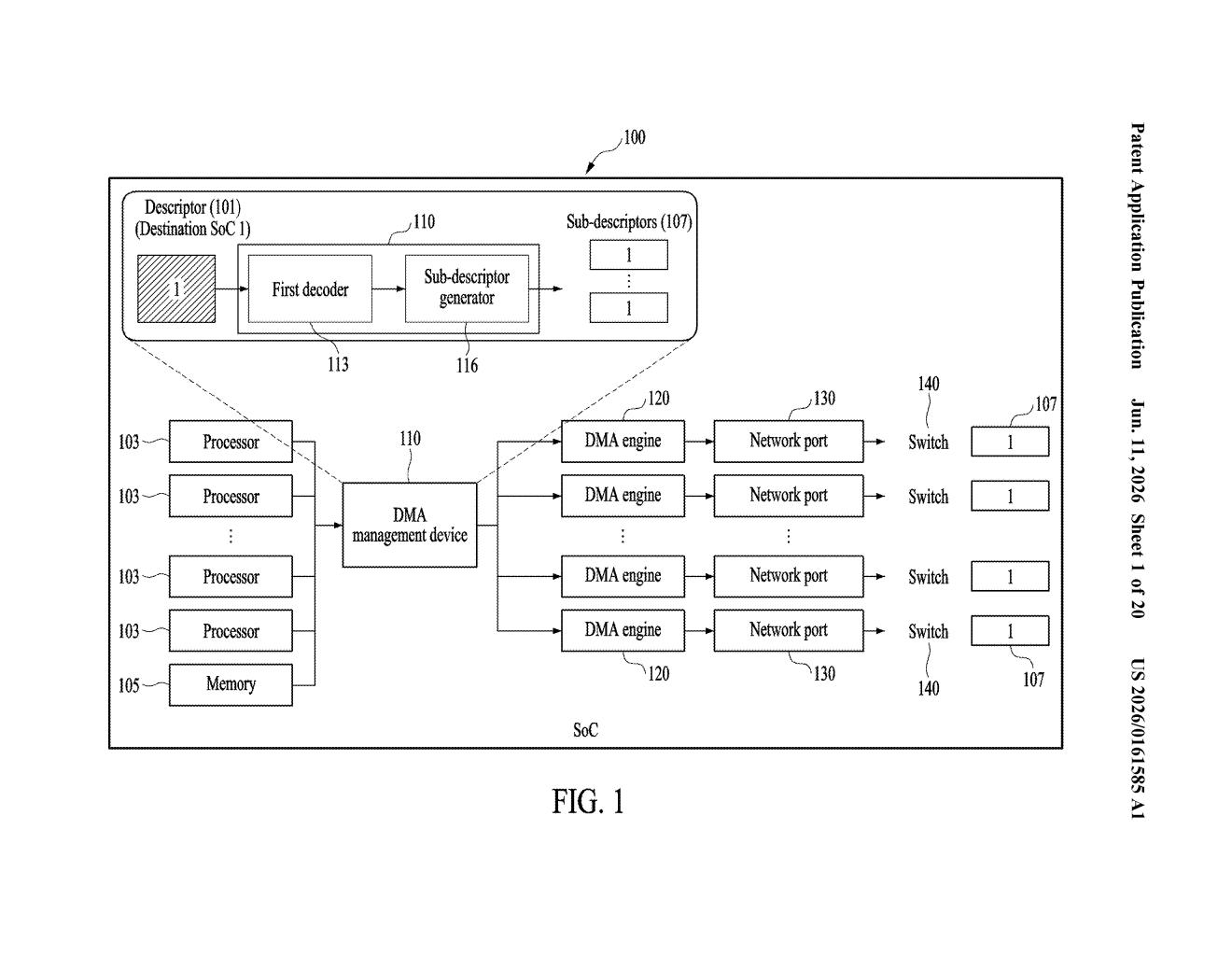
What Samsung's parallel memory transfer system actually does
Imagine you have a huge pile of boxes to move across a warehouse. Instead of one worker carrying them one at a time, you split the pile and send several workers in parallel — the job gets done much faster. Samsung's patent describes a system that does exactly this for data moving inside a computer chip.
When a processor needs to move a chunk of data from one place in memory to another, it issues an instruction called a descriptor — essentially a work order. Samsung's system intercepts that work order, breaks it into smaller pieces, and hands each piece to a separate DMA engine (a dedicated circuit built just for moving data). All the engines work at the same time, then the results are routed out through the chip's network connections.
This matters most in devices where many processors share the same memory — think data-center chips, AI accelerators, or advanced networking hardware — where moving data efficiently is just as important as computing it.
How the DMA manager decodes and distributes sub-descriptors
The patent describes a DMA (Direct Memory Access) management device — a dedicated piece of hardware that sits between a group of processors and the memory they share.
Here's how the flow works:
- Decode: Any of the multiple processors can issue a descriptor — a structured instruction that says what data to move, from where, and to where.
- Divide: The DMA management device decodes that descriptor and splits it into sub-descriptors, smaller chunks of the original transfer job.
- Distribute: Each sub-descriptor is handed to a separate DMA engine, which handles its portion of the data move independently and in parallel with the others.
- Deliver: Once each engine finishes, the combined result is sent out through one or more network ports to downstream switches — the routing hardware that connects different parts of a larger system.
The key insight is that DMA, which normally runs as a sequential single-engine job, becomes a parallelized pipeline. The claim also implies this architecture is designed for environments where memory is shared across multiple processors — a common setup in AI inference chips, network-on-chip designs, and multi-core server processors.
What this means for high-performance chip design
In dense computing systems — AI accelerators, high-bandwidth network processors, or data-center SoCs — the speed at which data can be moved often limits performance more than the speed at which it can be computed. A parallel DMA architecture directly attacks that constraint by letting multiple engines share the load.
For Samsung, which makes both memory chips and the application processors that go inside them, this kind of system-level efficiency patent fits squarely into its push for more capable, higher-throughput silicon. If this approach shows up in future Exynos or networking chips, it could mean your devices handle large data workloads — AI inference, 5G packet processing, storage I/O — with less waiting and less power waste.
This is a tidy piece of infrastructure engineering, not a flashy AI moment. Parallel DMA management is a well-understood problem space, and Samsung is filing a specific architectural claim on how to decompose and distribute transfer jobs in a shared-memory multi-processor context. It's the kind of patent that matters most if it ends up inside a high-performance chip where memory bandwidth is the binding constraint — which, in the AI era, is increasingly everywhere.
There are more where this came from
We read every patent application Big Tech publishes and send you the ones worth knowing. Plain English, free, every week.
Want this weekly breakdown for a company we don't cover? Patentlyze Pro →