
Sony Files Patent for Cars That Project Messages Onto the Road and Dodge Puddles
A car that flashes 'After you' onto the road is useless if the words land in a puddle. Sony's patent has the car check the road first, then move the message or trim it when the spot is bad.
What Sony's puddle-dodging road projector does
Right now, a message projected onto the road only works if the pavement scatters the light so people can see it. A puddle acts like a mirror and bounces the beam away. A bump or a cat's eye reflector can warp the words into something unreadable.
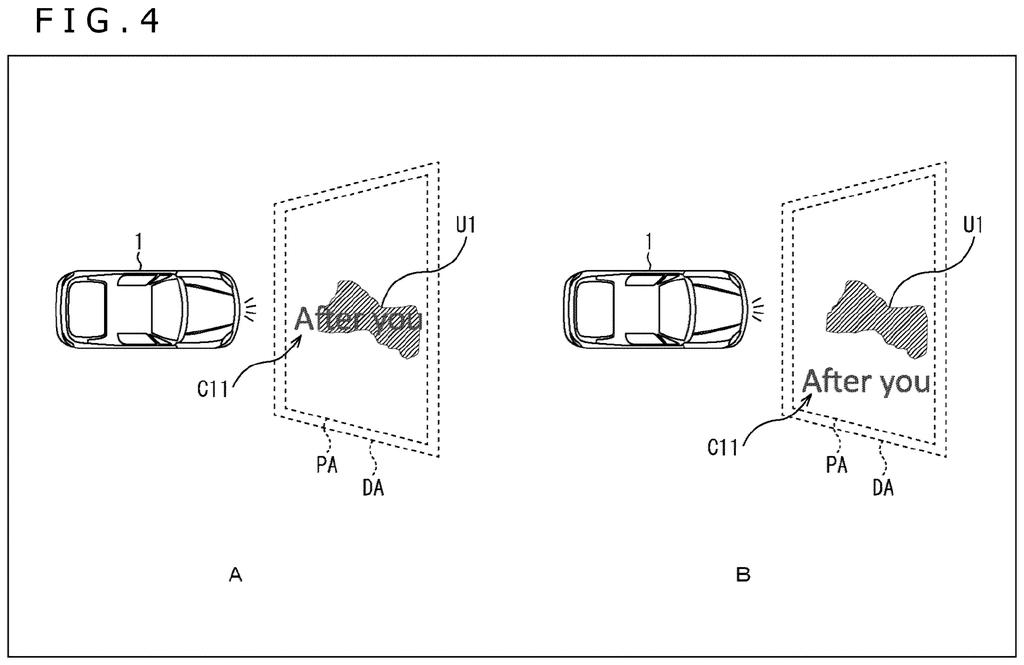
Sony's patent describes a car, or a robot moving through public spaces, that checks the road before it projects anything. Say the car wants to show 'After you' to a pedestrian, but a puddle sits right where the words would land. The car slides the message to a clear patch of road.
Some messages can't move, though. A line showing where the car is about to drive only makes sense in one place. In that case, the car leaves out the stretch that falls on the puddle. The filing also points out that a mirror-like puddle could throw a strong glare straight at someone nearby.
… controls output of projection information that is projected from the mobile body onto the road surface to establish communication with others.
Translation: The car projects visual messages onto the pavement to talk to people outside the vehicle.
How the car decides to move or trim a message
The system has three main parts:
- A driving plan unit works out the route, the speed at each point, and the destination, using what the vehicle senses around it.
- A road surface detector flags spots that are bad for projecting, which the patent calls 'unsuitable regions.'
- A projection control unit decides what gets projected, and where, based on the plan and those flagged spots.
Puddles are found with a polarization camera (a camera that can tell mirror-like shine from ordinary matte pavement). Bumps and obstacles are found with a time-of-flight sensor (it measures distance by timing how long light takes to bounce back). Four projectors, at the front, left, right and rear, can cover the whole area around the vehicle.
Each message carries a flag saying whether its location can change. A greeting to a pedestrian can be moved to clear pavement. A path showing where the car will drive cannot, so the car deletes the part that would fall on the puddle. Any message whose meaning depends on its spot is marked as fixed.
The car also feeds its own projection back to its sensors, so it doesn't mistake its own light for another vehicle's message or for a road defect. It reads projections from other vehicles, pedestrians and roadside poles when it plans. The filing also describes one shared lens for the projector and the cameras.
Why puddles matter for cars that talk to walkers
If cars start talking to pedestrians with light on the pavement, those messages have to work on a rainy night, when the road is wet and full of puddles. A message you can't read is worse than none, because you might guess wrong about what the car is about to do. The patent also flags a safety angle: a puddle can throw a strong beam straight at someone nearby.
The filing describes automated cars and robots, and it frames the problem as reliable communication with other people on the road. It names no product, so treat it as groundwork for road projection in general. For you as a walker or a driver, the practical point is simple: a projected message only helps if you can actually see it.
Sony's 29th filing we've tracked since July in the self-driving sensing race adds to earlier work like one predicting object danger and one aligning LiDAR and cameras.
Claim 1 covers any system on a moving vehicle that decides what to project onto the road by combining two inputs: where the vehicle is headed and what the pavement beneath it currently looks like. No specific sensors are named, no particular messages are required, and no brightness levels are specified. That scope is deliberately wide.
If granted, this claim would reach any road-projecting vehicle whose software consults both a route plan and road surface conditions before choosing what to display on the ground ahead. The specific behaviors described elsewhere in the patent, like moving a projected image around a puddle, appear only in narrower follow-on claims that serve as legal fallback positions.
That foundational breadth is what makes this matter. Sony would hold a claim on the basic decision loop behind how vehicles use light to talk to pedestrians and other drivers, before anyone gets to argue about the details.
Get our take in your Top Stories
Liked this breakdown? Add Patentlyze as a preferred source on Google, and our plain-English take shows up more often in your Top Stories the next time Sony patent news breaks.
There are more where this came from
We read every patent application Big Tech publishes and send you the ones worth knowing. Plain English, free, every week.
The drawings
10 drawing sheets from US 2026/0307583 A1 · click any drawing to enlarge


Show the other 2 sheets


Want this weekly breakdown for a company we don't cover? Patentlyze Pro →
Be the first to weigh in