
Sony Patents an AI That Picks Your Game Settings From a Plain-English Request
Sony's patent application describes a console where you type something like “make it immersive” and the system picks the graphics, audio and gameplay settings to match. No menu digging required.
What Sony's AI settings helper does for players
A player plugs in a new headset, then wanders through a maze of menus looking for the surround sound switch, the microphone slider and the default audio option. Consoles hide a lot of settings, and most of us give up and live with the defaults.
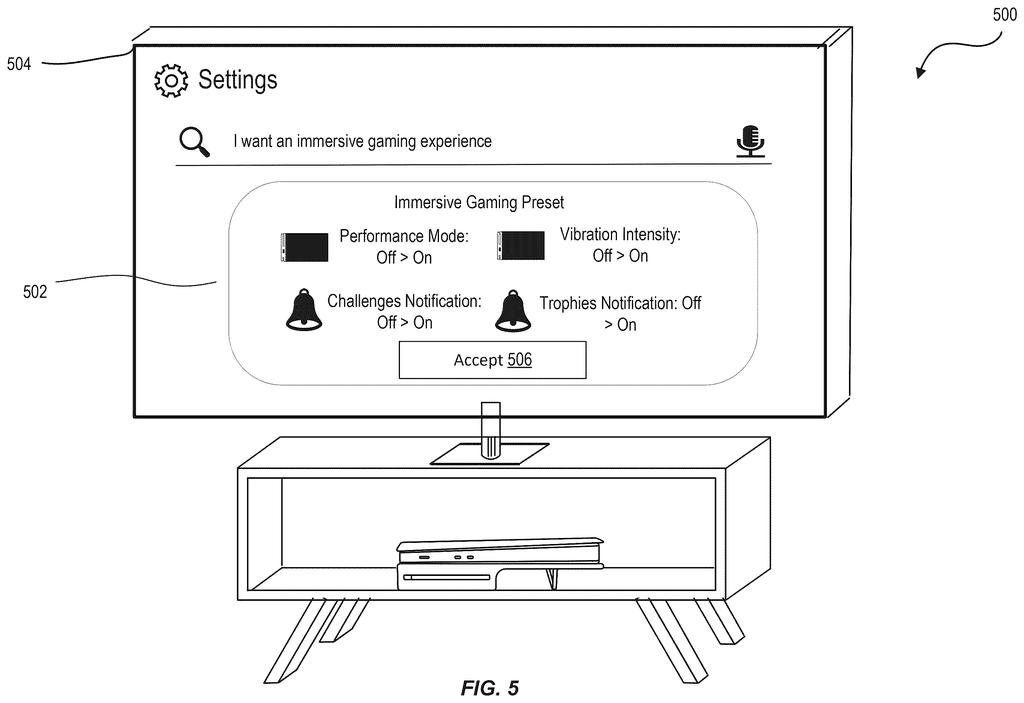
Sony's patent application describes a helper that skips the hunt. You type or say what you want, something like “Configure my new headset” or “I want an immersive gaming experience,” and the console answers with a short list of recommended changes, each one clickable.
The recommendations come from an AI model that has studied what lots of other players do in the same kind of game. It can also look at your own habits. If you always boost dialogue in story-driven games, it can suggest that for the next one. You can accept everything with one button, tweak each item, or let the console apply the changes for you.
receiving, by one or more processors of a gaming system, a request for a setting suggestion, the request being associated with a desired gaming experience or desired action …
Translation: The system listens for what kind of gameplay experience you want in plain words.
How the model turns a request into settings
The system starts with a request for a gaming experience or action. It can be a typed or spoken sentence such as “Optimize my settings for competitive play,” or it can be triggered automatically when you restart the console, launch a game or open a newly installed title. A second AI model (a language model, the same family of tools behind chatbots) turns your sentence into a structured request.
Next, the system packages that request with other information: your play history, settings you changed before, your connected hardware and what other players tend to choose. This bundle, called input data, goes to a trained machine learning model, a program that spots patterns in past examples and uses them to predict what will fit.
The model returns suggestions that come with instructions for applying them. The filing says these could be specific values for resolution, frame rate or audio levels, or the exact software calls needed to flip a setting. The system then builds a screen page listing the results and sends it to your TV or monitor.
The filing also describes some variations:
- Guest mode: with no account, suggestions come from group habits alone.
- Comparison: with an account, your history is compared against the group's.
- Auto-apply: the console can change settings itself and tell you afterward.
… one or more setting suggestion results from the machine learning model corresponding to one or more settings which can cause the gaming console or the video game to operate according to the desired gaming experience or desired action.
Translation: An AI translates your request into the exact technical adjustments your console needs.
What an AI settings helper means for players
Console settings pile up: graphics, audio, controllers and accessibility options, all spread across menus with technical labels. An assistant that finds the right switches could help the many people who never touch them. That includes players who would benefit from colorblind mode or text-to-speech and may not know those options exist. The filing also says poor settings can cause dropped frames, so good suggestions could mean smoother play.
The idea puts a conversational AI helper into the most routine part of owning a console, the settings page. Keep in mind that this is a patent application. It names only a gaming console and says nothing about whether a feature is coming, so the final design could look quite different.
Sony's ninth filing since July that we've tracked in our AI agents that act for you watch follows an AI gaming companion and an AI co-pilot for disabled gamers, each pushing the same core idea into a new area.
Claim 1 is wide. It asks for four things: a request tied to a wanted experience or action, a trained AI model that predicts settings, instructions for applying those settings, and a results page sent to a screen. It names no particular kind of model, no particular game and no particular type of data.
As written, that covers the basic idea of an AI settings helper on a gaming system, whatever happens under the hood. The details readers would find most appealing, like learning from other players' habits (claims 2 and 3) or understanding a typed sentence (claim 5), appear only in the later claims. If the application were granted in this form, anyone building an AI settings assistant for a console would want to read claim 1 closely.
The idea itself is sensible. Settings menus are a chore, and an assistant that does the digging has an obvious audience. The claim is broad and simple, and that is its main feature.
Get our take in your Top Stories
Liked this breakdown? Add Patentlyze as a preferred source on Google, and our plain-English take shows up more often in your Top Stories the next time Sony patent news breaks.
There are more where this came from
We read every patent application Big Tech publishes and send you the ones worth knowing. Plain English, free, every week.
The drawings
8 drawing sheets from US 2026/0306946 A1 · click any drawing to enlarge


Want this weekly breakdown for a company we don't cover? Patentlyze Pro →
Be the first to weigh in