
Qualcomm Patents a Method to Play Video Without Waking the Main Chip
Every time a video frame is ready, a device's main processor usually has to wake up and tell the screen hardware how to show it. Qualcomm's patent teaches the display hardware to do that on its own after a single nudge.
What Qualcomm's display-handles-video idea does
Ever wondered what your device is doing while a video plays? More than you would think. A video is a stack of still pictures flashed 30 or 60 times a second, and in the usual setup the main processor, the chip that runs your apps, gets woken up for every single picture just to tell the screen hardware how to handle it. That burns power, and on cheaper hardware the delays can show up as stutter.
Qualcomm's patent has the main processor hand the display hardware a stack of instructions once, up front, plus a single starting nudge. After that, the display hardware starts each following frame on its own, like a cook given the whole night's orders in advance instead of a waiter walking in for every dish.
The main processor only steps back in when the stored instructions run out. In the filing's example, a 120-frame video needs two wake-ups instead of 120.
… processing the video frame without involvement of an application processor, wherein a first trigger of the plurality of triggers is generated by the application processor and subsequent triggers of the plurality of triggers are generated by the display subsystem.
Translation: The main chip starts the video, but the screen handles the rest on its own.
How the display chip triggers itself frame to frame
The claims cover a display subsystem (the chip block that prepares each video frame for the screen) that receives a series of triggers, meaning start signals, one per frame. The first trigger comes from the application processor (the main chip that runs software). Every later trigger is generated by the display subsystem itself, and each frame is processed without the application processor.
The filing describes this flow:
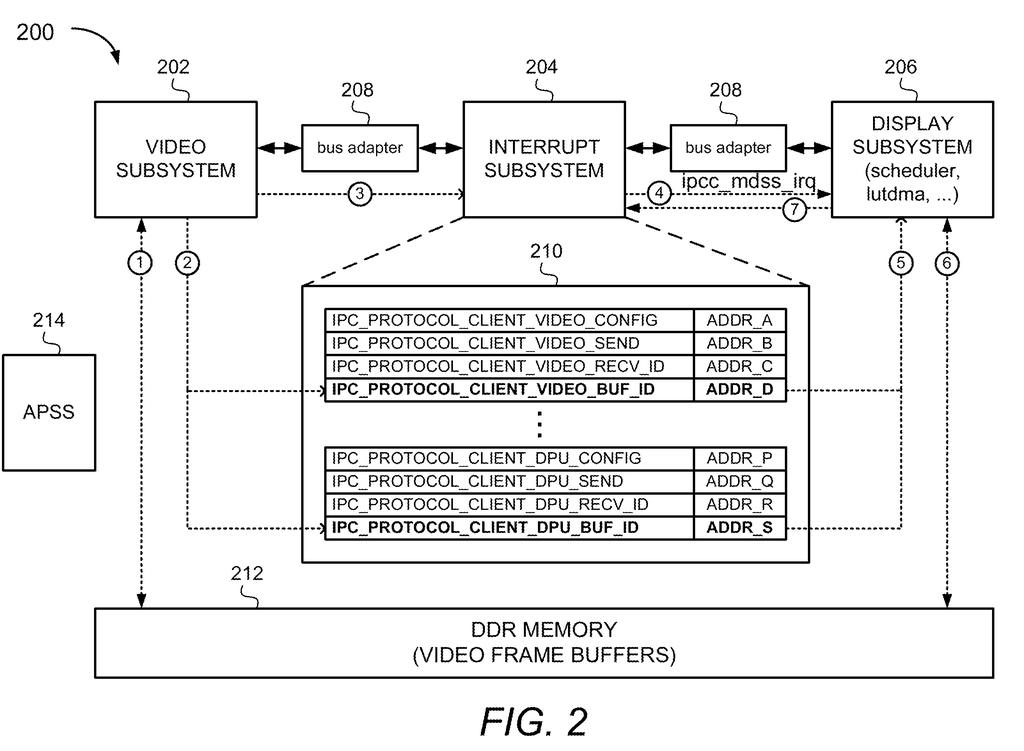
- A video block decodes each frame into one of several memory areas called frame buffers, then signals that the frame is ready and which buffer holds it, through a separate interrupt subsystem (a hardware message handler).
- Each buffer has its own command queue, a pre-loaded list of settings such as size, resolution and color depth.
- The display reads the buffer ID, pulls the matching settings, configures itself, sends the frame to the screen, and frees the buffer.
Because the queues hold a limited number of entries, the main processor must eventually reload them. With eight buffers holding eight entries each, that is 64 frames. The filing also describes reusing the same settings when frames match, and keeping a lookup table inside the display block to cut memory traffic.
If the video's frame rate differs from the screen's, the buffer ID simply points to the same or a newer frame, so frames get repeated or skipped with no software help.
… subsequent triggers of the plurality of triggers are hardware triggers that are generated by the display subsystem itself without involvement of an application processor.
Translation: After the initial prompt, the display unit runs itself without waking the main processor.
Why a quieter main chip matters for battery life
If it works as described, you would notice it in two places: battery life and smoothness. Video playback is one of the most common things people do on a screen, and anything that lets the main processor sleep through it saves power. The filing also says cheaper hardware can stutter when the main processor is slow to respond, and this approach takes that step out of the loop.
This is chip-level plumbing, so you would never see a setting for it. At most it would show up on a processor's feature list. The filing names no product, and a patent application is no guarantee that anything ships, but it shows what Qualcomm is trying to trim from the cost of showing each frame.
Qualcomm's 33rd patent application we've tracked in our Display coverage since May adds to a run that includes one adjusting zoom by eye distance and blending sharp and blurry VR zones.
You will never see this feature on a settings screen. You may feel it in your battery percentage after a long video.
In the filing's own example, a 120-frame clip needs the main processor to wake up twice instead of 120 times. The savings per frame are tiny and video plays all day, so they add up over a movie or a commute full of clips.
The filing also says cheaper hardware can stutter when the main processor is slow to answer, so lower-priced devices could see smoother playback. It is routine plumbing for chip designers, and a useful one for anyone watching on a budget device.
Get our take in your Top Stories
Liked this breakdown? Add Patentlyze as a preferred source on Google, and our plain-English take shows up more often in your Top Stories the next time Qualcomm patent news breaks.
There are more where this came from
We read every patent application Big Tech publishes and send you the ones worth knowing. Plain English, free, every week.
The drawings
14 drawing sheets from US 2026/0310394 A1 · click any drawing to enlarge


Want this weekly breakdown for a company we don't cover? Patentlyze Pro →
Be the first to weigh in