
Samsung Patents a Dual-Space Neural Network for Robot Path Planning
Most robot navigation systems struggle when obstacles cluster in awkward configurations. Samsung's new patent takes a geometric detour — literally — by solving navigation in a transformed mathematical space before snapping the answer back to the real world.
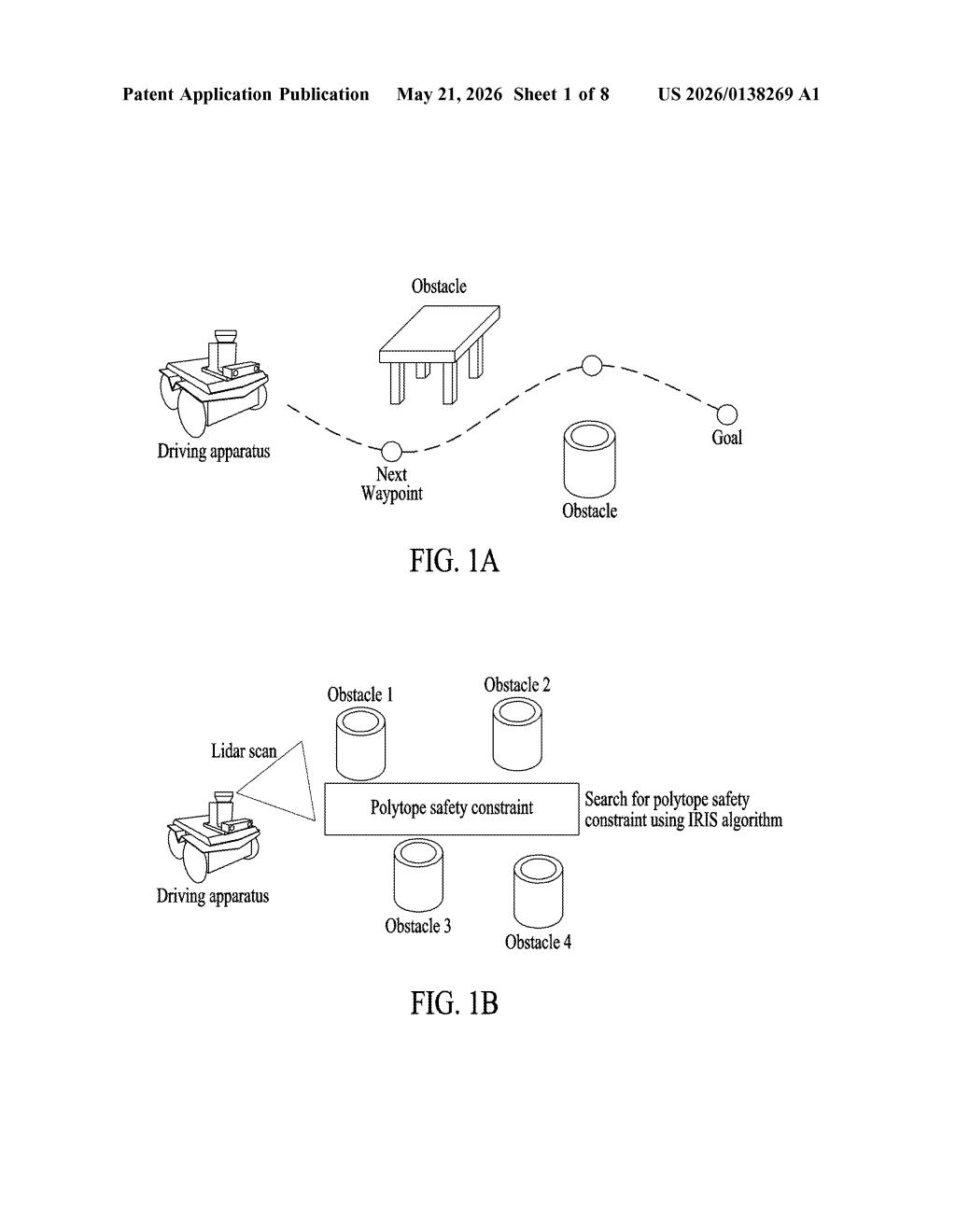
How Samsung's robot figures out where to go next
Imagine a robot delivery bot trying to cross a busy warehouse floor. It needs to figure out, in real time, which path is safe to take without bumping into shelves, forklifts, or people. That's a surprisingly hard geometry problem, especially when obstacles are close together.
Samsung's patent describes a system where the robot senses the obstacles around it, builds a description of the "safe zone" it can move through, and then feeds that into a neural network. The clever part is that the neural network doesn't work in the robot's normal physical space — it works in a dual space, a kind of mathematical mirror world where certain calculations become much easier.
Once the network produces an answer in that mirror world, the system flips it back into real-world coordinates to get the robot's next safe movement target, called a waypoint. The result is a navigation loop that's both learned and geometry-aware — potentially faster and more reliable than brute-force path search alone.
How the dual-space transformation finds safe waypoints
The system works in three main steps that repeat as the robot moves:
- Obstacle sensing and safety constraint generation: At each waypoint (the robot's current position), sensors capture the surrounding environment. That data is converted into safety constraint information — essentially a mathematical description of the "polytope" (a geometric shape, like a convex bubble) that represents where the robot can safely be. The patent mentions a TRIS algorithm for searching these polytope constraints efficiently.
- Dual-space prediction via neural network: The safety constraints and the current waypoint are fed into a pre-trained neural network. The network operates in dual space — a mathematical transformation (related to duality in convex geometry) where the boundary constraints of the safe region are easier to reason about. The network predicts where the next waypoint should be, expressed in this transformed coordinate system.
- Spatial transformation back to real coordinates: The dual-space prediction is inverted using a spatial transformation, converting the abstract answer back into a concrete real-world position the robot can actually drive to.
The training method for the neural network is also covered, meaning Samsung is patenting both the inference pipeline and the recipe for teaching the model in the first place. The architecture is designed to be computationally efficient enough to run on-device in a real-time control loop.
What this means for Samsung's robotics ambitions
Samsung has been quietly building out its robotics hardware and software stack — from the Ballie home robot to industrial automation partnerships. A navigation system that tightly couples learned neural inference with formal geometric safety guarantees is exactly the kind of foundational IP you need before deploying robots in unpredictable real-world environments like homes, hospitals, or factory floors.
For you as a user, the practical upshot is robots that can replan their paths faster and with fewer collisions, even in cluttered spaces. The dual-space approach is also notable because it bakes safety constraints into the network's reasoning rather than bolting them on afterward — which is a more principled way to guarantee the robot won't drive itself into a wall.
This is solid, technically grounded robotics IP — not a flashy consumer feature, but the kind of navigation infrastructure that separates capable autonomous robots from glorified Roombas. The dual-space framing is a real geometric insight, not just marketing language. If Samsung is serious about robotics, patents like this are exactly what they need in the portfolio.
Get our take in your Top Stories
Liked this breakdown? Add Patentlyze as a preferred source on Google, and our plain-English take shows up more often in your Top Stories the next time Samsung patent news breaks.
There are more where this came from
We read every patent application Big Tech publishes and send you the ones worth knowing. Plain English, free, every week.
Want this weekly breakdown for a company we don't cover? Patentlyze Pro →