
A weekly read of what the world’s biggest technology companies just told the U.S. patent office.
We wrote up 213 filings this week, down from 339. Google led at 32, or 39 with Waymo, Verily and other Alphabet-linked companies, then Samsung at 27, Qualcomm at 24, Apple at 22 and Microsoft at 20. OpenAI jumped from one filing last week to 12.
The full run lives under this week’s Big Tech patents; these twelve stood out.
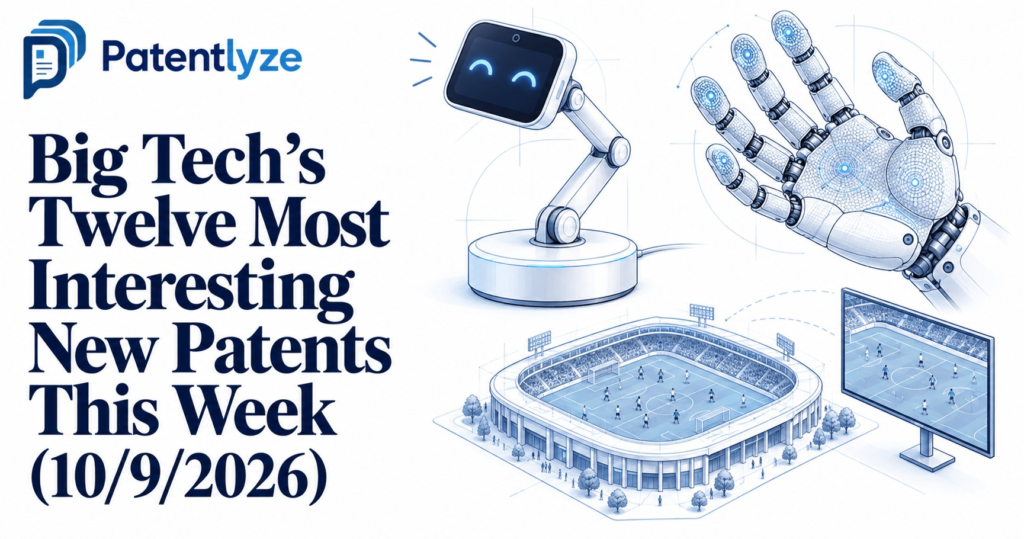
1. OpenAI Patents a Moving Assistant That Keeps Waving Until You Look at It
Most assistants announce a kitchen timer and a visitor at the door with the same beep. OpenAI has filed for a device that moves to catch your eye, checks with its camera whether you looked, and stops once you do.
Claim 1 is a device with a body, an actuation system that makes it move, a camera and a processor. When an event comes in, it picks a motion meant to get your attention, takes a picture of you, works out your attention state, and stops moving once you are looking at it.
The description fills in the rest. A motion generation engine, possibly a generative AI model, can write a new movement on the spot, and the stated rule is to use the least disruptive motion that works. A model scores your attention from 0 to 10. Ignore it and the motion gets bigger or changes.
The motion also ends if you answer it, touch it, or the alert times out. The drawings show a head on an arm, a wheeled body with eyebrow-like parts, and a screen with animated eyes. Glance-triggered versions may keep watching while idle, and the filing says little about those images.
One inventor, Eric Gonzalez. Filed in April 2026, claiming priority to a provisional from April 2025, twenty claims. It is the only hardware filing among OpenAI’s 12 this week; the other 11 cover voice chat, custom models and memory.
2. Alphabet Spinout Verily Patents a Blood-Sugar Sensor That Sits Under Your Eyelid
Today’s continuous glucose monitors still put a sensor under the skin and last about 7 to 14 days, the filing notes. Verily, the health company that spun out of Alphabet this year, has filed for a soft sensor that tucks under your lower eyelid and reads blood sugar with infrared light.
Claim 1 is the device: a tiny circuit with wireless power and communication, light sources that shine short wave infrared between 900 and 1,700 nanometers at the blood-rich lining of the eyelid, sensors that catch the reflection, and a flexible casing shaped to sit between the lower lid and the eye.
Tears are the main obstacle, so the casing repels water over the optics, and some versions add a coat of medical-grade oil. One light is tuned to glucose and another to water, and the water reading is subtracted. A phone can power and read the device over near field communication, the tech behind tap-to-pay.
Verily picked the eyelid lining because its blood vessels are shallow and look much the same from person to person. By the filing’s own account, optical readings at the wrist or finger have not reached acceptable accuracy. The filing includes no test results, so accuracy here is still an open question.
One inventor, Timothy Stowe. Filed in November 2025 as the U.S. entry of an international application from May 2024, sixteen claims. The description says the same approach could be tuned for other blood substances, such as cholesterol.
3. Google Patents Earbuds That Capture What Others Say So an AI Can Recap It Later
Walking out of a lecture with half of it already forgotten happens to everyone. Google has filed for earbuds that save what the people around you say, strip out your own voice, and let an AI assistant answer questions about it later.
Claim 1 is a method. It takes data from a recording of your voice made by the earbuds and data from a room recording with your voice left out, uses both to produce a smaller slice of that room audio, and stores the result.
In the description, you start a session by saying something like “start listening,” which can also switch the earbuds to transparency mode so you hear the room. Your voice and the background noise are subtracted, leaving other people’s speech. A generative model can then summarize each speaker’s view and remember your earlier questions.
The filing’s examples are a university lecture and a party. The obvious question is the people being recorded. The privacy language in the filing covers the user’s own data and does not say what happens for everyone else in the room.
One inventor, Shahabuddin Kakargola. Filed in April 2025 with no parent application, twenty claims. It has been waiting for an examiner since May 2025.
4. Apple Patent Puts a Miniature 3D Stadium Beside the Game, Including Players Outside the TV Shot
A broadcast shows you whatever the director picks. Apple has filed for a headset view that places a miniature 3D model of the venue beside the game, including players the TV shot is leaving out.
Claim 1 is a method for a device with displays and input devices. It shows a video window playing an event plus a 3D representation of the venue, the participants or both, where some of the model is missing from the video at that moment. You can change the model without changing the video.
That independence is the point. You can move the model around the room, resize it, or switch between preset viewpoints, including overhead and a player’s own perspective. It stays in step with playback, jumps when you scrub the timeline, and can show a replay from a different angle than the broadcast camera used.
The data comes from the content provider, in one version as joint-based tracking, a digital skeleton for each player. That is the catch, since a league or broadcaster has to send it. For Apple, live sports is the easiest pitch for wearing a headset for three hours.
Two inventors, Danvin Ruangchan and Bradley W. Peebler. Filed in June 2026 as a continuation of a May 2024 application, twenty-four claims.
5. Tesla Patents a Touch-Sensitive Skin Molded to Fit Robot Hands
A robot hand needs to feel what it holds, and flat touch sensors do not bend around a fingertip. Tesla has filed for a way to build a touch-sensitive skin flat, then heat-mold it to the shape of a robot hand.
Claim 1 is a manufacturing method: put conductive regions on a flexible plastic sheet, add a separator layer, stack a second patterned sheet on top, and form the stack into a target 3D shape. A second independent claim reverses the order, molding the sheet first and printing onto the curve.
Where the top and bottom conductors overlap, they form a sensing pixel. An insulating separator makes a capacitive sensor, and a pressure-sensitive one makes a resistive sensor. The steps are standard factory processes: screen printing, laser cutting, thermoforming. The drawing puts sensors on a robot’s thumb, palm and index finger.
The filing calls the result a tactile skin for a humanoid robot. Tesla is building one, Optimus, though the filing never names it. It gives no figures for sensitivity or durability, so how well a molded skin feels a light touch is still unproven.
Twelve inventors, including Hung Sheng Lin and Nitin Sitaraman. Filed in September 2025, claiming priority to a provisional from April 2025, twenty claims. One of two Tesla filings this week.
6. Samsung Patents a Smartwatch That Tightens Itself When You Start Running
The fit you want while asleep is the wrong fit for a run. Samsung has filed for a smartwatch that folds its own hinges and bends its screens to tighten or loosen around your wrist as your activity changes.
Claim 1 is the watch: a center section and two side sections joined by motorized hinges, a display, and sensors for the hinge angles and screen curvature. Once it detects that it is on your wrist, it reads your activity and adjusts the angle, the curvature, or both when that activity changes.
The side screens bend using electroactive polymer strips, a material that changes shape when current runs through it. Three hinge settings and three curvature settings give nine fit levels. Exercise tightens it, sweat loosens it a step, sleep loosens it, and after a swim it opens up so your wrist can dry.
Manual tweaks are saved per mode. One variation sends your saved settings to a phone or server, which could pass them to other people’s watches. The open question is a wrong guess: a strap that tightens at the wrong moment is worse than one you adjust yourself.
Two inventors, Heejung Kim and Seunghyuck Heo. Filed in May 2026 as a continuation of a Korean international application from December 2024, twenty claims.
7. Apple Patents a Watch That Predicts Your Period and Fertile Days From Heart Rate
Cycle tracking on a watch still leans on the dates you log. Apple has filed for a watch that blends your logged periods with your resting heart rate to predict your fertile window and your next period.
Claim 1 is a wearable with a calendar module, a heart rate sensor and three pieces of software. A preprocessor merges the calendar’s estimate with heart rate data. An ovulation estimator predicts a fertility window, and a period estimator uses that output to predict the next period date.
The preprocessor is strict. In one example it needs heart rate data on at least 23 of the last 45 days, and it favors your lowest resting readings, such as the bottom 10% of a day. A neural network scores each of the next 30 days, and predictions made on neighboring days are compared.
Updates reach your calendar only by rule: a new fertile window must still be ahead of you, and the period estimate changes once per cycle. That restraint matters for anyone planning around a cycle. The filing gives no accuracy figures, and resting heart rate varies from person to person.
Seven inventors, including Shunan Zhang and Carey Y. Zhang. Filed in June 2026 as a continuation of a May 2022 application, twenty claims. The device it describes, with a crown, a button and a heart rate sensor, maps onto the Apple Watch.
8. Nvidia Files Patent for AI That Invents New Camera Angles for Game Footage
A game stream shows you whatever the streamer sees. Nvidia has filed for an AI that builds a new camera angle from a single view of a scene, and declines when it lacks enough to make that view believable.
The first live claim, claim 31, is short: processors with circuitry that use neural networks to encode features of an input, then decide whether those encoded features hold enough information to generate a different view. Claims 1 to 30 were canceled in this continuation.
A variational autoencoder stores each object’s details along with its orientation and the camera position. The system computes a reconstruction probability and drops requests that fall below a threshold. If a request passes, a generative adversarial network paints the new view, guessing at parts the camera never saw, like the back of a character.
The filing names game streams where viewers switch to another player’s view that was never offered, replays from a fresh angle, and films shot from a single point of view. The refusal step is what makes it usable, because an invented angle that looks wrong loses viewers fast.
Three inventors, Siddhant Pardeshi, Pranit P. Kothari and Vinayak Vilas Gaikwad. Filed in October 2025 as a continuation of an October 2023 application, twenty claims.
9. Zoox Filing Has Robotaxis Listen for Police Orders and Tell Riders What to Do
An officer at a blocked intersection can wave a driver through. A robotaxi has no driver to wave at. Zoox, Amazon‘s robotaxi company, has filed for a car that listens for spoken police orders, confirms they come from real authority, and tells riders what to do.
The first live claim, claim 21, is a system that records audio outside an autonomous vehicle, uses its sensors to confirm the audio comes from an authorized entity, pulls out a command that includes an instruction for a passenger to follow, and controls the vehicle based on it.
The car finds where a voice came from by comparing when it reaches each microphone, eight in the drawings, then matches that direction against its cameras, lidar and radar. Flashing lights, a siren or a matching wireless signal mark a source as authorized. A remote operator can check the car’s reading of the order.
Riders can get the order as text, an icon or a map on the in-car screen, and the car can project light on the ground to mark an area to use or avoid. The filing calls out passengers who are deaf or hard of hearing. Noisy streets and fast speech will be the hard test.
Two inventors, Joseph Whinnery and Venkata Subrahmanyam Chandra Sekhar Chebiyyam. Filed in June 2026 as a continuation of a May 2024 application, nineteen claims.
10. Qualcomm Patents Store Shelf Price Tags That Point You to the Product You Want
Finding one product in a big-box store usually means wandering or asking. Qualcomm has filed for digital shelf price tags that show arrows to walk you to the item you picked in an app.
Claim 1 is a small display device, such as an electronic shelf label. It receives instructions from a network entity to show a navigation image for a path to a destination tied to one or more items, and it displays that image based on the user’s movement.
Cloud software works out where you are, from GPS, store sensors or a label you scan, then tells nearby labels to show arrows. Arrows stay up longer when you walk slowly and are preloaded so nothing downloads mid-trip. Several shoppers can each get their own arrow style, and routes can avoid crowded aisles.
Robots get QR codes instead, carrying moves such as “move 10 units, rotate 30 units, and move 5 units,” so a camera is all they need. Stores already run these labels, which makes the idea cheap to add. It is one of five Qualcomm store filings published this week.
Ten inventors, including Bapineedu Chowdary Gummadi. Filed in November 2025 as the U.S. entry of a Chinese international application from June 2023, twenty claims.
11. Meta Patents Smart Glasses That Combine Their Microphones to Cut Through Noise
Smart glasses only hear what is near your head, which is a problem in a loud restaurant. Meta has filed for glasses that pool their microphones, so one pair processes everyone’s recordings and sends cleaner sound back.
Claim 1 is a method. A first device picks up a sound with its own microphone, receives a second recording of the same sound from a nearby device, combines the two into a modified audio signal, and sends that back to the second device to play.
The combining step lines up the recordings by timing and loudness, then applies beamforming, noise cancellation, echo removal or voice separation. The output can be cleaner speech or a live translation. One device does the work, and the job can pass to another based on battery level or connection quality.
For a table of glasses wearers, a translation could be made once and shared instead of every pair running its own, which matters on devices with small batteries. The filing names smart glasses and VR headsets as examples and promises no product.
Six inventors, including Syed Shakib Sarwar, Vamsi Krishna Ithapu and Vladimir Tourbabin. Filed in April 2026, claiming priority to a provisional from April 2025, twenty claims.
12. New Apple Patent Lets Viewers Turn Down Sports Commentators While Keeping the Crowd
Sports fans have asked for the crowd without the announcers for as long as there have been announcers. Apple has filed for a rulebook that travels with the audio and lets you turn down or swap the commentary while the stadium sound stays.
Claim 1 is a method for feeding a spatial audio renderer. Audio arrives as separate scene components plus a scene description that says which ones you may change. Presets pick between alternative versions of a sound and set its volume or position. Your player shows the presets as controls and applies your choice.
The scene description groups sounds: a narrator by language, crowd noise as non-language, and choice groups such as Home Team or Away Team commentary, where only one plays at a time. Menu labels travel as index numbers into a shared string table, so adding a language costs almost no bandwidth.
The producer writes the rules, and your device shows only the switches the producer allows, which makes this a pitch to broadcasters as much as to viewers. The same scheme covers swapping film dialogue languages and sound that changes as you move through a virtual space.
Four inventors, Frank Baumgarte, Moo Young Kim, Dipanjan Sen and Sang Uk Ryu. Filed in June 2026 as a division of a February 2023 application, twenty claims.
What ties them together
Five of the twelve check before they act. OpenAI’s assistant stops moving once its camera sees you looking. Zoox’s car confirms an order came from police before following it. Nvidia’s generator declines an angle it cannot draw believably.
Apple’s period estimator touches your calendar only by rule, and Samsung’s watch confirms it is on a wrist before it tightens. In each case the check is written into the claims themselves.
The other thread is the body. Verily reads blood through an eyelid, Apple reads resting heart rate, Samsung reads sweat and motion, and Tesla’s robot skin reads pressure. Two read the room instead: Google’s earbuds keep what other people say, and Meta’s glasses pool microphones across a table.
Three are about who holds the controls. Apple’s audio rulebook lets the producer decide which sounds you may change, and its stadium model lets you move the 3D view without disturbing the broadcast. Qualcomm’s shelf tags put the store’s own map on every shelf.
The tension from recent weeks holds. Most of these readings need a sensor pointed at you or at the people near you, and only some of the filings say what happens to that data. The ones that check before acting are a start.
Patentlyze reads every new patent application that Apple, Google, Microsoft, Meta, Nvidia, Samsung, OpenAI, Qualcomm, Sony, Intel, AMD, IBM, Adobe, Salesforce, Tesla, Amazon, and Disney file at the USPTO, and writes a plain-English breakdown of the ones that say something about where products are heading. New filings drop every Thursday. The full archive lives in our patent library.
Get lists like this in your inbox
We read every patent application Big Tech publishes and send you the ones worth knowing. Plain English, free, every week.