
Samsung
Samsung · Wearable · Filed May 13, 2026 · USPTO published Oct 8, 2026 · Oct 8 release
Samsung Patents a Smartwatch That Tightens Itself When You Start Running
Samsung's patent describes a smartwatch that tightens itself when you start a run, loosens while you sleep, and opens up after a swim so your wrist can dry.
- Publication number
- US 2026/0310256 A1(US20260310256A1)
- Applicant
- Samsung Electronics Co., Ltd.
- Filed · Published
- May 13, 2026 · Oct 8, 2026
- Inventors
- Heejung KIM, Seunghyuck HEO
- Status when we published
- Waiting for an examiner
- Document
- 20 claims
- US classification
- 361/679.03
- Parent application
- Continuation of PCT/KR2024/020891 (filed Dec 20, 2024)(PCTKR2024020891)
What Samsung's self-adjusting watch actually does
Right now, getting a smartwatch to fit well means stopping what you're doing and fiddling with the strap. The patent itself points out that the fit you want changes with what you're up to: snug for a run, easy for sleep, and so on.
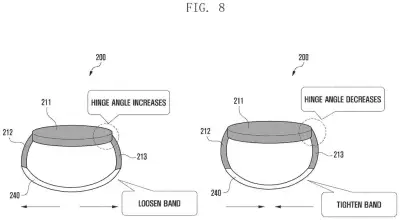
Samsung's patent describes a watch that does the adjusting for you. Sensors notice that you're wearing it and work out whether you're resting, sleeping, exercising or swimming. Then hinges driven by the watch itself bend the watch body so it hugs your wrist more tightly or relaxes its grip. Start a run and it snugs up. Fall asleep and it loosens. Finish a swim and it opens right up so your wrist can dry out.
You keep the final say. A digital buckle slider on the screen lets you nudge the fit tighter or looser, and the watch can remember your preference for next time.
detect a state in which the wearable electronic device is worn on a wrist of a user using the sensor module, identify an activity state of the user using the sensor module based on detecting the state in which the wearable electronic device is worn on the wrist of the user …
Translation: Sensors figure out when you put the watch on and what kind of physical activity you are doing.
How the hinges and bending screen change the fit
The watch body has three sections: a center piece holding the main screen and a side piece at each end, joined by two hinges that a built-in drive unit can open and close. Changing those angles changes how far the watch wraps around your wrist. The two side screens can also change how much they curve, using electroactive polymer strips (thin strips of material that change shape when electricity passes through them) attached behind the display.
The watch first checks that it's on your wrist, then reads its sensors to judge your activity: a motion sensor, a humidity sensor for sweat or water, and angle sensors on the hinges. In the claims, more movement means a smaller hinge angle and a tighter curve. Less movement means the reverse.
Three hinge settings and three curvature settings add up to nine fit levels, from very tight to very loose. The filing's examples:
- Exercise: tighten up, then loosen if sweat is detected, and again afterward so it can dry.
- Sleep: loosen.
- Swimming: very tight, then one step looser, then very loose to clear moisture.
Manual tweaks are saved per mode and reapplied later.
… adjust at least one of the angle between the housing structures and the bending curvature of the display based on a change in the activity state of the user.
Translation: The watch changes its shape and screen curve automatically when your activity level shifts.
What this means for sleeping and sweating in a watch
The pitch is simple: your watch fits the moment without you touching the strap. Comfort is the obvious payoff, since the fit you want while sleeping is not the fit you want while running. The filing also includes a mode for taking body measurements, where the screen guides your motion, so fit is tied into the watch's health features too.
One variation sends your saved fit settings to a phone or server, which could pass them along to other users' watches. A patent is not a product, though, and nothing here says Samsung will build one. The filing mentions smartwatches and smart bands as the target.
Samsung's 46th filing in our Wearable patents we cover since May follows an AI exoskeleton push system and a privacy-triggered silent speaker.
Source: US 2026/0310256 A1 at the USPTO (PDF). Full patent text and figures are in the official publication.
Get our take in your Top Stories
Liked this breakdown? Add Patentlyze as a preferred source on Google, and our plain-English take shows up more often in your Top Stories the next time Samsung patent news breaks.
Add Patentlyze on Google
One click.
There are more where this came from
We read the new patents from Big Tech, carmakers and more and send you the ones worth knowing. Plain English, free, every week.
The drawings · 27 sheets
27 drawing sheets from US 2026/0310256 A1 · click any drawing to enlarge


Show the other 19 sheets


More from Samsung
All 1,662 Samsung patents →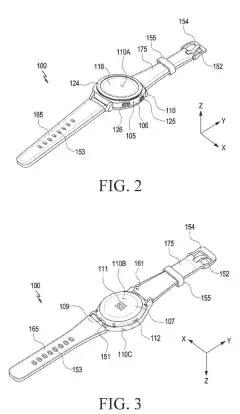
More in Hardware
All 2,375 Hardware patents →
Google
Google Patents a Smartwatch Method That Forecasts Your Next Irregular Heartbeat Episode
Google
Google's New Patent Stops Your Smartwatch from Getting a Bad Heart Rate Reading Mid-Run
Apple
Apple Patents a Foam-Filled Eartip Designed to Fit More Ears
Google
No comments yet