
Apple Files Patent for Making Video Calls Sound Like One Shared Room
Apple has filed a patent application for joining two rooms together acoustically, so a video call sounds as if both people share one space. The filing even describes opening your living room onto a stadium, like a private box seat.
What Apple's merged-room sound patent does
Imagine you're on a video call from your living room while a colleague sits in a conference room across the country. Normally their voice comes out of a speaker carrying that room's echo, while your room sounds like your room. The two spaces never really meet.
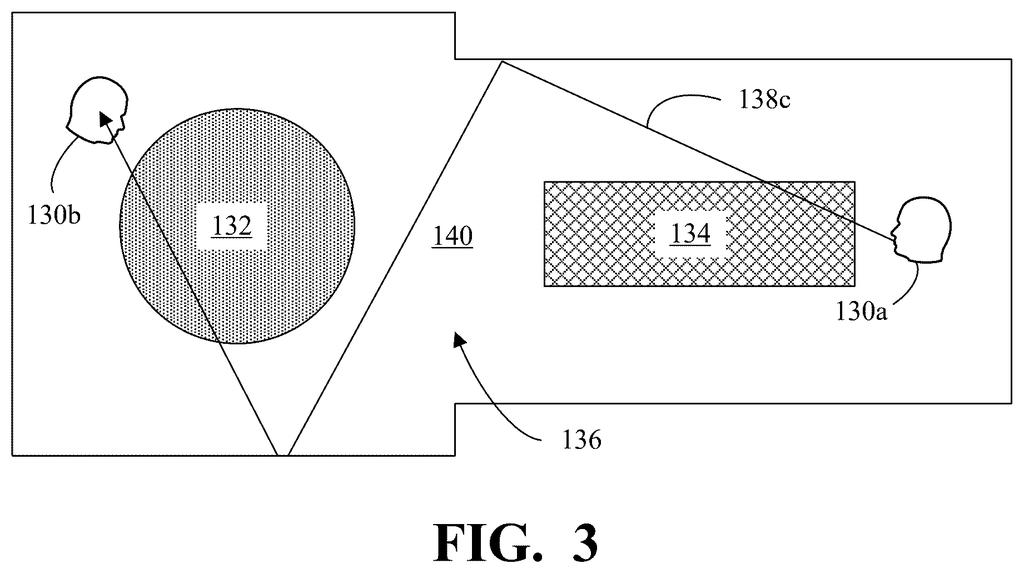
Apple's patent application describes a way to make them meet. Each device builds a rough 3D model of its room, often from a camera image. The system then joins the two models at a spot on a wall, a bit like cutting a doorway between the rooms. Sound is adjusted so it travels the way it would through that doorway, echoes included.
The filing also pictures opening your living room onto a concert hall or stadium, so the music and crowd sound like they're reaching your sofa from a private box.
… generating a merged mesh data structure based on the first mesh data structure and the second mesh data structure, the merged mesh data structure representing a merged environment that joins the first environment with the second environment at a joined location …
Translation: It combines 3D maps of different rooms to create one unified virtual space.
How Apple stitches two room models together
The patent starts with a mesh data structure (a 3D model made of connected flat polygons that stands in for a room's walls, furniture and people). A device can build one from a depth camera image, pull a generic one from a library (say, a standard conference room with a rectangular table), or use one a person drew by hand. A trained machine learning model can also guess at the parts of the room the camera can't see.
Next, the system merges two meshes into one at a joined location, which the filing also calls a portal. Think of it as cutting an opening in a wall of each room and gluing them together. A user can pick the spot, or the software can choose it, for example by recognizing a wall. Rooms can also be chained in a row, or one can sit nested inside another.
Then comes the transfer function (a mathematical recipe for how a sound changes as it travels from one point to another, including echoes off the walls). An acoustic simulator works this out for a path between a spot in one room and a spot in the other. The device reshapes the audio with that recipe, using ordinary audio processing, before playing it through a speaker.
The filing lists several extras:
- Showing a live video feed or avatar at the portal so people can see the joined space
- Updating the merged model when someone walks in and changes how the room absorbs sound
- Using the predicted sound path to strip echo from speech (de-reverberation)
- Placing virtual sound sources, like a speaker or instrument, in the merged space
… modifying an acoustic signal originating at a first location with the transfer function to produce a modified acoustic signal to be played back at a second location …
Translation: It alters sound from one room so it echoes and travels naturally inside the other room.
What this means for calls and live events
If you've ever been on a video call in a boomy conference room, you know the problem: the other room's echo gets layered on top of your own. This patent application points at a fix where both ends share one set of acoustics, which could make calls easier to follow and speech cleaner to pick out.
It reaches past work calls, too. The filing describes a living room opened up to a concert hall or stadium, so a live event sounds like it's happening around your seat. It lists headsets, glasses, smartwatches, laptops and phones as possible devices. As with any patent application, there's no sign here of a product or a release date.
Apple's 538th filing in our Apple coverage since May joins earlier applications like the period-prediction watch and floating AR controls.
Claim 1 is short and wide. It asks for four steps: take two room models, merge them at a joined spot, work out how sound changes between a point in each room, and adjust a sound to play at the other point. Nothing in that wording requires a camera, a video call, or machine learning.
Those details live in the dependent claims: camera-built models, guesses about parts a camera can't see, nested rooms, video shown at the portal. So the core claim reaches well past conferencing, to any product that stitches two real or virtual spaces together and reshapes sound between them, including game and headset audio.
As filed, it stakes out the whole idea of a shared acoustic space, and that idea is easy to picture: your sofa, a stadium, one echo. Broad wording like this is often narrowed during review, so the final scope may look quite different.
Get our take in your Top Stories
Liked this breakdown? Add Patentlyze as a preferred source on Google, and our plain-English take shows up more often in your Top Stories the next time Apple patent news breaks.
There are more where this came from
We read every patent application Big Tech publishes and send you the ones worth knowing. Plain English, free, every week.
The drawings
8 drawing sheets from US 2026/0323239 A1 · click any drawing to enlarge


Want this weekly breakdown for a company we don't cover? Patentlyze Pro →
Be the first to weigh in