
Microsoft Files Patent for Headsets That Animate Your Avatar on Calls
On a video call with your camera off, you're usually a blank square. Microsoft's patent application describes a way for your headset to play your reactions through a stand-in version of you.
What Microsoft's headset-driven avatar does
You're on a team call with your camera off, and your boss just made a point you agree with. Everyone else on screen is a face. You're a gray square with a name on it, so your nod goes nowhere.
Microsoft's patent application describes a fix. The call software creates a stand-in version of you, such as a picture or a cartoon-style avatar, and your headset's sensors move it. Turn your head and the avatar turns. A sensor that reads infrared light bouncing off your face can even pick up when your mouth is moving.
You can steer feelings too. A particular gesture can signal an emotion, and a faster or harder gesture makes it stronger. The people on the call see your stand-in react, while your real face stays private.
… receiving sensor data from a headset device worn by the particular user; determining an action to be performed by the virtual presence based at least on the sensor data; controlling the virtual presence to perform the action …
Translation: The system reads movement from your headset to make your digital avatar copy your real actions.
How the headset's sensors steer the avatar
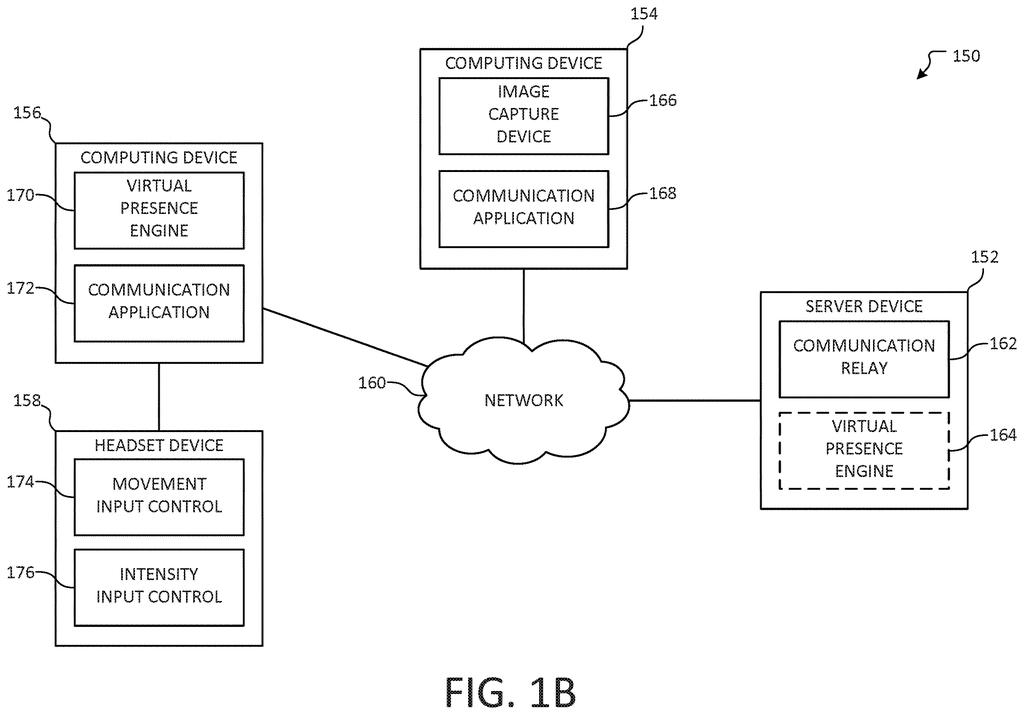
The claims cover a method, a system and a storage device that all do the same thing. The software generates a virtual presence (a stand-in for a person, such as a 2D picture or a 3D avatar) for someone in a communication session. It receives sensor data from a headset that person is wearing, decides what the stand-in should do, makes it do that, and sends word of the action to another participant's device.
The narrower claims add specifics:
- Movement: inertial data (readings from motion sensors that track how the headset moves) makes the avatar move to match.
- Emotion: a gesture is mapped to an emotion, and the speed or force of the gesture sets how intense that emotion looks.
- Mouth movement: infrared sensor data (light that bounces off your face and shows when your lips move) drives the avatar's mouth.
The description explains the motivation. Some people join calls without video, either by choice for privacy or because their computer has no camera, and they lose small social cues like nodding. It suggests a cartoon-like avatar may be better than a lifelike one, to avoid the uncanny valley (the creepy feeling when a human likeness is almost right but not quite). It also describes dialing emotion up or down by context: more subdued with people outside your company, more expressive with family, or a deliberate poker face for some people and not others.
The filing also describes using a headset to control other things, such as switching which computer it controls when you look at it, or ducking in a video game. The claims here focus on the avatar.
… sensor data from one or more sensors of a headset device are processed to identify implicit and/or explicit user input. A context may be determined for the user input, which may be used to process the identified input and generate an action that affects the behavior of a computing device accordingly.
Translation: Sensors on the headset track what you are doing so the software can react to your physical movements.
Why this matters if your camera stays off
If you sometimes join calls with your camera off, whether for privacy or because your computer has no camera, this idea gives you a way to still show up. Your nods, head turns and reactions would reach everyone else, instead of silence from a gray square. That could make audio-only attendance feel less like hiding.
The approach also leans on a device many people already wear on calls. The filing points out that headsets are common and socially accepted, so adding input to them asks little of you. It also gives you control over how much feeling the avatar shows to different people, which matters in a workplace where you may want to look composed in front of clients and relaxed with teammates.
Microsoft's 15th filing we've tracked since May in the AR glasses race adds to a pattern that includes one on adaptive headset instructions and a blurring thermal lens.
The shortest route to a product here is mostly software. The filing says the avatar can be packed into an ordinary video stream, so the people on the other end would need nothing new to see it. Tracking nods and head turns needs only motion sensors, and the text lists those among the parts a headset may already have.
The mouth is the harder piece. Reading lip movement from infrared light means an emitter and a sensor aimed at your face, hardware most headsets on the market today do not carry. A lip-synced avatar is therefore a new-hardware job, while a nodding, gesturing avatar could in principle arrive as an app update.
The simple version is the likelier first step. The emotion gestures ask you to learn a new set of signals in the middle of a meeting, and that is where a feature like this could meet resistance from users.
Get our take in your Top Stories
Liked this breakdown? Add Patentlyze as a preferred source on Google, and our plain-English take shows up more often in your Top Stories the next time Microsoft patent news breaks.
There are more where this came from
We read every patent application Big Tech publishes and send you the ones worth knowing. Plain English, free, every week.
The drawings
11 drawing sheets from US 2026/0310399 A1 · click any drawing to enlarge


Show the other 3 sheets


Want this weekly breakdown for a company we don't cover? Patentlyze Pro →
Be the first to weigh in