
Google Files Patent to Fix Phone Cameras That Hunt for Focus in the Dark
Anyone who has watched a phone camera pulse in and out of focus at a dim dinner table knows the problem. Google has a patent on cleaning up the grainy preview image first, so the camera has a clearer signal to focus with.
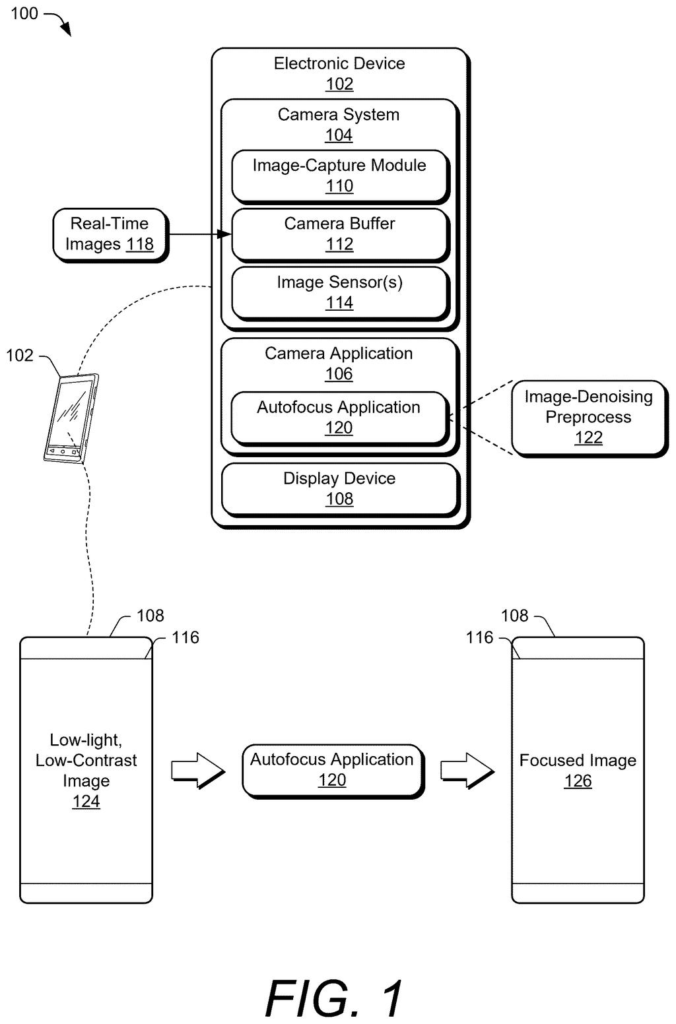
What Google's low-light autofocus patent does
Imagine you're at a dimly lit birthday dinner, trying to snap a photo of a friend in a plain gray sweater. You tap the screen, and your phone's lens slides back and forth, never quite settling on sharp.
That hunting happens because your camera finds focus by checking how crisp the edges look in the live preview. In the dark, the preview fills with grainy speckle, and that speckle looks a lot like detail. The camera gets fooled into thinking it found the sharpest spot when it hasn't.
Google's patent adds a cleanup step first. The software shrinks and softens the preview image, then runs it through a filter that scrubs out grain while keeping real edges. Only then does the camera measure sharpness, so the signal it follows is far cleaner and the lens can settle faster.
… executing a denoising preprocess on the blurred-image data to provide noise-reduced image data; filtering the noise-reduced image data using a focus-value filter to provide a filtered output; and extracting a focus value from the filtered output …
Translation: The software cleans up the blurred image to accurately measure how sharp it is.
How Google cleans the image before focusing
The patent describes a software step that sits in front of contrast-detection autofocus. That is a common focusing method where the camera uses its own image sensor to judge focus: a sharp image has bigger differences between neighboring pixels, so the camera moves the lens until that contrast peaks. The filing says the hardware version of this gets thrown off by noise in low light and on low-texture subjects, producing many false peaks.
The fix is a short pipeline run on the live preview frames:
- Gaussian pyramid blur: the image is turned into a stack of smaller, softer copies (each half the width and height, so one-fourth the area). This cuts noise and the amount of computing needed.
- Denoising filter: a spatially adaptive filter, such as a Wiener filter (a statistical cleanup that estimates and removes noise) or a bilateral filter (it averages neighboring pixels, but only ones with similar brightness, so edges survive). The filing names 5×5, 7×7 and 9×9 bilateral sizes.
- Focus-value filter: a standard sharpness-measuring filter, such as a bandpass or Sobel filter, produces focus values for several zones (center, corners and so on).
The camera then picks the zone that matters, for example the one holding a face, finds the peak pattern there, and adjusts the lens.
The filing says this gives more accurate measurements, shorter scan times and smoother-looking focus changes than the hardware approach in dim, low-contrast scenes. The claims cover a method, a camera device and stored instructions.
This software autofocus technique utilizes a Gaussian pyramid to reduce noise and downscale the image to reduce computation costs.
Translation: It shrinks the picture to save processing power while clearing away visual grain.
Why sharper night focus matters on your phone
If this ends up in a phone, the practical win is fewer blurry shots in the situations where you can least retake them: dim restaurants, evening living rooms, a pet asleep on a gray couch. The filing notes that many cameras fall back on contrast focusing when other methods are unsure, such as when depth sensors or phase detection give weak answers. A cleaner contrast signal helps in exactly those moments.
The patent office has approved this application, and once Google pays the final fee it should be issued as a granted patent. The filing doesn't name a product, so where it lands is open. Since the approach is software, it asks for no new camera hardware.
Google's 871st filing we've tracked since May adds to a body of work that includes a speaker-blocking finger sensor and an under-eyelid glucose monitor.
Blurry low-light photos are one of the most common ways a phone camera lets people down, and a moment that has passed can't be retaken. A birthday candle, a sleeping kid, a restaurant table: those are the shots people care about, and they are exactly where autofocus struggles.
Google's answer matches the size of that problem well. It needs no new lenses or sensors. It cleans up the picture the camera already sees before the camera judges focus. Because the approach is software, it asks for no new parts, which suits a problem that shows up in millions of everyday photos.
The open question is proof. The filing promises faster, smoother focusing but gives no measurements, so the size of the gain is unknown. Even so, a modest fix aimed at a daily annoyance is a sensible match.
Get our take in your Top Stories
Liked this breakdown? Add Patentlyze as a preferred source on Google, and our plain-English take shows up more often in your Top Stories the next time Google patent news breaks.
There are more where this came from
We read every patent application Big Tech publishes and send you the ones worth knowing. Plain English, free, every week.
The drawings
6 drawing sheets from US 2026/0323161 A1 · click any drawing to enlarge


Want this weekly breakdown for a company we don't cover? Patentlyze Pro →
Be the first to weigh in