
Waymo Files Patent for Cars That Let Drivers Behind Them Pass Before Turning
A self-driving car that drifts left as the lane widens before a right turn can leave nearby drivers guessing. Waymo's patent teaches the car to work out whether the driver behind it is trying to squeeze by, then move over at the right moment.
What Waymo's wide-lane turn patent does
You're driving up to a corner where the lane widens, and the car ahead is sitting in the middle of it. Is it turning right or going straight? You can't tell, so you edge toward its right side to get around.
Now make that car a self-driving one. The patent says autonomous cars tend to stay centered in the lane, which can confuse other drivers about where the car is headed, and a turn signal alone often doesn't settle it. Waymo's filing covers the moment when a vehicle behind the self-driving car looks like it's trying to pass in the stretch just before an intersection.
The car checks clues such as how fast that vehicle is moving, where it sits in the lane and whether it's honking. Then it adjusts. It might slow down or hold its speed, let the other driver go by, and only then move toward the turn side.
… determining, using the sensor data, by the one or more processors, that the object is behind the vehicle and the object is attempting to pass the vehicle within an area prior to an intersection; and maneuvering, by the one or more processors, the vehicle based on the determining.
Translation: The car figures out when someone behind it is trying to pass near an intersection and moves accordingly.
How the car decides who is trying to pass
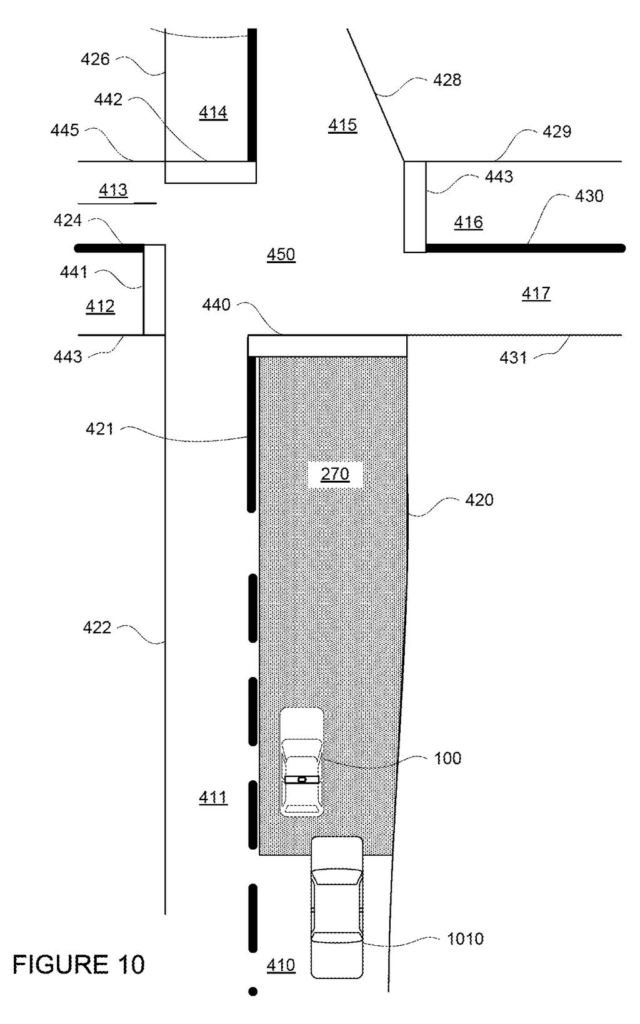
The patent covers a self-driving car approaching a turn, usually a right turn where traffic drives on the right. Many lanes widen just before an intersection, so the car has to decide when to drift toward the turn side. The claims focus on one case: another vehicle is behind the car and looks like it's trying to pass in that stretch.
The car can find these stretches on its detailed maps, where a "wide lane" fits two vehicles side by side (the description gives about 16 feet as an example), or by measuring the gap between lane lines and the curb live. Its sensors (the perception system) track nearby vehicles and ignore any that are too far away, such as 8 seconds or 200 feet out.
Then the car weighs clues about the vehicle behind it:
- Position: if it sits closer than the car to the turn side, it is probably trying to pass.
- Speed: how fast it is going compared with the car.
- Honking: whether the driver is honking.
If the other vehicle looks like it is passing, the car can slow down or hold its speed, let it go by, then move over. If the vehicle is directly behind or off to the far side, the car can move toward the turn right away. The description also says the car may only partly cross into a parking space or bike lane to show its intent, and that machine learning (software that learns from examples) could pick exact spots from past turns.
An area of the lane prior to the turn having a lane width of at least a predetermined size is also identified. Sensor data identifying an object within the lane is received from a perception system of a vehicle.
Translation: The vehicle looks for a wide enough spot in the road and uses its sensors to spot vehicles nearby.
Why Waymo cares about corner etiquette
Lane etiquette is mostly unspoken, and a self-driving car that ignores it makes everyone around it nervous. The description says a turn signal may not tell other drivers what the car plans to do, and that moving over at a fixed point can be dangerous if someone is already on that side. Reading the driver behind you and giving way is a small behavior that could make a robot driver feel more predictable on ordinary streets.
The filing is the latest in a family that goes back to a 2017 application and has already produced issued patents, so the idea has been around a while. For you, the benefit would be fewer awkward squeezes at corners, with the car behind getting past without a standoff.
Google's 67th filing we've tracked since May in our robotaxi sensing watchlist, following front-wheel turn prediction and dual-radar positioning, adds another piece to how Waymo reads the road.
Claim 1 is short and wide. A vehicle's sensors spot an object, the computer decides that object is behind the vehicle and trying to pass in the stretch before an intersection, and the vehicle moves in response.
The claim never says what that move must be, and it never mentions a turn, a wide lane, honking or speed. Those details arrive in the later claims, which add things like the other car's speed, its honking and letting it go by.
If granted as written, the first claim would reach any vehicle that notices a car trying to overtake near a corner and reacts in any way, whether by slowing, holding speed or something else. That is a lot of ground for a behavior human drivers handle without a second thought.
Get our take in your Top Stories
Liked this breakdown? Add Patentlyze as a preferred source on Google, and our plain-English take shows up more often in your Top Stories the next time Google patent news breaks.
There are more where this came from
We read every patent application Big Tech publishes and send you the ones worth knowing. Plain English, free, every week.
The drawings
16 drawing sheets from US 2026/0307681 A1 · click any drawing to enlarge


Show the other 8 sheets


Want this weekly breakdown for a company we don't cover? Patentlyze Pro →
Be the first to weigh in