
Apple Files Patent for Phones That Tell Cell Towers When Their AI Can't Cope
Your phone's AI might be trained for one factory floor or one kind of room. This Apple patent has the phone check whether that training fits where you are right now, then tell the network.
What Apple's AI self-check for phones does
Imagine your phone has an AI model trained to work out where you are inside one particular factory. You walk out the door into a parking lot, and suddenly its guesses are worthless. Nothing in modern setup lets the phone say so in a useful way.
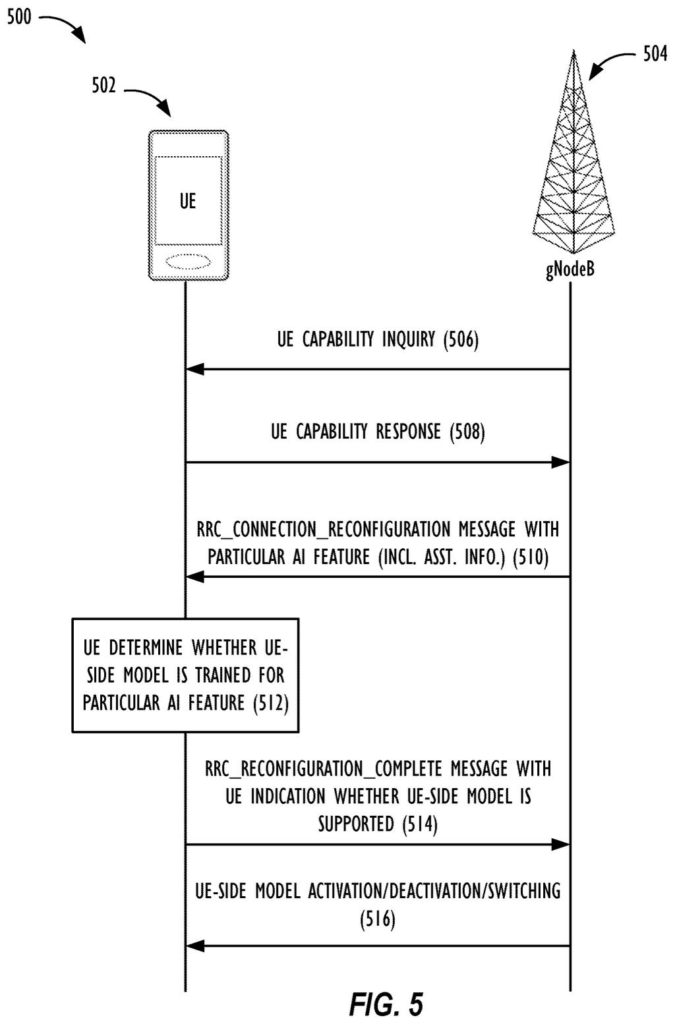
This Apple patent application adds that step. The cell tower asks what AI-based jobs your phone can handle, then points to a specific AI feature it would like the phone to use. The phone checks whether its model actually fits the current situation, based on things like where it is, what it is measuring, and settings the tower sent. Then it answers yes or no.
The tower can then switch the feature on, turn it off, or swap in a different model. The phone can also ask to turn an AI feature off, for example to save battery. It only reports whether a feature works, not the private details behind that answer.
receiving a first capability inquiry from a base station, wherein the first capability inquiry relates to a capability of the UE to perform at least one task using a first model based on artificial intelligence (AI) or machine learning (ML); …
Translation: The phone gets a question from the cell tower about whether its artificial intelligence can handle a specific job.
How the phone tells the network yes or no
The claims describe a back-and-forth between a phone (the patent calls it a user equipment, or UE) and a cell tower (a base station). The tower first sends a capability inquiry, asking whether the phone can do a task using an AI or machine learning (ML, software that learns from examples) model. The phone replies yes or no. The tower then points to a particular AI feature, and the phone evaluates whether its model supports that feature right now and reports back.
How the phone checks depends on the model type:
- Site-specific: it compares its current position with the places the model was trained for.
- Scenario-specific: it looks at a current measurement, such as whether conditions match what the model learned.
- Configuration-specific: it checks assistance information the tower sends along.
The claimed tasks include CSI compression (shrinking the signal-quality report your phone sends back, with one half of the AI model on the phone and the other half at the tower), beam management (choosing the best direction for a focused radio signal), and positioning.
The tower's feature request arrives in a standard configuration message (RRC reconfiguration), and the phone answers in a matching "complete" message. The tower can then send an activation command, and the phone can ask to deactivate a model.
The filing also describes a second idea. If a positioning model fails a validity check while the phone is idle, the phone uses the standard random access procedure (the usual way to reconnect to a tower) to request an updated model setup.
… evaluating, by the UE, whether the first mod-gNodeB el supports the particular AI or ML feature (e.g., based on a current UE position for a site-specific model, UE measurement for a scenario-specific model, and/or assistance information for a configuration-specific model); …
Translation: The device checks if its AI model can handle the specific feature based on things like its current location.
Why phone AI needs to know its limits
Phone radios are starting to lean on AI for chores like picking the best signal direction and working out where you are. A model trained for one setting can give bad answers in another, and the network needs a way to find out. This patent gives the phone a way to say "my model doesn't fit here," so the tower can switch it off or swap it.
For you, that could mean more reliable connections and less battery wasted on AI that isn't helping. The filing says the phone reports only whether a feature works, which keeps its internal details and your information away from the network. It is standards plumbing you will never see on screen, but it decides whether AI in your phone's radio can be trusted when you move around.
Apple's second filing we've tracked since October in our AI models that work in teams watchlist follows one on self-grading signal forecasts.
Every design choice here has a price. The phone grades its own homework: it decides whether its AI model fits the moment and sends the network a short yes or no. That keeps Apple's model details private, but the network has to take the phone's word for it.
The other cost is chatter. Each check and each report is one more message over the airwaves, and the idle-phone version adds a reconnect just to fetch an update. If those checks fire too often, the savings the AI promises could get eaten by the overhead.
Still, the trade reads as worth it. A model that keeps giving wrong answers in the wrong place costs more than a few extra messages. This is routine phone-standards plumbing, and sensible plumbing at that.
Get our take in your Top Stories
Liked this breakdown? Add Patentlyze as a preferred source on Google, and our plain-English take shows up more often in your Top Stories the next time Apple patent news breaks.
There are more where this came from
We read every patent application Big Tech publishes and send you the ones worth knowing. Plain English, free, every week.
The drawings
12 drawing sheets from US 2026/0322704 A1 · click any drawing to enlarge


Show the other 4 sheets


Want this weekly breakdown for a company we don't cover? Patentlyze Pro →
Be the first to weigh in