
Samsung Files Patent for a Rollable Screen Backing That Stops Internal Lubricant From Leaking
Rollable screens wind around a rod and unroll again, and the soft backing behind the glass can ooze silicone oil. A new Samsung Display patent application tries to seal that in with a second, firmer layer.
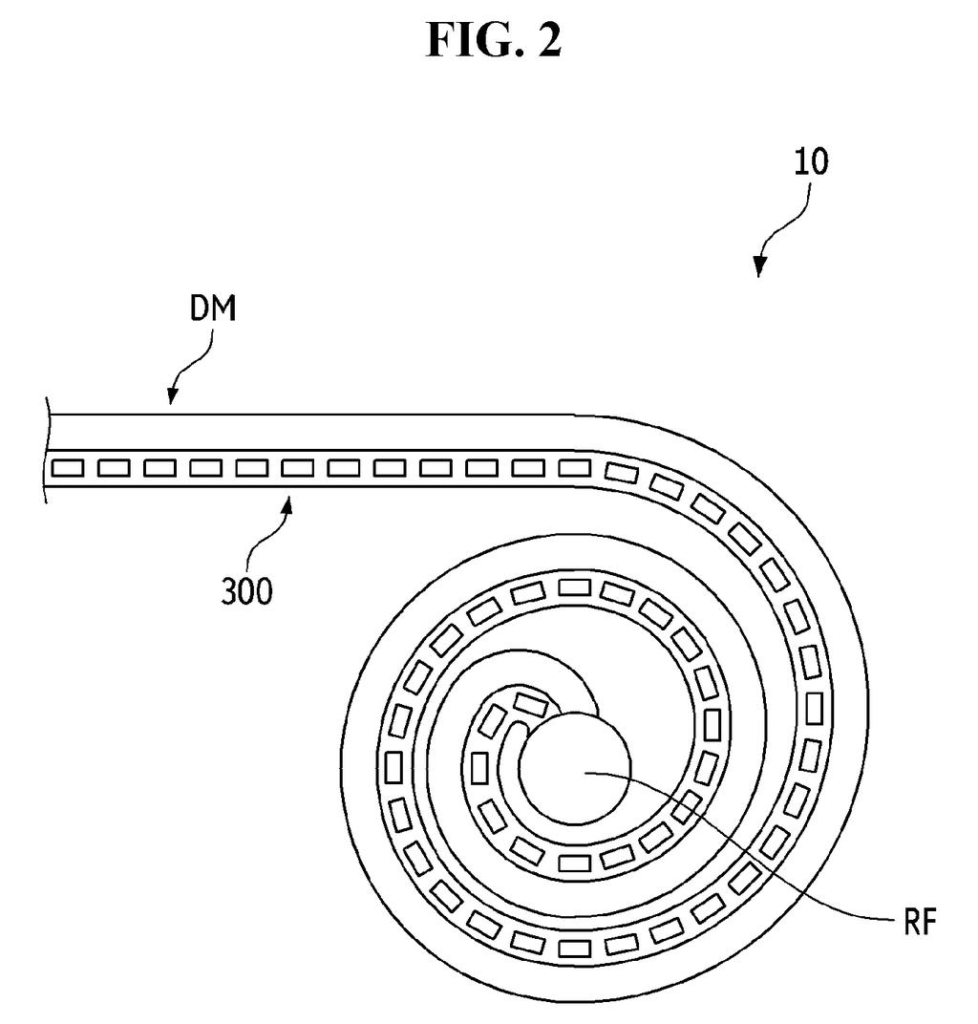
What Samsung's two-layer screen backing does
A rollable screen spends its life winding around a rod and unrolling again. Behind the glass sits a soft, rubbery backing that cushions all that bending, and that backing can give off a little silicone oil. If you owned one of these screens, you would not want grease creeping out of it.
Samsung Display's patent application splits the backing into two layers. The top layer is soft and flows easily when it is made. Beneath it sits a firmer layer made from a much denser resin, which acts like a lid and keeps the oil from escaping.
Thin strips of metal or fiber are embedded in one of the layers to give the whole stack some backbone. A thin cover on the bottom keeps the sticky silicone from clinging to whatever it touches.
1 . A display device comprising: a display module; and a module support member placed under the display module, wherein the module support member comprises: a first support layer; a second support layer placed under the first support layer; and a plurality of supports arranged inside one of the first support layer and the second support layer.
Translation: The screen sits on top of a multi layered backing structure built with internal supports.
How the soft and stiff silicone layers stack
The patent covers the module support member, the stack of material glued under the display panel of a rollable screen. It has two silicone-based layers (silicone or urethane acrylate resin) with a row of rigid supports embedded inside one of them. A thin protective film sits on top and touches the display, and a cover layer sits on the bottom.
The two layers differ on purpose. The top one has a lower modulus (a measure of stiffness, so it is softer) and a lower viscosity (how thick a liquid is, so it flows easily before curing). The filing's example numbers are 0.2 megapascals and 1,000 mPa·s for the top layer, against 2 megapascals and 40,000 mPa·s for the bottom. The denser bottom layer is what stops silicone oil from the soft layer leaking down through it.
The filing describes two layouts, and the claims cover both:
- Supports inside the top layer: the top layer is 600 micrometers thick, the bottom layer 200, and the supports 400.
- Supports inside the bottom layer: the thicknesses swap, with a 200 micrometer top layer and a 600 micrometer bottom layer.
The supports could be stainless steel, aluminum alloy, titanium alloy, or carbon or glass-fiber plastics.
To build it, resin is poured into a mold (called a jig) and baked at 60 to 80 degrees Celsius for 30 minutes to an hour. The supports are laid down, the second resin is poured around them, and it is baked again. Cured silicone stays sticky, so a film or slip coating covers the bottom surface.
Why oil leaks matter for rollable screens
The filing's stated goal is narrow: keep silicone oil from getting out of the backing. For you, that would mean a rollable screen that stays clean inside after being rolled and unrolled again and again. It is a durability fix, and you would only notice it if it were missing.
Samsung Display lists phones, tablets, TVs, watches, smart glasses and car dashboard screens as places the display could go, though the detailed examples all describe a roll-up screen. Rollable screens only work as products if the layers behind the glass survive constant flexing, and this filing addresses one specific way they could fail.
Samsung's 116th filing we've tracked since May in our display technology watchlist, this application joins one on cooling channels and one on auto-dimming screens.
If this works, you will never notice it, and that is the point. The failure it prevents is a rolled-up screen slowly seeping oil from its own backing, an ugly surprise in a device built to be rolled and unrolled daily.
The filing is narrow and practical. It solves one materials problem with two layers of rubbery resin and some embedded metal strips, and the claims cover both the finished screen and the way to build it.
Nothing here adds a feature you can show off on a shelf. Its value shows up years later, in a rollable screen that still looks and feels clean.
Get our take in your Top Stories
Liked this breakdown? Add Patentlyze as a preferred source on Google, and our plain-English take shows up more often in your Top Stories the next time Samsung patent news breaks.
There are more where this came from
We read every patent application Big Tech publishes and send you the ones worth knowing. Plain English, free, every week.
The drawings
19 drawing sheets from US 2026/0323849 A1 · click any drawing to enlarge


Show the other 11 sheets


Want this weekly breakdown for a company we don't cover? Patentlyze Pro →
Be the first to weigh in