
Samsung Files Patent for an Always-On Screen That Dims Itself to Match the Room
Samsung has filed a patent application for an always-on screen that checks the light around it, then shifts every color by the same amount so your wallpaper keeps its look at any brightness.
What Samsung's always-on display patent does
Imagine glancing at your phone on the nightstand at 2 a.m. The clock and wallpaper glow like a flashlight. Now imagine stepping outside on a sunny afternoon, where the same screen looks washed out. An always-on display has to cope with both, all day, without wearing itself out.
Samsung's patent application describes a way to set the brightness of what's on screen based on the light around your phone. The phone finds the brightest color value in your content, checks it against a chart for the current room light, and nudges every color by the same amount. A pink clock stays pink, just dimmer or brighter.
Bigger images get stricter limits, since a large lit area held in place can burn into the screen over time. In harsh sunlight, the wallpaper can disappear entirely to save power.
detecting ambient illuminance; identifying a maximum value among a red (R) value, a green (G) value, and a blue (B) value of content; acquiring a difference value by comparing an RGB value of a reference table corresponding to the detected ambient illuminance with the identified maximum value; …
Translation: It measures room light and compares the screen colors against a reference chart.
How Samsung's reference table sets brightness
The application covers a method for setting the brightness of anything an always-on display shows: images, icons, text and widgets. The phone first reads its ambient light sensor (a small sensor that measures how bright your surroundings are, in units called lux). It then finds the largest of the red, green and blue values in the content. Each pixel's color is stored as three numbers, and this step picks out the single highest one.
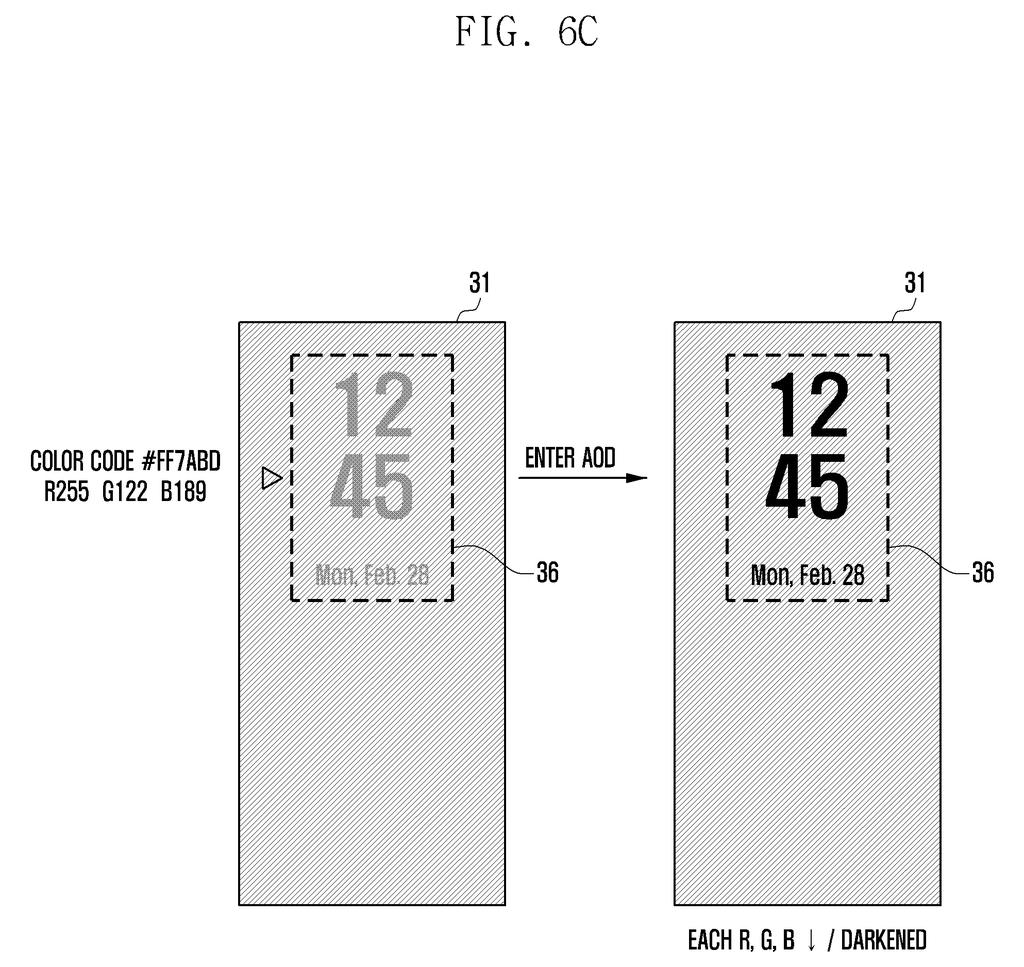
Next it looks up a reference table (a chart of allowed color values for each light level) and subtracts the content's highest value from the table's number. That difference is applied to every red, green and blue value. In the filing's example, a SeaGreen clock has values of 46, 139 and 87, so its highest is 139. If the table says 204, every value rises by 65. If the table says 43, every value drops by 96. Because everything moves together, the filing says the content keeps its tone and atmosphere.
The filing also describes several extras:
- Tables by size: separate tables for content covering under 20% of the screen, 20% to 40%, and 40% or more. At 100 lux, the white values are 31, 19 and 15, so bigger content gets dimmer.
- Layers: a background, widget and app are each handled on their own.
- Masking: the background is covered by a mask whose see-through level follows the light. At about 3000 lux or more it goes fully opaque, which removes the background and saves power.
- Movement: below about 500 lux the content stays put. Above that, it shifts a set distance at set intervals to protect the screen.
… adjusting the R value, the G value, and the B value of the content based on the acquired difference value, and displaying the content, the R-value, the G-value, and the B-value of which have been adjusted, as the always on display content on a display.
Translation: The phone then tweaks the color values to dim the always-on screen to match the room.
What this means for Samsung always-on screens
If you use a phone or watch with an always-on display, you've probably seen the tradeoff: bright enough to read outdoors, but gentle enough in a dark bedroom. This patent application tries to settle it with a simple rulebook. The table sets a ceiling for each light level, and the content's own brightness is shifted to fit under it (or lifted up to it).
The burn-in angle is the practical payoff. The filing ties its table values to the maximum that avoids burn-in and afterimages, so a big, bright wallpaper gets dimmed harder than a small clock. For you, that could mean an always-on screen that looks good and lasts longer. The power savings from dropping the background in bright sun would also help battery life.
Samsung's 114th filing we've tracked in Samsung's display technology since May follows work like the fix for jagged 3D lines and the touch signal interference fix.
This one sits close to shipping. The claims describe a light sensor, a display, a processor and some stored tables, and phones and watches with always-on screens already have all of that. The core of it is a software change to how the standby screen picks its brightness.
The work that has to come first is tuning. Every number in the examples (204, 128, 69 and so on) depends on how bright a particular panel can get and how quickly it wears, so Samsung would need to measure each display and fill in its own tables. That is lab time, not new hardware.
The shortest route to a product is a software update to an existing always-on mode, probably invisible to you except that the screen looks better in odd lighting. That also makes it a modest idea. Math this simple is easy to ship and easy for others to copy, so expect it to improve a feature you already use rather than add a new one.
Get our take in your Top Stories
Liked this breakdown? Add Patentlyze as a preferred source on Google, and our plain-English take shows up more often in your Top Stories the next time Samsung patent news breaks.
There are more where this came from
We read every patent application Big Tech publishes and send you the ones worth knowing. Plain English, free, every week.
The drawings
24 drawing sheets from US 2026/0311660 A1 · click any drawing to enlarge


Want this weekly breakdown for a company we don't cover? Patentlyze Pro →
Be the first to weigh in