
Nvidia Files Patent for Teaching Cheap Car Radar to Do the Job of Costly Lasers
Nvidia's patent describes training a cheap radar with the answers from a pricey laser scanner, so the car only needs the radar once it is on the road.
What Nvidia's radar-from-laser training does
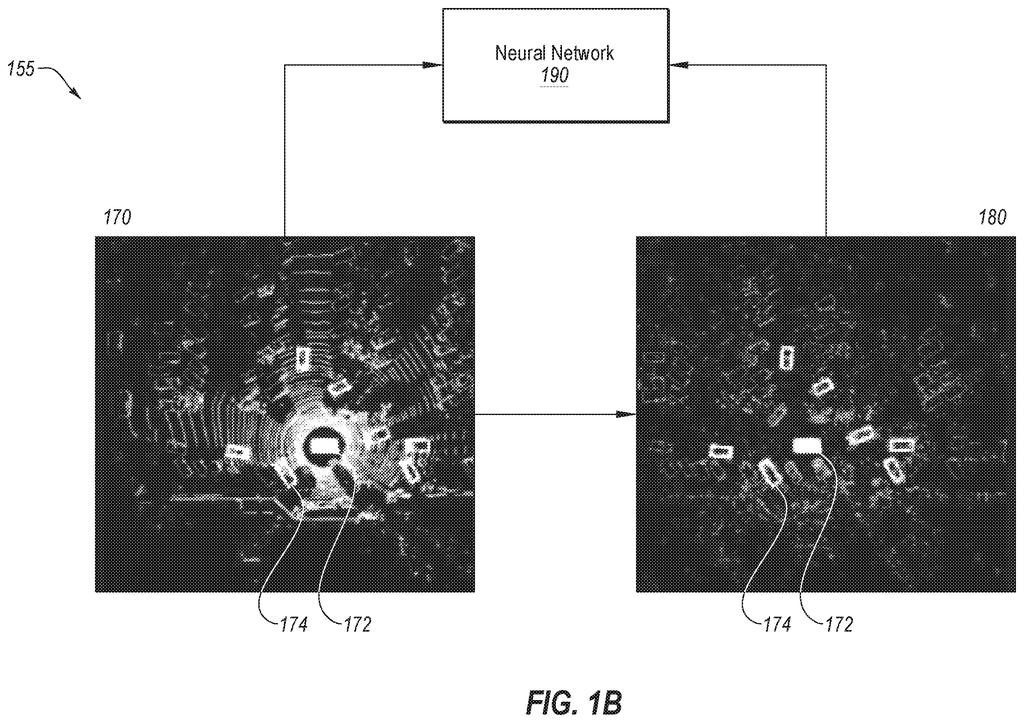
A test car rolls down a city street with two kinds of sensors on board. One is a laser scanner that draws a detailed 3D picture of everything around it. The other is a radar that sees only a thin scatter of dots.
Laser scanners are expensive and produce piles of data, while radar is cheap and already common on cars. Nvidia's patent describes a way to get radar-only cars to behave as if they had the better sensor. During training, the system takes the detailed laser picture, marks which patches of road are open and which are blocked, and copies those markings onto the radar's data from the same moment.
An AI model then learns from those marked-up radar scenes. Later, the car needs only the radar, so you get a decent read on where it is safe to drive without paying for the pricier hardware.
obtaining output data based at least on processing, using a neural network, sensor data having a first fidelity, the neural network having been previously trained to generate the output data using ground truth sensor data having a second fidelity higher than the first fidelity …
Translation: An AI processes cheaper sensor data after being trained on much more accurate sensor data.
How laser labels get copied onto radar data
The core idea is a training shortcut. A neural network (software that learns patterns from examples) processes lower-quality sensor data, but it was trained using higher-quality "ground truth" data (the trusted answer key). The output is then used to make a machine, such as a car, perform control operations. The claims also cover the broader idea of training on one type of sensor and running on a different one.
The filing's main example uses LiDAR (a scanner that measures distance with laser pulses) as the answer key and RADAR as the cheap input. The steps look like this:
- The LiDAR scan is labeled with objects and freespace (ground a vehicle can drive on), automatically or with a person reviewing the labels.
- The system traces rays from the radar's position to work out which areas the radar can actually see.
- Each area gets a label such as observed and free, observed and occupied, partially observed, or unobserved.
- Those labels are copied onto radar data captured at the same time and place, and the model trains on that.
The example network is a convolutional neural network (a type of AI built for grid-like image data). It takes a radar grid in and produces three outputs: whether an object is present, a box around it, and the probability that each spot is free. Box labels are dropped when too few radar points land inside them, with thresholds of 3 to 6 points given as examples.
During training, labels derived from the higher-fidelity ground truth data are propagated to lower-fidelity training data, and model parameters are updated accordingly, enabling the trained model to perform high-quality inference on lower-fidelity inputs.
Translation: Training on expensive laser data teaches the system how to make cheap radar data nearly as useful.
What cheaper sensors could mean for driver aids
If this works as described, a car could find open road using only the radar it may already carry, instead of adding a costly laser scanner. That could make driver-assistance and self-driving features cheaper to build, which often decides whether they reach ordinary cars. The filing also notes that heavy sensor loads slow down processing, so a lighter setup could help there too.
The claims go wider than cars. They cover any machine, from trucks and warehouse robots to drones and boats, and any pair of sensors where one is sharper than the other. The idea is a training recipe: the expensive sensors stay with the test fleet while your vehicle gets by with less.
Nvidia's 88th filing we've tracked since May in the self-driving sensing race adds to a run that includes one on naming objects and one on trailer detection.
The trade here is clear: you spend money on expensive sensors once, in the lab, so every car after that can skip them. The cost shows up on the road. A radar model works from far less information than a laser scanner collects, so it is making educated guesses about open space, and a guess can be wrong.
The filing handles this sensibly. Patches the radar can't see, such as the space behind a parked truck, get labeled as unknown, roughly a coin flip between free and blocked. That keeps the model from learning false certainty, which seems a smart price to pay.
The remaining risk is a rare situation the training cars never met. For driver assistance on a budget, the trade reads as worth it, as long as the system treats its output as odds that can be wrong.
Get our take in your Top Stories
Liked this breakdown? Add Patentlyze as a preferred source on Google, and our plain-English take shows up more often in your Top Stories the next time Nvidia patent news breaks.
There are more where this came from
We read every patent application Big Tech publishes and send you the ones worth knowing. Plain English, free, every week.
The drawings
11 drawing sheets from US 2026/0321020 A1 · click any drawing to enlarge


Show the other 3 sheets


Want this weekly breakdown for a company we don't cover? Patentlyze Pro →
Be the first to weigh in