
Nvidia Files Patent for Self-Driving Cars That Preview Where a Move Leads
Before a self-driving car commits to a move, Nvidia's patent has it imagine the scene that would follow and grade that future. A bad grade means the car doesn't simply go ahead.
What Nvidia's look-ahead check does for a car
Ever slowed down on a road because something up ahead just looked off, even though you couldn't say what? You ran a quick mental movie of what might happen next, didn't like the ending, and eased off the gas.
Nvidia's patent gives a self-driving system that same habit. The car's usual driving software proposes a path. Then a second set of AI models imagines the scene that would result if the car took that path, and scores how good or bad that future looks. If the score is fine, the car goes ahead. If not, it can hand control back to you, switch off certain features, or slow down while it searches for a better path.
The filing also says those tricky moments can be saved and used to teach the main driving software, so the car stumbles less the next time it meets the same situation.
… compute, based at least on processing a representation of the candidate trajectory using one or more neural networks, an estimated favorability of a future world state corresponding to the candidate trajectory …
Translation: AI neural networks predict how safe and desirable the outcome will be if the vehicle takes a certain path.
How the car imagines and scores a future
The system starts with an existing driving stack, which can be an end-to-end one (a single AI pipeline that turns raw camera, radar and lidar data directly into driving decisions). That stack produces a candidate trajectory: a planned path with positions, speeds and timing.
A second branch then checks the plan:
- A world model network (an AI that predicts what a scene will look like next) takes the plan and the recent history of the scene, then outputs a range of possible future states. The most likely one is sampled.
- A state evaluator network scores that future for quality, safety or favorability, for example from zero (best) to ten (worst).
- A control component compares the score with a threshold.
If the score passes, the plan is used. If it fails, the car can decline to engage autonomy, disengage, switch off features such as automatic lane changes or adaptive cruise control, or run a safety maneuver. Alternatively, an optimization loop starts: a second planner proposes a new path, and the evaluator's score is fed back to adjust that planner (using backpropagation, the standard way AI models learn from errors). This repeats until a path clears the bar. The car may slow down to buy processing time.
Situations that trigger the loop, such as a tree branch in the road, are recorded with the better paths and used to retrain the main planner.
… quantifying a measure of the quality, safety, and/or favorability of the predicted subsequent state. If the quality, safety, and/or favorability of the estimated subsequent state satisfies a designated threshold …
Translation: The system scores the predicted future scene to ensure it meets acceptable safety and quality standards before making a move.
Why a car that admits doubt matters
For you as a rider or driver, the practical change is a car that can notice when it is out of its depth. Today's end-to-end driving systems have to learn the right response to every odd situation they might meet, from a blown paper bag to a lost wheel. This design lets the car check its own plan against a predicted outcome, so it can slow down or ask you to take over instead of guessing.
It also turns each strange moment into training material. The filing describes recording the cases where the check failed and feeding them back, so the car should need the slow-down loop less over time. The text names Nvidia's DRIVE Orin chip as hardware it could run on, and it also covers robots, drones and warehouse vehicles.
Nvidia's 85th filing we've tracked since May in the self-driving sensing race adds to a run that includes night vision from cheap cameras and one on curved lane lines.
The price of this design is time and trust. Every check adds a prediction step, and the filing itself says the car may need to slow down while it runs extra rounds of refinement. A car that eases off for every odd shadow would annoy its passengers and the drivers behind it.
Trust is the bigger cost. The whole scheme rests on one AI model guessing the future correctly and a second one grading it correctly. The grader learns from examples of humans driving without a crash, and from accidents and driver takeovers, which are rare, so it has little bad data to study. A wrong call in either direction means a needless stop or a missed warning.
Still, the trade reads as worth making. Slowing down in unfamiliar territory is what careful people already do, and a car that admits doubt is easier to live with than one that confidently swerves around a paper bag.
Get our take in your Top Stories
Liked this breakdown? Add Patentlyze as a preferred source on Google, and our plain-English take shows up more often in your Top Stories the next time Nvidia patent news breaks.
There are more where this came from
We read every patent application Big Tech publishes and send you the ones worth knowing. Plain English, free, every week.
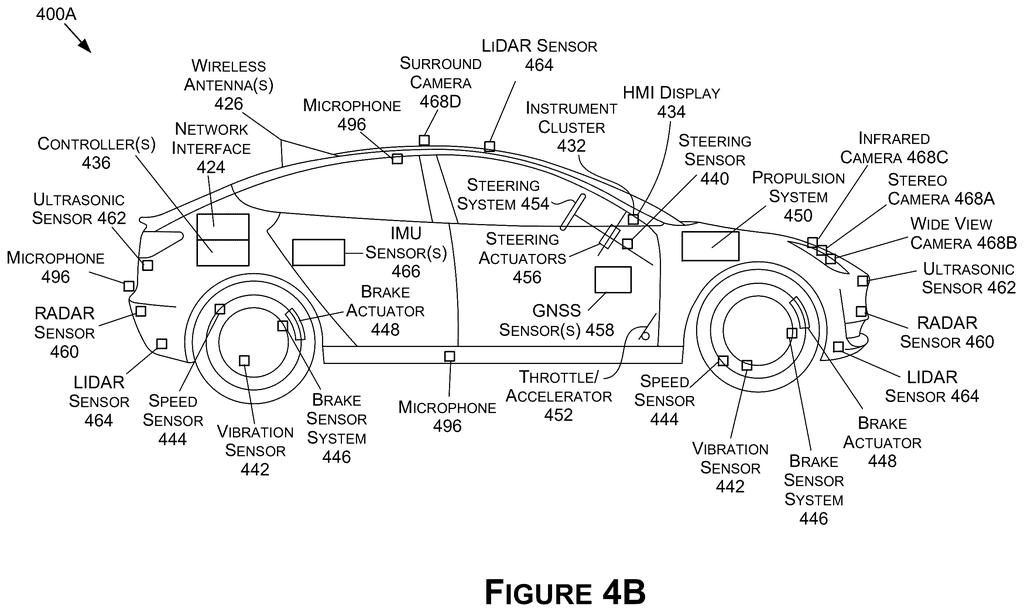
The drawings
11 drawing sheets from US 2026/0307676 A1 · click any drawing to enlarge


Show the other 3 sheets


Want this weekly breakdown for a company we don't cover? Patentlyze Pro →
Be the first to weigh in