
Google Files Patent for AI Art That Learns a Style From a Few Images
Google's patent application describes teaching an AI image tool a new art style from as few as one example picture, using training light enough for a phone. The trick is a tiny style add-on that gets swapped in while the giant model stays untouched.
What Google's art-style AI patent actually does
Ever asked an AI image tool for a dog in your favorite watercolor look and gotten something almost right, but not quite? Teaching a huge image model something new usually takes a data center's worth of computers, so most people never get a style that is truly theirs.
Google's patent application describes a cheaper route. The big image model stays frozen, and a tiny style add-on gets trained for each look. According to the filing, you might need as few as one reference image to teach it, and the training is light enough that a phone or laptop could handle it.
When the tool draws, it works out the picture in steps and makes two guesses at each one: one with the add-on and one without. The gap between the two shows what the style contributes, and the tool leans into that gap so the style comes through strongly. The filing also describes a version with a second add-on for a specific object, like your own pet.
… one or more first sets of parameters that are shared across different styles, and one or more second sets of parameters that are specific to the specified style …
Translation: The AI uses general settings for all images and custom settings just for the requested art style.
How Google swaps in a small style add-on
The patent covers turning a prompt that names a style into an image. A text encoder (a neural network that converts words into numbers) summarizes the style request, and the image model holds two groups of parameters (the adjustable numbers a network learns): one shared by every style, one specific to the requested style.
In the filing's main version, the model is built from Transformer blocks (a design that uses attention, a way of weighing which parts of the data matter to each other). The shared attention layers stay fixed, while a small adapter in each block holds the style numbers and can be about ten times smaller than an attention layer. Training one takes between one and ten image-and-caption pairs.
To draw, the model starts with a canvas of blank mask tokens (placeholders for small image pieces) and fills them in over several steps. At each step it makes two predictions:
- One using the shared parameters plus the style adapter.
- One using only the shared parameters.
The difference between them, scaled by a guidance factor, helps score which image piece fits each patch. Pieces are sampled, many in parallel, and a decoder turns the final pieces into pixels.
A second independent claim adds a third group for a specific object, such as one particular pet, so each step makes four predictions. A blending weight, suggested at 0.5 to 0.7, balances object against style.
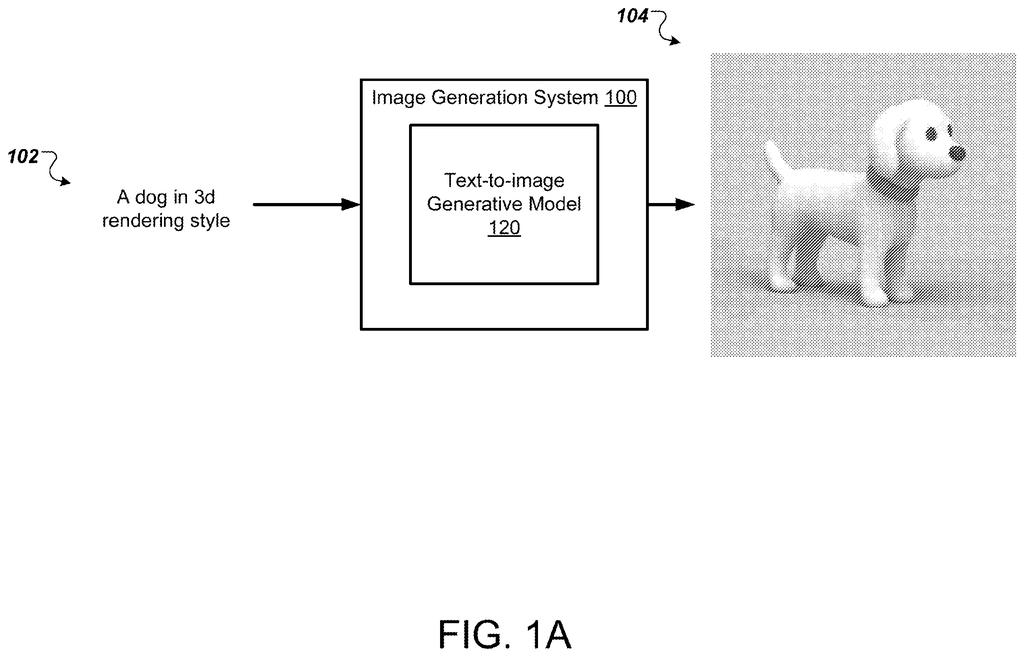
Methods, systems, and apparatus, including computer programs encoded on computer storage media, for generating an output image using a text-to-image generative model from a text prompt.
Translation: This describes software that creates pictures based on written descriptions.
Why learning styles on a phone matters for you
Today, getting an AI tool to match a specific look usually means a giant, costly training run. The filing says adapting to a new style is far lighter than building the base model and could run on a phone, laptop or home device, so adding your own style would not need a data center.
For designers, brands and hobbyists, that points to a consistent look across many images from only a few samples. The same setup also lets a style and a specific object (your dog, say) be combined while both stay recognizable. It is still a patent application, so there is no sign of a product, and the filing gives no quality results.
Google's 67th filing we've tracked since May in the AI photo editing race follows earlier applications like the panoramic video sweep and the AI-trained makeup filters.
Anyone who has asked an AI tool for "my brand's look" knows the problem: you get a loose cousin of what you meant. Getting an exact style is costly because the usual fix is retraining a giant model, and few people have the computers for that.
Google's approach fits the size of that problem well. Training only a small add-on per style keeps the cost low, and the filing's statement that a phone could do the work gives it reach beyond big studios.
The open question is quality. The text we have offers no test results, so how faithfully one reference image captures a style is unproven. As a cost fix, it targets a real annoyance. As a promise of perfect style copying, it needs evidence.
Get our take in your Top Stories
Liked this breakdown? Add Patentlyze as a preferred source on Google, and our plain-English take shows up more often in your Top Stories the next time Google patent news breaks.
There are more where this came from
We read every patent application Big Tech publishes and send you the ones worth knowing. Plain English, free, every week.
The drawings
7 drawing sheets from US 2026/0320867 A1 · click any drawing to enlarge


Want this weekly breakdown for a company we don't cover? Patentlyze Pro →
Be the first to weigh in