
Samsung Patents a Multi-Directional Gate Layout for Denser Image Sensors
Samsung is patenting a way to wire up image sensor pixels using gate lines that snake across two differently-oriented active regions — a structural tweak that could help pack more pixels or more capable transistors into the same chip area.
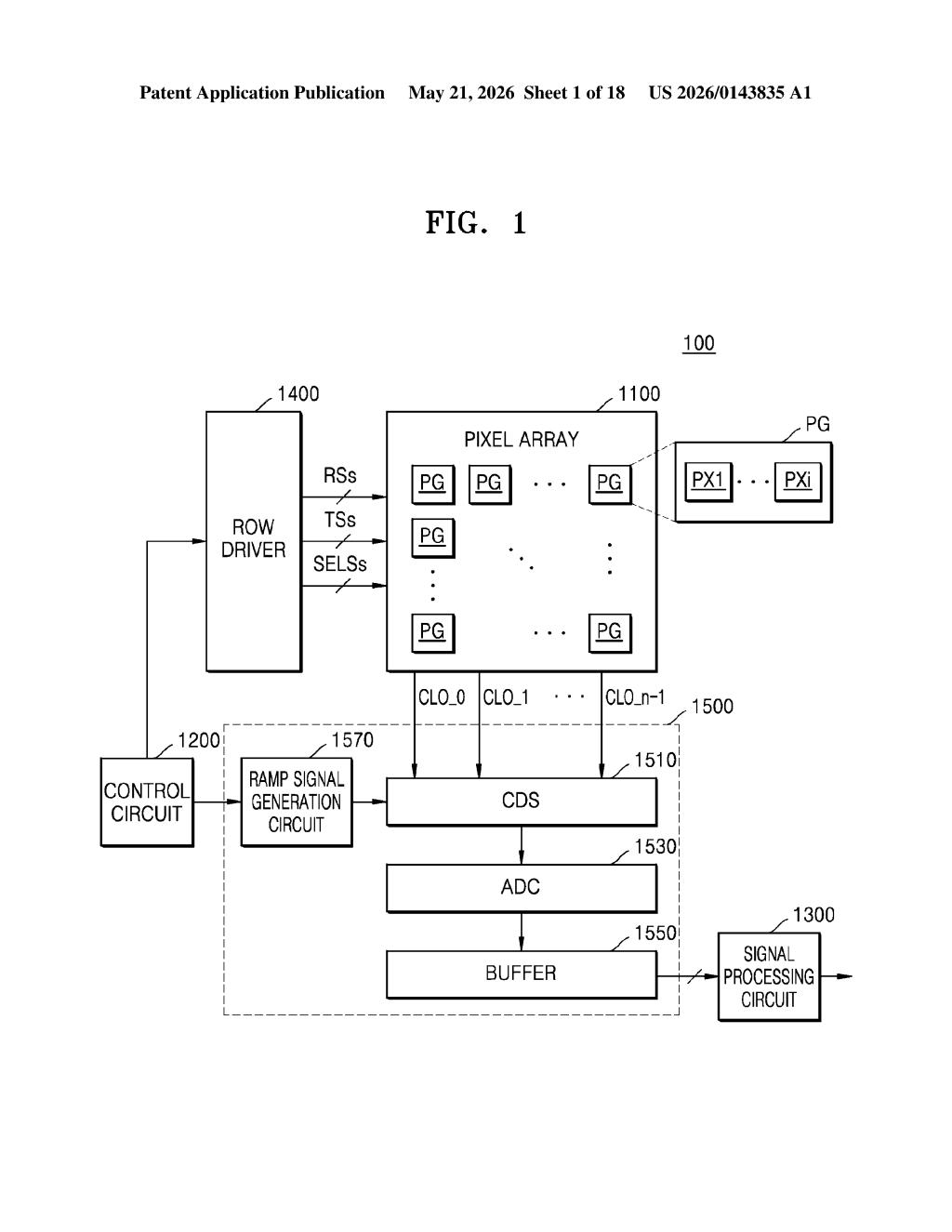
What Samsung's pixel gate design actually does
Imagine a camera sensor as a giant grid of tiny light-collecting buckets. Each bucket needs its own electronics to read out the light signal, and those electronics take up space. The smaller and more efficiently you can lay them out, the more buckets — and thus more detail — you can fit on the same chip.
Samsung's patent describes a pixel design where two active regions (the silicon zones where transistors live) run in different directions — one horizontal, one vertical, essentially forming an L-shape. A single transistor's gate then runs across both, connected by a bridging line that passes over the insulating layer between them.
That bridging gate line is the key idea here. By tying together two differently-oriented active regions under one gate structure, Samsung can fit a more capable transistor into a smaller, more irregular footprint — the kind of geometric flexibility that matters a lot when you're designing at nanometer scales.
How the L-shaped active regions and bridging gate line work
The patent describes an image sensor with at least two pixel regions. Inside the first pixel region, two active regions (the conductive silicon areas where transistors are built) sit side by side on a semiconductor substrate — but they point in different directions. One extends along a first axis, the other along a second axis (think horizontal and vertical).
A single transistor gate structure spans both active regions using three gate lines:
- A first gate line running over the first (horizontal) active region
- A second gate line running over the second (vertical) active region
- A third, connecting gate line that bridges the two — passing over the device isolation layer (the insulating trench that electrically separates active regions from each other and from neighboring pixels)
The critical detail is that bridging gate line. Normally, gate structures stay within a single active region. Extending one across the isolation layer to connect two differently-oriented active regions is a layout approach that lets a single transistor control charge from an L-shaped or bent silicon area, rather than a strictly linear one.
This could allow the pixel's transfer transistor (the switch that moves charge from the photodiode to the readout circuit) to be more compact or better shaped for a given pixel pitch — useful as pixel sizes shrink below 1 micron.
What this means for Samsung's next camera sensors
As smartphone cameras push toward higher resolutions without growing the sensor physically, every square nanometer of pixel real estate matters. A gate structure that can bridge across differently-oriented active regions gives chip designers more freedom to route transistors around the cramped geometry of a tiny pixel without sacrificing electrical performance. That's a meaningful tool in the toolbox for whoever is designing Samsung's next-generation CMOS image sensors.
This is also relevant for stacked sensor designs where pixel-level circuitry is increasingly squeezed. If Samsung can implement a transistor that wraps around an L-shaped active region cleanly, it may reduce the area penalty of per-pixel amplification or global shutter circuits — features that are increasingly expected in flagship mobile and industrial imaging.
This is a dense, quiet piece of semiconductor layout engineering — not the kind of patent that makes headlines, but exactly the kind that ends up in shipping silicon. The bridging gate line concept is a real structural idea, not a software patent dressed up as hardware. Whether it makes it into a Galaxy camera sensor or stays on paper, it reflects the unglamorous precision work that keeps Samsung competitive in image sensor density.
There are more where this came from
We read every patent application Big Tech publishes and send you the ones worth knowing. Plain English, free, every week.
Want this weekly breakdown for a company we don't cover? Patentlyze Pro →