
Samsung Files Patent for a Foldable Phone That Doubles as a Smart Ring Charger
Smart rings have no screen, so Samsung's patent application turns the outer display of a foldable phone into the ring's charging dashboard.
What Samsung's ring-charging foldable does
Right now, a smart ring is awkward to charge. It has no screen, so it can't tell you whether it's connected, how full its battery is, or whether you set it down in a spot that barely charges. Samsung's patent application hands that job to a foldable phone.
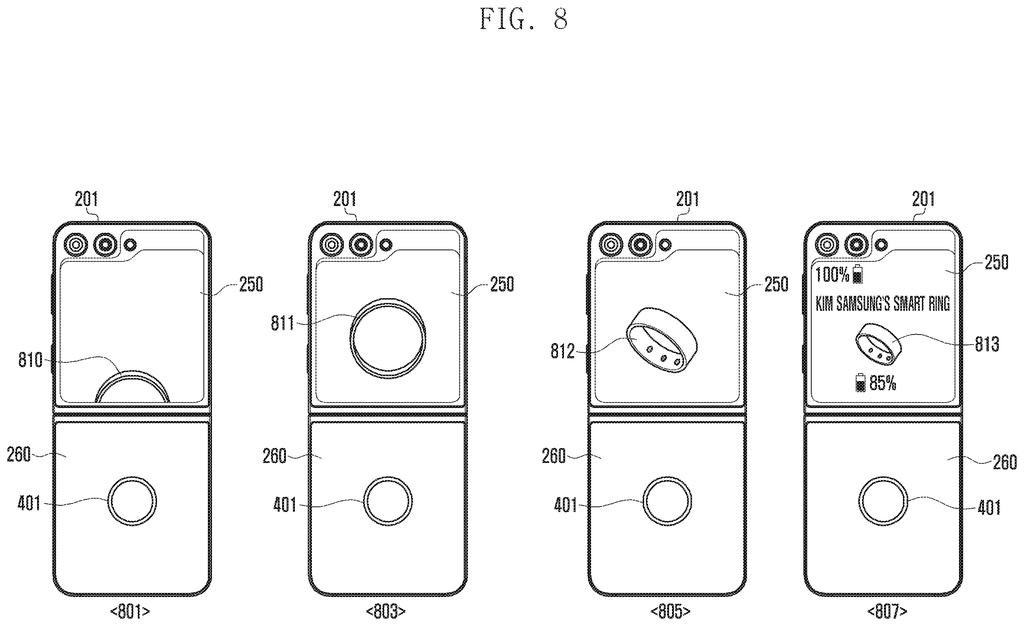
Set the ring on the charging area on the back of the phone, and the small outer screen lights up with a picture of the ring, whose ring it is, and its battery level. If the ring sits where charging is weak, the screen nudges you to move it. Twist the ring's band like a dial and you can choose how much charge it gets.
The ring's image fades in at the spot where you put it, then glides to the center of the screen. A brand-new ring even gets a setup screen that offers to copy your health data over.
determine whether a wearable device is placed in a charging area corresponding to the coil, identify one or more of a user of the wearable device or a device name thereof through the communication circuitry …
Translation: The phone checks if a smart ring or watch is sitting on its charging spot and figures out what device it is.
How the phone spots and greets your ring
The patent application describes a foldable phone with a large main display on the inside and a small cover display on the outside. A wireless-charging coil sits on the outer side and can send power out or take it in. When a wearable such as a smart ring lands on the charging area, the phone identifies its owner, its device name, or both over a short-range link (the filing mentions Bluetooth Low Energy and NFC, or talking through the coil itself).
The phone also checks which way the cover display faces, using its motion sensors (the example is facing up, away from the ground). Only then does it show a ring screen on the cover display and start sending power at the level set in the charging configuration.
The claims and description add several details:
- The ring's image fades in where it sits on the coil, then slides to the center.
- A first-time connection brings up a registration screen and an avatar for the owner.
- A guide moves the ring to a spot with better power reception.
- Ring status shows up without covering the app already running on the outer screen.
- Twisting the ring's side works as a dial for how much to charge, such as half a turn for 50%.
The description also covers a lost-ring screen where the phone vibrates in proportion to the distance from the ring.
… transmit power to the wearable device on the basis of charging settings and display a user interface regarding the charging of the wearable device.
Translation: The phone sends power to charge the wearable accessory while showing charging status on the screen.
Why a ring with no screen needs a phone
If you own a foldable and a smart ring, this would give the ring something it lacks today: a way to tell you what it's doing. You would see whether it's connected, how long until it's full, and whether you've parked it in a poor charging spot, all on the phone's outer screen.
It also hints at how Samsung might tie phones and wearables closer together. The filing's sample screens mention a 'Galaxy Smartring case' and show how much the phone's own battery drops while charging the ring (10% in one example), so you can see what topping up the ring costs. Nothing here says when, or whether, any of it ships.
Samsung's latest application is the 87th we've tracked in our foldable phone patents watchlist since May, adding to earlier work like a mixed-spring hinge and a crease-reducing glass layer.
Almost everything here is software. The screens, animations, and prompts run on hardware the filing treats as already settled: a foldable phone with a small outer screen and a wireless-charging coil on the back.
The shortest path to a product is a software update paired with a case that has a ring-shaped bump on it. That bump has to cooperate too, since the twist-to-set-charge idea only works if the ring reports that turn back to the phone, meaning both devices need updates at the same time.
That keeps the audience small: you need a foldable, a smart ring, and a reason to care about charging the ring while you're out. As a convenience feature it ships easily, and the lost-ring locator screen buried in the description is the most memorable idea in the document.
Get our take in your Top Stories
Liked this breakdown? Add Patentlyze as a preferred source on Google, and our plain-English take shows up more often in your Top Stories the next time Samsung patent news breaks.
There are more where this came from
We read every patent application Big Tech publishes and send you the ones worth knowing. Plain English, free, every week.
The drawings
37 drawing sheets from US 2026/0322912 A1 · click any drawing to enlarge


Show the other 29 sheets


Want this weekly breakdown for a company we don't cover? Patentlyze Pro →
Be the first to weigh in