
Sony Files Patent for a Mouse That Becomes a VR Controller When You Lift It
Your mouse and your VR controller could become one object: lift it off the desk and the headset flips from a flat screen to a 3D model. Sony's filing relies on a simple distance sensor to make that call.
What Sony's lift-to-switch mouse actually does
Ever had to put down your mouse, feel around for a VR controller, and then do the whole thing in reverse ten minutes later? That is the daily shuffle for people who design products on a screen and then inspect them in a headset.
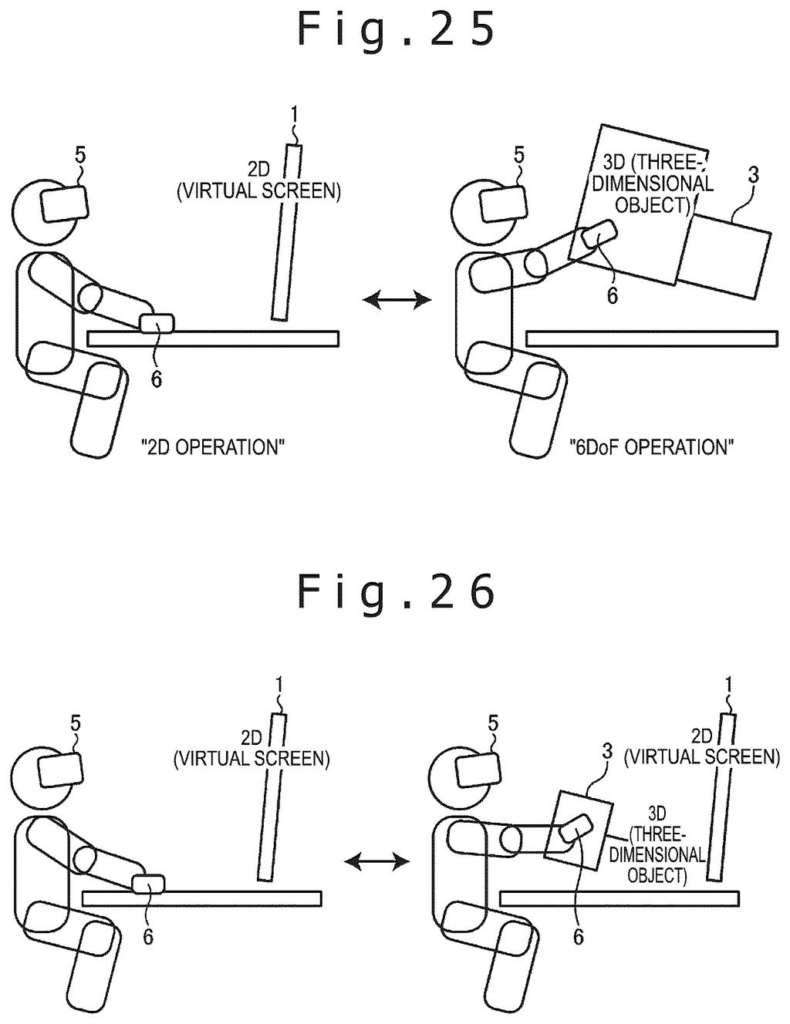
Sony's patent application describes one device that handles both jobs. On your desk it behaves like an ordinary mouse, moving a cursor across a flat design screen. Lift it, and a sensor notices the growing gap between the device and the desk. It stops reporting desk movement and starts reporting where it is in the air, so you can grab, turn, or draw on a 3D model.
The headset follows along. Set the mouse down and your flat screen comes back; lift it and the 3D object takes over. The buttons change roles too, and the body is shaped so you can pick it up without a tight squeeze.
How the controller knows it left the desk
The controller combines two input systems in one body. A mouse function reports flat coordinates on a surface. A 6DoF function (six degrees of freedom: movement in three directions plus three kinds of tilt) reports where the device is and how it is angled in the air. A third piece outputs a switching signal that tells the display which mode to use.
The trigger is a distance sensor that measures how far the controller sits from its surface. Past a set threshold, higher than the small hops of normal mouse use, the signal fires: the mouse side goes quiet and the 6DoF side starts reporting. Put it back down and the reverse happens. The description also lists a tilt sensor, a side pressure sensor, or a headset camera as alternative triggers.
The claims and description also cover:
- Buttons that change roles when you lift: a flat-image action becomes a 3D-image action, and a click can become a light touch, since there is nothing to push against in midair.
- A chevron-shaped body with side surfaces that flare outward near the top and a center of gravity inside, so it lifts without a hard grip.
- A display device, such as a headset, that switches from 2D to 3D mode when it receives the signal or the distance data.
The distance math can also run on the headset or a connected PC instead of the controller.
What this means for VR design reviews
The problem behind this filing is design review. Designers refine a product on a flat screen, then inspect a 3D version in a headset, and today that usually means swapping between a mouse and a VR controller. One device that does both could remove that swap for anyone doing computer-aided design (CAD) work in VR. Sony's examples include a camera and a car, with the car's interior large enough to crowd out the flat screen.
It is still only an application. The examiner's first review rejected the claims as filed, which is routine at this stage and usually followed by amendments. Nothing in the document names a product or a release, so treat it as a look at how Sony thinks about mixing desk work and headset work.
Sony's 613th filing in our Sony coverage since May follows work like the headphone orientation fix and parked-car concert streams.
The distance check is the easiest part of this filing to build. Measuring how far a device sits from a desk and flipping a mode when the number crosses a line takes a cheap sensor and a few lines of code, and the headset only has to react to one signal.
The hard part is hardware. Someone has to build a mouse that also carries tracking, such as the LED ring or magnetic sensing the filing mentions, then tune its shape and weight so it lifts without a squeeze. The headset needs a way to see or sense it, and the design software has to make use of both the 2D and 3D modes.
The shortest route to a product is a mouse with an LED ring paired with a headset that already tracks its own controllers. That is a real hardware project, so expect this idea to stay on paper unless design teams clearly want it. As a concept it is sensible and easy to grasp.
Get our take in your Top Stories
Liked this breakdown? Add Patentlyze as a preferred source on Google, and our plain-English take shows up more often in your Top Stories the next time Sony patent news breaks.
There are more where this came from
We read every patent application Big Tech publishes and send you the ones worth knowing. Plain English, free, every week.
The drawings
29 drawing sheets from US 2026/0319573 A1 · click any drawing to enlarge


Show the other 21 sheets


Want this weekly breakdown for a company we don't cover? Patentlyze Pro →
Be the first to weigh in