
A New Samsung Patent Lets Your TV Borrow Another Device's Memory of Your Voice
Your TV could greet you personally even if it has never heard your voice, because Samsung's filing has it ask another device that already knows you. The device that has you on file passes your identity along.
What Samsung's shared voice recognition does
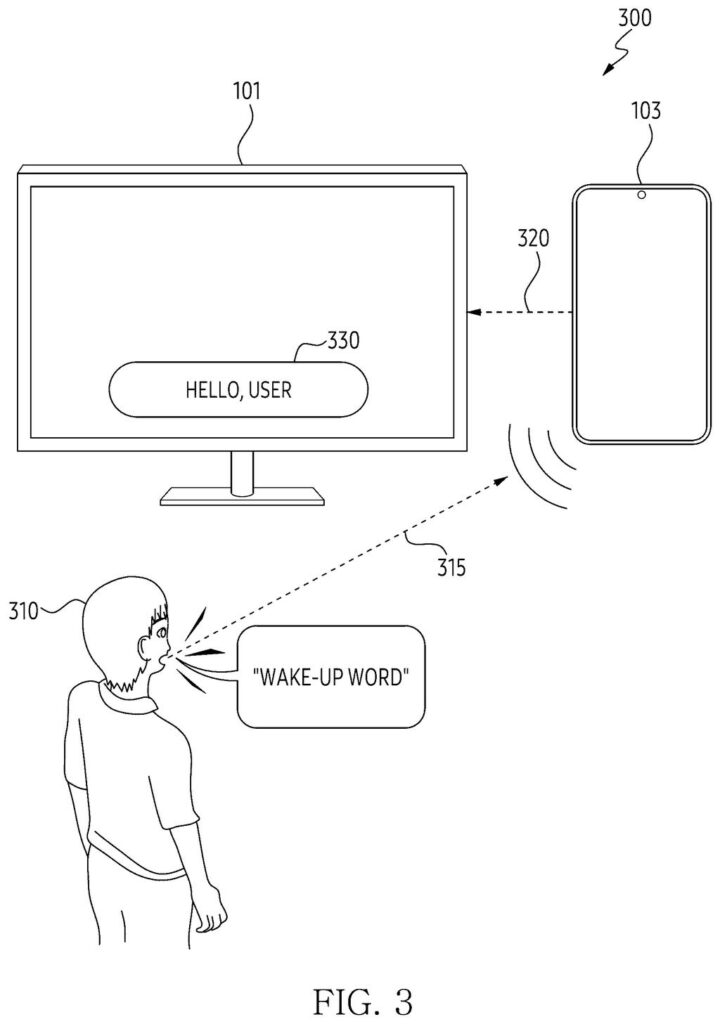
You walk into the living room and say "Hi Bixby." Your phone, your tablet and the TV all hear you, but only your phone has ever learned your voice. The TV has no idea who just spoke, so it treats you like a stranger.
Samsung's patent fixes that by letting devices share the answer. The TV sends a short report on what it heard to a server, and the server sends back who the speaker is, taken from the device where you're already registered. The TV can then show a greeting made for you or open an app that needs to confirm it's really you.
The filing also describes a bonus. A device that has never met you can use that identity to learn your voice from the clips it hears, until it can recognize you on its own.
… generate, from the voice signal including a wake-up word, a first recognition result for the wake-up word; transmit the first recognition result to a server connected to one or more external electronic devices capable of recognizing the wake-up word; receive, from the server, a second recognition result for a user who uttered the wake-up word …
Translation: The TV hears a wakeup word and asks a cloud server to figure out who is speaking based on data from other gadgets.
How the server passes your identity along
The patent covers a setup where several devices share the same wake-up word (the phrase, like "Hi Bixby," that makes a device start listening). When you speak, a device picks up your voice with its microphone and builds a first recognition result about the wake-up word. In the description's example, that includes a confidence score, how loud the speech was (the sound power level), the signal-to-noise ratio (how much speech there is compared with background noise), and a timestamp.
The device sends that result to a server that manages the nearby devices. The server replies with a second recognition result about the person, using identification from another device where you are registered. "Registered" means that device already has a trained voice model for you. The description's example includes a speaker ID, a group label such as "Family," and a confidence score for the match.
The device then runs a designated function for you. The filing gives two examples:
- Showing a screen that tells you it recognized you, such as a "Hello" message.
- Opening an app that requires you to be verified first.
The claims also cover working out which device you meant to talk to, and training a new voice model on a device that lacks one. The number of voice samples needed for that training depends on how good the signal quality is. The description says training can run in the background.
The second recognition result includes identification information indicating the user, obtained from an external electronic device, in which the user is registered, among the one or more external electronic devices.
Translation: Your television identifies you by pulling your voice profile from another smart device you already set up.
Why a shared voice ID matters at home
Most homes now have several voice-enabled gadgets, and most of them treat every speaker the same. This filing points to a family TV that could greet you, or pull up your own schedule when you ask for it, without you setting up your voice on that TV first. The description's own example is a request like "tell me today's schedule" being answered with the right person's calendar.
It also matters for shared devices. A TV in a living room is used by everyone, so it rarely knows who is asking. Borrowing identity from a phone that already knows you would let that TV respond to you in particular, and the filing says the speaker's group (like "Family") can travel along with the identity too.
Samsung's 25th filing we've tracked since June in our AI assistants that remember you watchlist builds on work like giving chatbots longer memory and recapping paused shows.
Claim 1 covers any device with a microphone that sends a wake-word match to a server and gets back a confirmed identity drawn from another device where that person is already enrolled. The final step, "a designated function," is deliberately open, so a greeting, an unlocked app, or a personalized playlist all qualify.
That breadth has real consequences. Any system routing voice identity through a central server, rather than letting each gadget learn your voice independently, falls inside this claim.
The practical territory is a household full of connected speakers and screens that share one account of who is speaking. That is a common setup, and a claim this wide would cover a large share of the coordination logic holding it together.
Get our take in your Top Stories
Liked this breakdown? Add Patentlyze as a preferred source on Google, and our plain-English take shows up more often in your Top Stories the next time Samsung patent news breaks.
There are more where this came from
We read every patent application Big Tech publishes and send you the ones worth knowing. Plain English, free, every week.
The drawings
13 drawing sheets from US 2026/0321268 A1 · click any drawing to enlarge


Show the other 5 sheets


Want this weekly breakdown for a company we don't cover? Patentlyze Pro →
Be the first to weigh in