
Google Files Patent for a Training Fix to Help Voice Software Catch Wake Words and Speaker Changes
Voice software learns from hours of ordinary talk, so the rare moments that matter most, like a wake phrase, barely register during training. Google's patent application makes those moments count for more.
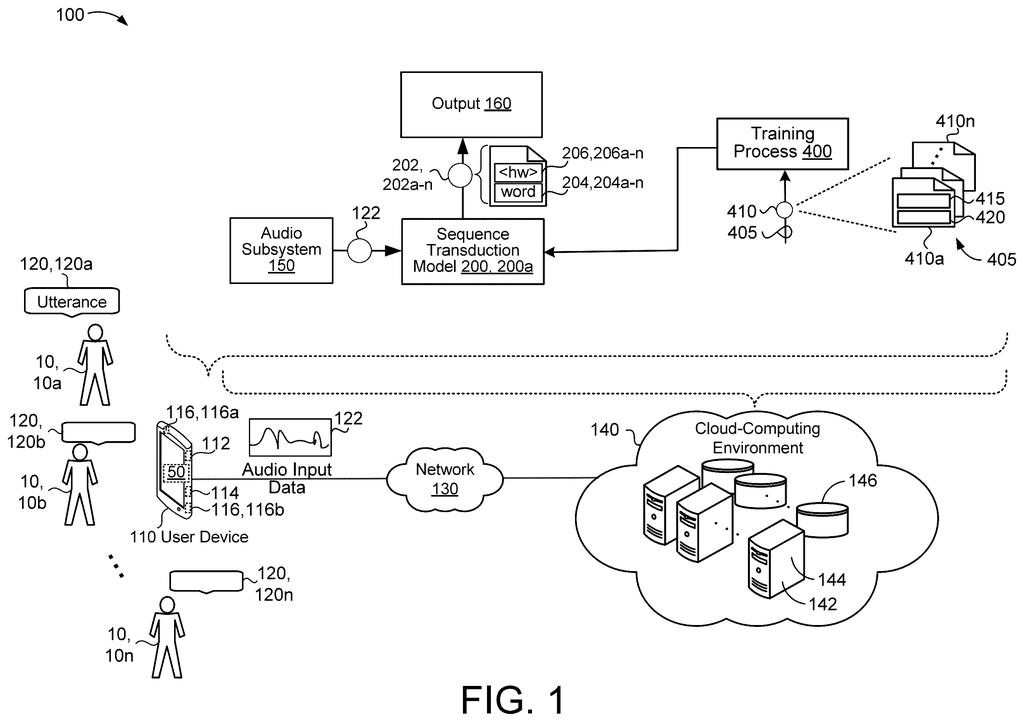
What Google's speech-training patent actually fixes
Every time you say a wake phrase to your phone or smart speaker, the software has to spot one short moment buried in a lot of ordinary talking. That is harder than it sounds. Wake phrases and speaker changes are rare in the recordings these systems learn from, so during training they get drowned out by everyday words.
Google's patent application describes a second round of training that fixes this. After the system learns the basics, it goes back over the same recordings and checks its own guesses. Missing a wake phrase, or hearing one that was never said, now counts as a bigger mistake than getting an ordinary word wrong.
The same idea covers noticing when one person stops talking and another starts. The filing also says it could apply to reading handwriting and to translation, where certain items, like names, should be left alone.
processing, using a sequence transduction model, the corresponding sequence of training input features to obtain one or more output token sequence hypotheses …
Translation: The system runs audio data through a model to generate guesses for what words were spoken.
How Google re-scores missed and false markers
Google's filing covers a way to train models that turn one sequence into another, such as audio into a written transcript. In the training data, the correct answers contain ordinary tokens (the words or word pieces) plus special tokens, which are markers such as '' placed right after a wake phrase or '' where the speaker changes.
Training runs in two passes. First, the model learns the standard way, by raising the probability of the correct transcript. Then it goes back over the same data. For each recording, it produces an N-best list (its several top guesses at the transcript) and compares each guess with the right answer.
The comparison uses a customized Levenshtein distance (an edit count of how many insertions, deletions and swaps turn one text into the other). Special markers can never be swapped for ordinary words. They can only be correct, wrongly added, or missed. The loss (the model's score for how wrong it was) then tallies:
- Special markers wrongly inserted
- Special markers deleted
- Ordinary word errors
In the description, marker mistakes are weighted a bit heavier than word mistakes, for example a cost of 1.1 instead of 1 in the edit count, with larger weights in the loss formula. That result is blended with the original training loss. The example model is a compact speech model small enough to run on the device itself.
a number of special token insertions each associated with a corresponding predicted special token that appears in the hypothesis but does not appear in a corresponding sequence of ground-truth output tokens …
Translation: The algorithm counts extra wake words or triggers that the system incorrectly imagined were there.
Why wake words and speaker labels may improve
If this works as described, the payoff shows up in small, daily moments: your assistant wakes when you call it and stays quiet when you don't, and a meeting transcript labels who said what more reliably. Both depend on spotting rare events in a flood of ordinary speech, which is exactly the gap this training method targets.
The filing is also broader than voice assistants. It names handwriting recognition and machine translation as other places the same scoring could apply. The examiner's first review rejected the claims as filed, which is routine at this stage and usually followed by amendments, so the final scope may shift.
Google's 53rd filing in Voice & speech AI we've tracked since May follows a drone delivery voice alert and training with blanked audio.
Claim 1 is wide. It does not mention audio, wake words or speakers at all. It covers any model that turns an input sequence into an output sequence containing special markers, counts the markers it wrongly added and the ones it missed, and trains to cut that error rate. If granted as written, that would reach well past voice assistants.
The specifics live in the dependent claims. Weighting marker errors above word errors is claim 2, the two-pass training is claim 4, the edit-count method is claim 8, and the wake phrase and speaker change cases are claims 6 and 7. Those are the details a competitor could most easily design around, so the real protection depends on how much of claim 1 survives the examiner's objections.
The idea itself is sensible and easy to explain: if something rarely happens, make each miss hurt more. Whether anyone can build a product that falls inside a claim this broad is a question for patent lawyers, but the breadth is the thing to watch as the application moves forward.
Get our take in your Top Stories
Liked this breakdown? Add Patentlyze as a preferred source on Google, and our plain-English take shows up more often in your Top Stories the next time Google patent news breaks.
There are more where this came from
We read every patent application Big Tech publishes and send you the ones worth knowing. Plain English, free, every week.
The drawings
6 drawing sheets from US 2026/0320312 A1 · click any drawing to enlarge


Want this weekly breakdown for a company we don't cover? Patentlyze Pro →
Be the first to weigh in