
Google Files Patent for AR Glasses That Warn You Before a Coffee Cup Meets Your Hard Drive
Point at a router port, and Google's AR glasses could answer a question you never asked out loud. The patent application also describes spotting a coffee cup parked too close to a hard drive.
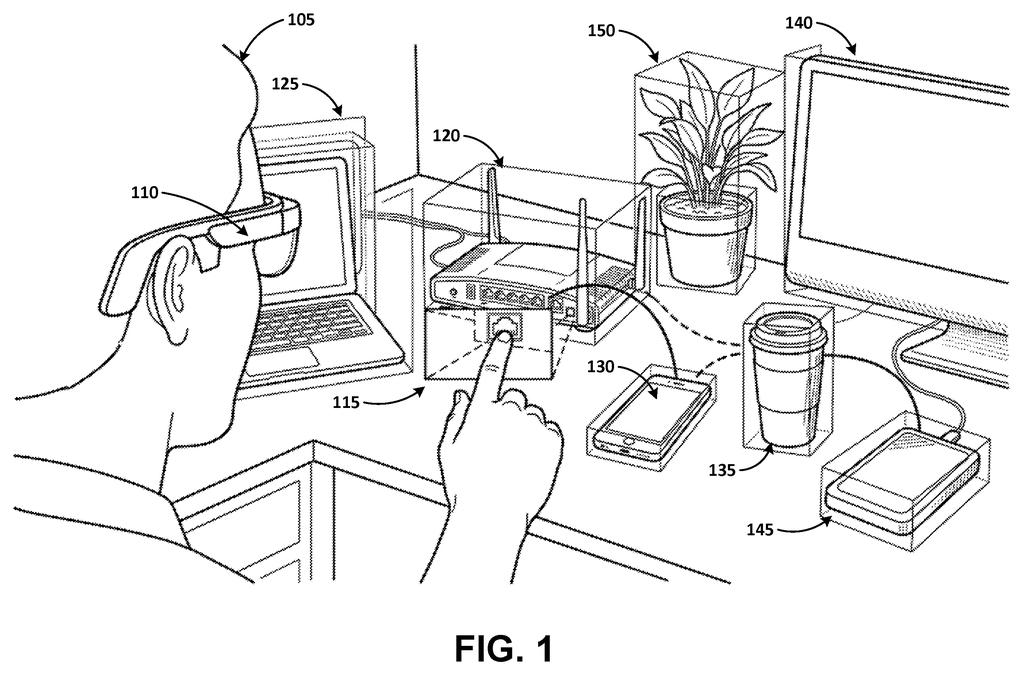
What Google's AR glasses see when you point
Every time you set up a new router, you squint at tiny port labels, grab your phone, and type a question into a search bar. Google's patent application describes AR glasses that skip the typing. You point at a port, and the glasses work out what you are asking about.
The glasses look at three things at once: the small part you are pointing at (a port or a label), the whole object it belongs to, and how nearby objects relate to each other. One AI model turns that into a detailed question. A second model looks up the answer, and it shows up as a label or a line drawn in the room, stuck to the real object even if you pick it up.
The filing also describes a safety angle. Set a cup of coffee next to a hard drive, and the glasses could flag the spill risk and tell you to move it.
identifying a first object in a physical environment at a first scale of interaction corresponding to a component of the first object; identifying a second object in the physical environment at a second scale of interaction corresponding to a functional relationship between the second object and at least one of the first object or a third object; …
Translation: The glasses look at individual parts of things and figure out how different objects interact with each other in the room.
How the glasses turn a gesture into a question
The claims describe a method that sorts what the glasses see into three scales of interaction (levels of zoom). The first is a part of an object, like one Ethernet port or a label. The second is a whole object. The third is the functional relationship between objects, such as a phone that needs to connect to a router.
Two AI models then work in sequence. The first writes a prompt (the written instruction an AI answers) based on the objects it identified. The second retrieves information using that prompt. The filing says the first model can expand a simple gesture into a paragraph-length instruction, and can check the second model's answer and ask for revisions. The result appears as a visual overlay (a label, highlight, or line) in your view.
The other claims and the description add supporting pieces:
- A scene graph (a map of how objects connect) that updates when you move something
- Digital anchors (virtual markers pinned to real objects), placed by casting a ray from the camera through a box around the object until it hits a 3D scan of the room
- Intent cues such as fingertip distance, how long you hold a gesture, or where your eyes rest
- Relationship types: grouped items, interchangeable items, and step-by-step order
- Drift correction, using regular camera snapshots to keep overlays lined up
Claims also cover reading label text with OCR (software that reads printed words), working out what 'these' means in a spoken question from what you have selected, and simulating what could happen if one object moves near another.
Why Google's AR glasses idea could cut the typing
If this works, setting up gadgets, reading a tiny nutrition label, or fixing a computer takes a lot less typing. You point, the glasses figure out what you mean, and the answer lands on the object itself instead of on a separate screen. Spoken questions get easier too, because the glasses can work out what 'these two parts' refers to from what you have selected.
The filing also addresses trust. It says raw camera images can be processed on the device first, with faces, photos, and printed documents swapped for generic boxes before anything reaches a cloud model. Whether that holds up in a real product is unknown, since a patent describes an idea and not a shipped feature. The examples (routers, lab benches, plant care, supplement labels) show where the filing sees wearable AR being useful.
Google's 48th filing we've tracked since May joins earlier applications on frame notifications and switchable mirror lenses in our smart glasses display watchlist.
Asking a computer about something in front of you is clumsy. You stop what you are doing, find words for a tiny port or a half-built circuit, then type or speak them. That friction costs a few seconds each time, and a phone camera search already covers much of it.
The filing aims at moments when your hands are busy and the question is hard to put into words, like cabling a gateway or working at a lab bench. In those moments, pointing instead of asking makes sense. The machinery is large for that problem: depth scans of the room, markers pinned to objects, drift correction, and two AI models checking each other.
The spill warning is the most memorable example and the least urgent one. Everything depends on whether people will wear glasses often enough to benefit. A mild annoyance gets a lot of engineering here, and it pays off only if the glasses are already on your face.
Get our take in your Top Stories
Liked this breakdown? Add Patentlyze as a preferred source on Google, and our plain-English take shows up more often in your Top Stories the next time Google patent news breaks.
There are more where this came from
We read every patent application Big Tech publishes and send you the ones worth knowing. Plain English, free, every week.
The drawings
8 drawing sheets from US 2026/0319581 A1 · click any drawing to enlarge


Want this weekly breakdown for a company we don't cover? Patentlyze Pro →
Be the first to weigh in