
Google Files Patent to Fix Smartwatch Health Sensor Lights That Dim With Age
The tiny light inside a health-tracking watch weakens as it ages, and that fade can be as large as the body changes the watch is trying to measure. Google's patent builds a small dark room around the watch's self-check sensor to keep it honest.
What Google's smartwatch light-sensor shield does
Ever had a lightbulb slowly get dimmer without you noticing? The health sensor on the back of a smartwatch has the same problem. It shines a small light into your skin and reads what comes back, and over months that light fades.
That matters because the body changes these sensors hunt for are tiny, about 0.1% a month according to the filing, which is the same size as the fade. To catch it, the watch can carry a second little sensor that watches the light directly. The catch is that this checker can get fooled by light bouncing off your skin and the glass on the back of the watch. Google's patent wraps the checker in a barrier, a sort of dark room, so it only sees the watch's own light.
A second version swaps the fixed barrier for a window that flips between clear and dark in microseconds, going dark whenever the watch checks itself.
… at least one calibrator light detector positioned in the internal cavity; an outer cover arranged adjacent to the internal cavity; and a light blocking surface positioned between the at least one calibrator light detector and the outer cover so as to minimize transmittance of one or more interference signals to the at least one calibrator light detector.
Translation: An extra sensor and a barrier are added inside to block stray light and maintain accuracy.
How the dark house hides the calibrator sensor
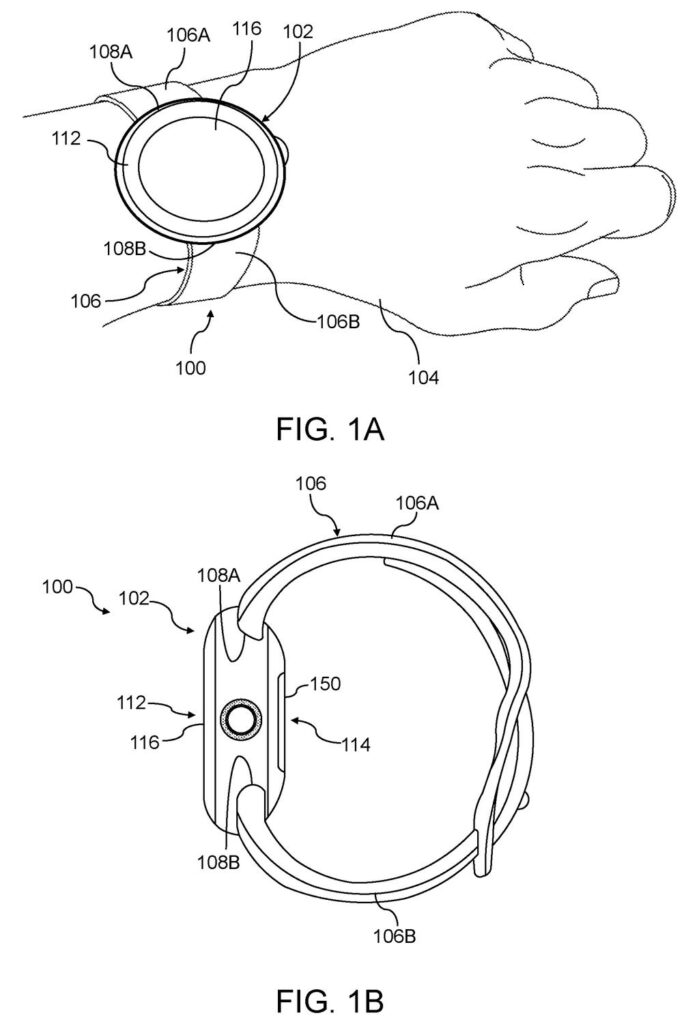
The patent covers a watch-style device whose back half (the lower housing) has a cavity holding three parts: a light emitter such as an LED, a light detector (a photodiode, a chip that turns light into a tiny electric current), and a calibrator light detector that watches the emitter's own brightness. An outer cover sits against your wrist.
The new piece is a light blocking surface between the calibrator and that outer cover. It keeps interference, meaning light reflected off your skin or the watch's own glass and walls, from reaching the calibrator. The filing calls the result a 'dark house.' A second independent claim covers just the LED-and-calibrator module as a standalone part.
The filing describes two ways to build the blocker:
- Light blocking flange: a fixed lip, either molded into the cavity walls or attached as a separate piece.
- Switchable polarizing material: a window that a voltage flips between near 100% clear and near 100% light-absorbing, within microseconds. It stays clear during normal use and goes dark during calibration.
During sensing, the LED runs at constant current and a small share of its light is bounced to the calibrator (by a reflective prism in the drawings). A circuit called a transimpedance amplifier (it converts the tiny current into a readable voltage) records that signal. The two blockers can also be combined.
Why aging LEDs matter for wrist health tracking
If your watch is meant to track slow health trends, it has to trust its own light first. A sensor that drifts as it ages could hand you a trend line that is really just a tired LED. The filing ties this kind of sensing to skin markers linked with aging and heart health, and to conditions such as diabetes, so long-term accuracy is the whole point.
The described device is worn like a wristwatch, and the application is early: the examiner's first review rejected the claims as filed, which is routine and usually followed by amendments. It is a hardware detail, not a finished feature, and nothing in the text says when or whether it would ship.
Google's 18th filing we've tracked since May in our wearables that read your body watchlist follows earlier applications like an under-eyelid blood sugar sensor and a heartbeat forecast method.
Every watch maker fights for space inside the case, and a dark chamber around a sensor takes some. A fixed flange is a cheap wall, but it can only block what it was shaped to block. The switchable window adds a part that needs power and timing control, plus one more thing that could fail on a device worn through sweat and showers.
Even so, the trade looks worth making. The sensors involved hunt for changes of about 0.1% a month, so a calibration signal polluted by stray light would put the whole reading in doubt. A small wall is a modest price for trusting the number.
The patent is plain hardware with no new software trick, and it gives no test results. Its value rests on whether the barrier holds up in a thin watch.
Get our take in your Top Stories
Liked this breakdown? Add Patentlyze as a preferred source on Google, and our plain-English take shows up more often in your Top Stories the next time Google patent news breaks.
There are more where this came from
We read every patent application Big Tech publishes and send you the ones worth knowing. Plain English, free, every week.
The drawings
6 drawing sheets from US 2026/0318733 A1 · click any drawing to enlarge


Want this weekly breakdown for a company we don't cover? Patentlyze Pro →
Be the first to weigh in