
Google Patents Earbuds That Use Ear-Canal Sound to Track Chewing, Sleep, and Jaw Grinding
Your earbuds already play music into your ear canal. Google wants to bounce sound off the canal walls too, and use the echoes to figure out whether you're chewing, sleeping, or grinding your teeth.
What Google's ear-canal sound tracking actually does
You're sitting at your desk with earbuds in, and without pressing a button or filling out a survey, your device figures out that you just started eating lunch. That's the kind of thing Google is working toward with this patent.
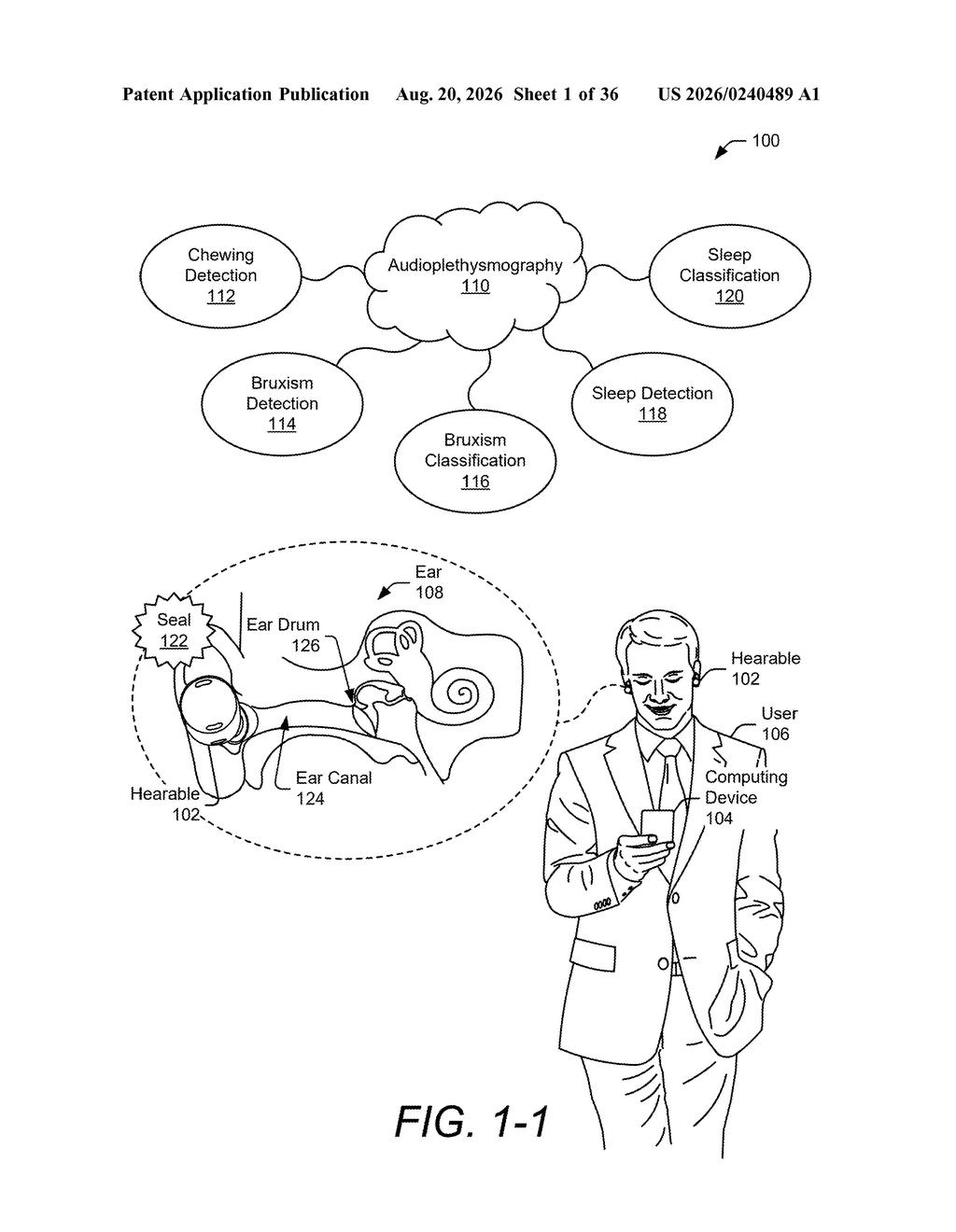
The idea is to use the earbud itself as a tiny sonar system. It sends a sound signal into your ear canal, then listens to how that signal bounces back. Because your jaw, muscles, and skin shift in different ways depending on what you're doing, the returning echo changes too. The earbud reads those changes to figure out whether you're chewing, sleeping, or grinding your teeth at night (a condition called bruxism).
The clever part is that it doesn't try to detect each behavior in isolation. Detecting one behavior, like sleep, helps the system better detect another, like jaw grinding that happens during sleep. That layered approach, Google says, makes the whole system more accurate than if it tried to spot each behavior separately.
transmitting, via a hearable of a user, an acoustic transmit signal that propagates within at least a portion of an ear canal of the user; receiving an acoustic receive signal, the acoustic receive signal representing a version of the acoustic transmit signal with one or more of an amplitude, a phase, or a frequency modified due to the propagation within the ear canal …
Translation: The earbuds send sound waves into your ear canal and measure how the shape of your ear changes the sound as it bounces back.
How the earbud sends signals and reads the echo
The patent describes a method for what Google calls interdependent human behavior detection, all running through a single acoustic sensor inside an earbud (referred to in the patent as a hearable).
Here's the basic sequence:
- The earbud transmits a sound signal into the ear canal.
- The signal bounces around and is received back by a microphone in the same earbud.
- Software analyzes how the returned signal differs from the original, specifically changes in amplitude (volume), phase (timing), or frequency (pitch).
- Those differences reveal what the body is doing, because jaw movement, muscle tension, and tissue position all alter how sound travels in the canal.
What makes this distinct from simpler approaches is the interdependency. The system first identifies a primary behavior, say, that the user is asleep. It then uses that confirmed context to sharpen its detection of a secondary behavior, like whether the sleeping user is also grinding their teeth. Each detection informs the next one, rather than each running blind.
The end result can then control a device: pausing audio, logging health data, or triggering an alert. All of this, the patent notes, can run from a single sensor type without needing cameras, accelerometers, or skin-contact electrodes.
Interdependent human behavior detection and/or classification involves using the detection and/or classification of a first human behavior to assist with the detection and/or classification of a second human behavior.
Translation: The system improves accuracy by using the detection of one activity, like chewing, to help identify a second one, like sleeping.
What this means for health-tracking wearables
For anyone wearing earbuds for long stretches, this kind of passive health tracking could mean real information about sleep quality or eating habits without wearing a separate medical device or manually logging anything. The system doesn't require you to do anything differently.
The design bet here, using acoustics alone rather than a mix of sensors, is what plain-English patent summaries of wearable health filings keep returning to: the simpler the sensor stack, the cheaper and smaller the device, which matters enormously for earbuds where space is tight. Google's acoustic-only approach fits earbuds that people already own and wear daily, which is a significant distribution advantage over purpose-built health hardware.
Google files its ninth patent in our wearables that read your body watchlist since May, building on earlier applications like a screen photo health data filing and a heart monitor rhythm filing.
The tradeoff at the center of this filing is a real one: using a single acoustic sensor keeps the design compact and cheap, but ear canals vary significantly from person to person, and the same person's canal changes with earwax buildup, earbud fit, and even ambient temperature. The system is leaning heavily on software to compensate for that physical variability. Whether the accuracy holds up across a broad population is the question the patent doesn't answer, and it's a meaningful one for health applications where false positives (flagging chewing as bruxism, for example) carry real consequences. The interdependency architecture is genuinely clever engineering, but it also means that if the first behavior detection is wrong, any behaviors downstream of it inherit that error.
There are more where this came from
We read every patent application Big Tech publishes and send you the ones worth knowing. Plain English, free, every week.
The drawings
36 drawing sheets from US 2026/0240489 A1 · click any drawing to enlarge


Want this weekly breakdown for a company we don't cover? Patentlyze Pro →
Be the first to weigh in