
Google Files Patent for Smart Glasses That Guide You With Landmarks and Directional Sound
Instead of "go 200 feet," these glasses would tell you "turn left at the fountain," then use sound that seems to come from the direction you should walk.
What Google's landmark-based glasses directions do
Today's walking directions love to say things like "in 300 feet, turn right." That only helps if you can judge 300 feet by eye. Between tall buildings, your phone's GPS can also bounce off the glass and put you on the wrong street. And you keep glancing at a screen instead of looking around.
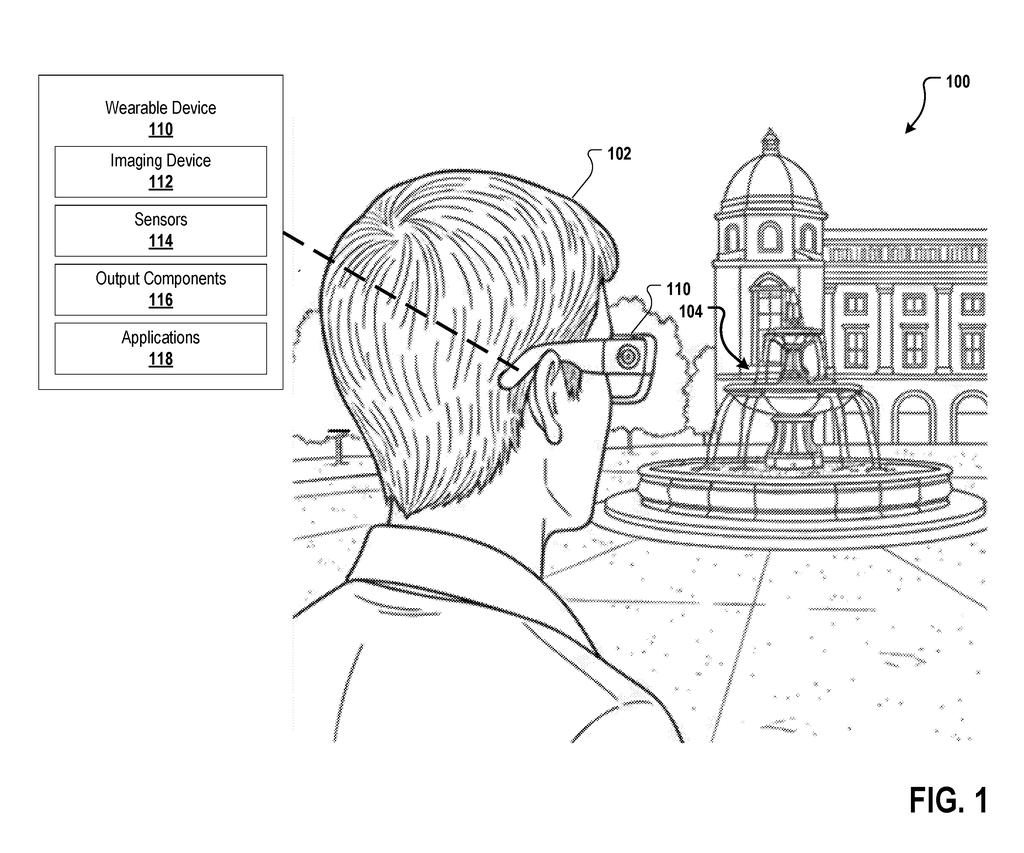
Google's patent application describes a fix built around smart glasses. A camera spots a nearby landmark, such as a fountain or a storefront, and checks it against a stored description of that place. Once the glasses know which way you're facing, they can give directions like "turn left at the fountain."
Sound does the rest. If you drift off course, the glasses play a cue that seems to come from the direction you should head. Face the right way and they stay quiet.
… identifying a feature from the set of candidate features included in the image data based on a correspondence between the image data and a respective feature profile of the plurality of feature profiles; …
Translation: The glasses recognize landmarks by matching what the camera sees with stored data profiles.
How the glasses figure out which way you face
The system starts with a rough position, such as a GPS reading, and pulls a short list of feature profiles. These are stored digital descriptions of landmarks near you, like a building, a fountain or a piece of street infrastructure. Only landmarks within a set distance make the list, which keeps the search small and fast.
A camera on the wearable device then captures an image. An AI model that understands both pictures and text (a vision language model) compares what it sees to the profiles and picks the best match. Each match gets a confidence score, and landmarks that are likely to stay put get extra weight over things like a temporary stall.
Next, the system compares where the landmark appears in the camera's view with where it is known to be. That gives the device's orientation: three numbers for where it is and three for which way it is turned and tilted (called six degrees of freedom). It can also estimate distance from the size of the box drawn around the landmark.
The output then follows the route:
- Instructions pair a turn direction with a landmark, in order.
- Spatial audio uses filters that mimic how sound reaches each ear, so a cue seems to come from a specific direction.
- If you face the right way, the audio stays off. The filing gives about fifteen degrees of drift as an example trigger.
- The cue gets louder or changes pitch as you drift further off.
- The camera fires only near a turn point or when you ask.
The instruction synthesis module provides the navigation action via a spatial audio signal in response to a determination that the orientation has deviated from a target heading, resulting in a reduction of cognitive load and a persistent orientation calibration.
Translation: When you wander off course, directional sound cues guide you back without overwhelming your brain.
Why landmark directions could ease screen staring
The practical pitch is walking directions you can follow with your head up. Pointing out a landmark you can actually see is easier to trust than a distance guess, and a sound from the right direction needs no screen at all. That could matter on busy sidewalks, or for anyone wearing glasses and not holding a phone.
It also targets a real weak spot. The filing says GPS and compass readings get unreliable among tall buildings, and it uses the camera to correct them. The claims also cover showing instructions on a display, not only audio, so the idea isn't tied to speakers. How well any of it works would depend on how many landmarks are described in the underlying database.
Google's 49th filing we've tracked in our smart glasses display watchlist since May builds on ideas like glasses warning of spills and frame-based notifications.
The central trade is that this design stops depending on satellites and starts depending on a landmark database plus a camera that has to recognize things correctly. If a shop changes its sign or a fountain is fenced off for repairs, the match can fail. The filing's answer is to favor landmarks that tend to stay put, which is sensible, but it only works where someone has described the landmarks in detail.
The second cost is the camera itself. Glasses that look at the world around you raise obvious privacy worries. The filing responds by capturing images only near a turn or when you ask, and only with your consent. That choice also saves battery, so it pays for itself twice.
The quiet-when-on-course behavior is the sharpest bargain here. You give up the constant reassurance of a voice talking every few seconds, and you get silence until you actually need help. Some people will miss the hand-holding. The deal looks worth taking, as long as the landmark coverage is good enough to keep the cues accurate.
Get our take in your Top Stories
Liked this breakdown? Add Patentlyze as a preferred source on Google, and our plain-English take shows up more often in your Top Stories the next time Google patent news breaks.
There are more where this came from
We read every patent application Big Tech publishes and send you the ones worth knowing. Plain English, free, every week.
The drawings
6 drawing sheets from US 2026/0318700 A1 · click any drawing to enlarge


Want this weekly breakdown for a company we don't cover? Patentlyze Pro →
Be the first to weigh in