
Samsung Files Patent for a Smartwatch Band That Reacts to Touch and Wrist Twists
Samsung's patent application turns the watch strap into a second screen, then uses a twist of your wrist to tell the watch whether you want a quick peek or a lasting change.
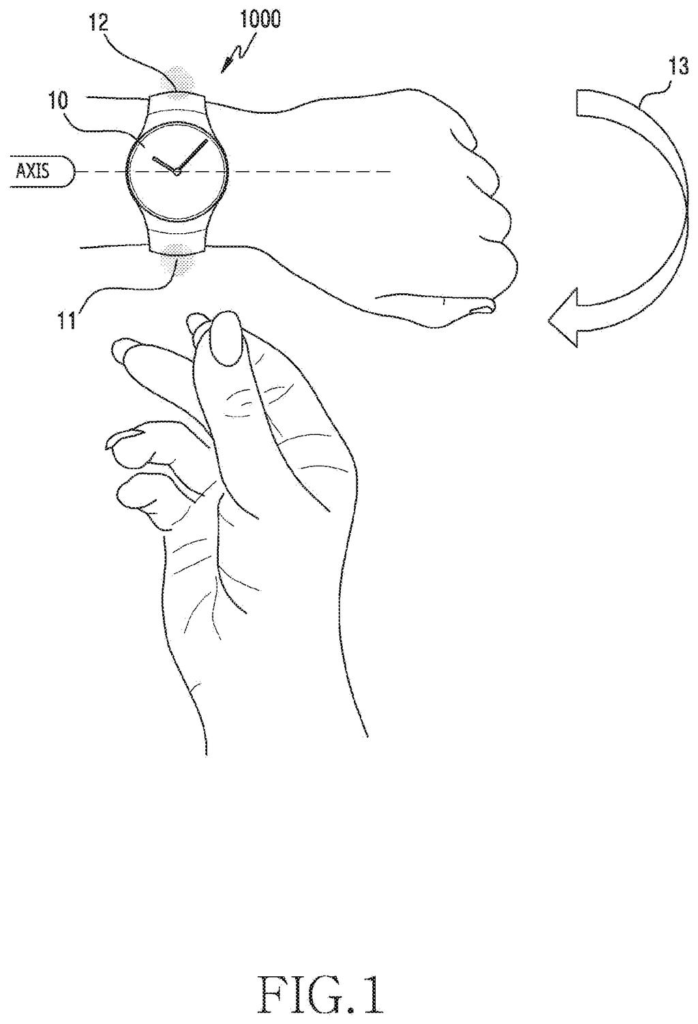
What Samsung's touch-and-twist watch band does
Every time you glance at your smartwatch, you get the same small circle of information. To see more, you tap and swipe a tiny screen with a fingertip that blocks half of it.
Samsung's patent application treats the watch band as part of the display. Put two fingers on the band, one above the screen and one below, and slide them. If your wrist stays still, extra details pop up on the band, such as hourly weather beside a weather screen or the full schedule for a date you picked on a calendar. Lift your fingers and the extras vanish.
Twist your wrist while you hold the touches, and the watch does something different. It can turn the screen's contents or slide them onto the band, and the change stays after you let go. In one example, a text message that just arrived gets pinned to the band this way.
… receiving a first user input on a sub-display area corresponding to a band portion of the wearable electronic device, the first user input comprising a multi-touch …
Translation: The watch detects when you touch the strap with more than one finger at the same time.
How the watch tells a finger slide from a twist
The watch has a main display in the middle and a sub-display on the band, which the filing describes as a flexible screen. The main display shows a first GUI (graphical user interface, meaning whatever screen is up, like a watch face or a weather app).
You touch the band with two fingers at once, one on each side of the main display, then slide one or both. Meanwhile the watch's motion sensors report whether the whole watch is rotating around your forearm. The watch compares the direction and amount of rotation with the direction and distance your fingers moved. That tells it whether your fingers slid, or your wrist twisted under fingers that stayed put.
- No rotation: a second GUI, preset for that app, appears on the band. The preset depends on where the touches started, which way they moved and how far. Let go and it disappears.
- Rotation: the first GUI changes, either turning inside the main display or moving onto the band. Let go and the change stays.
The filing gives plenty of examples. A dual-clock watch face gets weather under each time. A calendar shows details for a chosen date. A map could list nearby gas stations or parking, and a screen for a connected TV could show remote-control info. A cycling app's stats rotate as you twist, and an incoming message gets pinned to the band.
… determining whether the wearable electronic device is rotated while the second user input is being received …
Translation: The watch checks if you are twisting your wrist while sliding your fingers on the strap.
Why a second screen on your strap could matter
If you wear a smartwatch, you know the trade: the screen is small, your finger blocks it, and menus run deep. This patent describes a way to get extra information with one two-finger slide on the band, with no digging through apps. Because the touches land on the strap, your fingers stay off the main screen, and letting go puts everything back, so it works as a quick peek.
The catch is hardware. Everything depends on a band that is itself a touch display, which the filing describes as a flexible screen. This is a patent application describing an idea, and it does not say any Samsung watch will ship with it.
Samsung's 119th filing we've tracked since May in our Samsung display technology watchlist follows one on video wall markers and one mixing flat and 3D images.
Small watch screens are a real annoyance: your finger covers a big share of a display about the size of a large coin, and each extra detail costs another swipe through menus. Samsung's answer borrows space the watch already has, the strap.
That is a sensible size of fix for a modest problem. It does depend on a band that is also a display, which is a big hardware ask. Nobody replaces a watch over weather forecasts, so the idea pays off only if a screen band is already on the wrist for other reasons.
The twist-versus-slide trick is the clever part. Telling a deliberate finger slide from a drag caused by turning your wrist is a small problem, and the patent handles it by comparing two sensor readings. Whether people will remember a two-finger-plus-twist gesture is the open question, since hidden gestures often go unused.
Get our take in your Top Stories
Liked this breakdown? Add Patentlyze as a preferred source on Google, and our plain-English take shows up more often in your Top Stories the next time Samsung patent news breaks.
There are more where this came from
We read every patent application Big Tech publishes and send you the ones worth knowing. Plain English, free, every week.
The drawings
24 drawing sheets from US 2026/0319654 A1 · click any drawing to enlarge


Show the other 16 sheets


Want this weekly breakdown for a company we don't cover? Patentlyze Pro →
Be the first to weigh in