
Tesla Files Patent for Car Doors Where the Outer Metal Skin Is the Crash Protection
In most cars, the door skin you see is thin and the real crash protection hides inside. Tesla's patent application flips that, making the outer panel itself the protection.
What Tesla's one-sheet car door actually does
Imagine closing your car door and knowing that the outer skin is doing the heavy lifting in a side crash. No hidden steel bar inside, just one sheet of metal built to take the hit.
In most cars today, a door is a sandwich. There is an outer panel you see, an inner panel, several welded reinforcements, and a thick steel bar tucked inside to protect you from a side impact. Tesla's patent application proposes throwing out most of that layering. The outer panel, cut and shaped from a single sheet of steel or aluminum, becomes the crash protection itself.
The window motor, hinges and latches would bolt straight onto that panel, too. The filing says fewer parts means lower cost and a smaller factory footprint, and the idea could stretch to roofs, hoods, fenders and trunk lids.
… an exterior door panel comprising a monolithic metal sheet having a continuous uninterrupted exterior, the exterior door panel forming a structural part of an exoskeleton of the vehicle and being fixedly and directly coupled to the exterior portion of the vehicle frame through a hinge; …
Translation: The outside of the door is one solid piece of metal that acts as the vehicle's outer shell and connects directly to the frame.
How the window load travels to the car frame
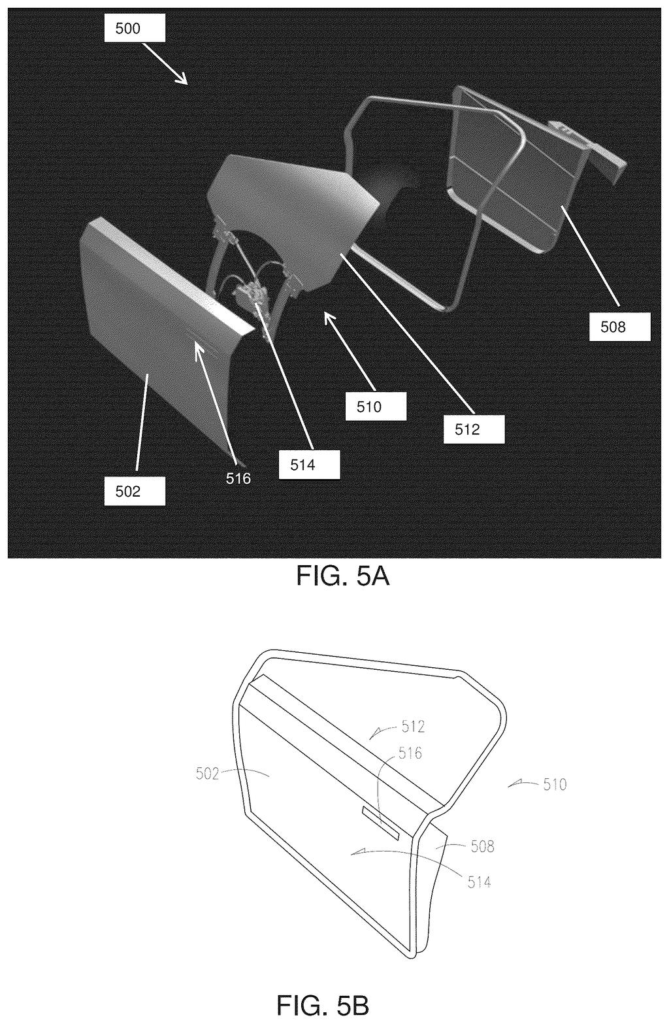
The patent application describes a vehicle whose outer body panels are part of its structure, an approach the filing calls an exoskeleton. The main example is a door. The outer door panel is a monolithic metal sheet (one unbroken piece of metal with a smooth, continuous outside) that attaches to the car's frame through a hinge.
Everything else mounts to that panel. The electric window assembly (the glass and its motor) is attached directly to it, and the claims say the panel is the main support for the window. They also describe a structural load path, meaning the route forces take: from the window, through the door panel, through the hinge, and into the frame.
Other details from the filing:
- The panel can be steel (cold-rolled in some versions) or aluminum, and some versions skip paint.
- It can replace the anti-intrusion bar (the thick steel beam inside a conventional door) and the inner reinforcement panels.
- Near the B-pillar (the post between the front and rear doors), only one interior support is needed instead of two.
The manufacturing method cuts a metal sheet, by laser in some versions, shapes it into the panel, then attaches the window assembly and hinges. The same idea could apply to roof, hood, fender and trunk panels.
A vehicle having an exoskeleton exterior panel that provides crash resistance is described. The exterior panel may be formed from a monolithic metal sheet and attached to an exterior portion of the vehicle frame, and the exterior panel does not comprise an additional support structure.
Translation: The outer metal panel protects against crashes without needing a traditional hidden support frame underneath.
What a bar-free door could mean for your car
If the idea works, the practical payoff is a simpler door. Fewer layers means fewer parts to make, weld and service, and the filing says the approach could shrink manufacturing footprint and costs. You might see that as a lower price or fewer things to go wrong inside the door, though the filing promises neither.
The filing's pictured example is an all-electric pickup truck, and the same panel-as-structure idea could reach roofs, hoods and fenders. Keep in mind this is a patent application, not a product, and it reports no crash test data to show how the panel performs.
Tesla's 51st filing in our Tesla coverage since May adds to a run of sensing and loading ideas, including the self-tilting truck and the road-reading camera.
You would probably never notice this one while driving. A door built this way looks and feels like any other door, so the benefit shows up elsewhere: in the sticker price, if savings on parts and factory time get passed along, and in fewer pieces inside the door that can rattle or wear out.
The filing includes no crash test results, so the safety side is a promise and the proof is still missing. It does say the outer panel can match or beat the protection of a conventional hidden bar in some versions. That is a bold line to put on paper, and a crash lab is where it gets settled.
The open question for owners is repair. If the outer skin carries the structure, a bad dent could mean more than a cosmetic fix, and the filing does not say how that would work.
Get our take in your Top Stories
Liked this breakdown? Add Patentlyze as a preferred source on Google, and our plain-English take shows up more often in your Top Stories the next time Tesla patent news breaks.
There are more where this came from
We read every patent application Big Tech publishes and send you the ones worth knowing. Plain English, free, every week.
The drawings
4 drawing sheets from US 2026/0326520 A1 · click any drawing to enlarge


Want this weekly breakdown for a company we don't cover? Patentlyze Pro →
Be the first to weigh in