
Nvidia Patents a System That Catches Self-Driving Cars Acting Erratically Before a Crash
Self-driving cars can make mistakes, and sometimes those mistakes snowball fast. Nvidia has patented a way to detect when a vehicle's own AI is going off the rails and intervene before anything goes wrong.
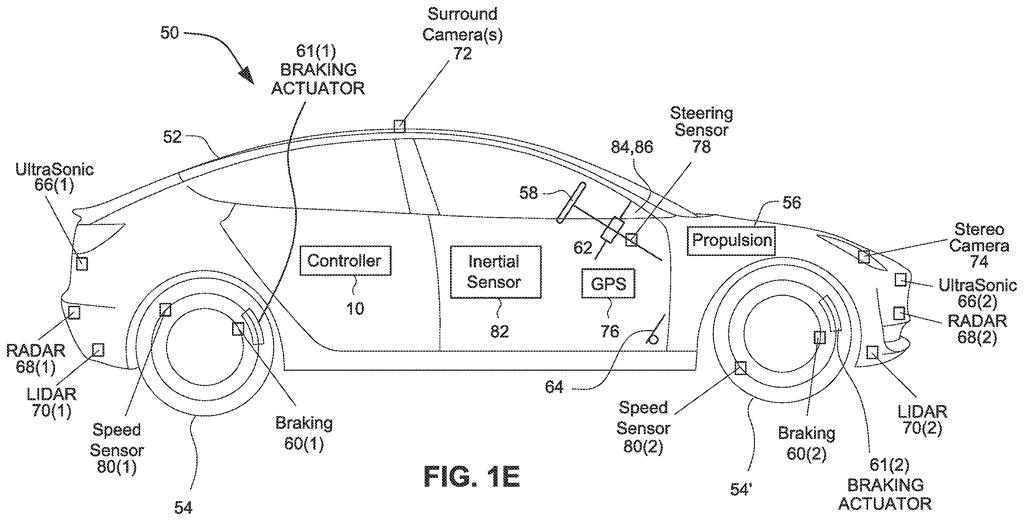
What Nvidia's self-driving safety check actually does
What happens when a self-driving car starts making bad decisions? Not a single dramatic failure, but a gradual slide into erratic behavior that no one notices until something goes wrong?
Nvidia's patent describes a system where multiple AI "pipelines" run in parallel inside the vehicle, each one analyzing the same sensor data and producing its own plan for what the car should do next. A separate component, called an arbitration layer, watches those outputs and picks the best one. If one pipeline starts suggesting strange or dangerous maneuvers, the other pipelines and the arbitration layer can catch it and override it.
Think of it like having two co-pilots who can veto each other if one suddenly starts acting oddly. The car doesn't just trust a single AI brain; it cross-checks itself in real time. Nvidia's track record in autonomous vehicle patents shows this kind of redundancy thinking running through a lot of their work in this space.
… an arbitration component that arbitrates between outputs of two or more processing pipelines that individually process sensor data obtained using one or more sensors of the plurality of sensors.
Translation: A built-in judge compares different streams of sensor data to pick the best driving decision.
How the arbitration system picks between competing driving plans
The patent describes an autonomous or semi-autonomous machine (a car, robot, or similar vehicle) that runs several separate sensor-processing pipelines at the same time.
- Multiple pipelines: Each pipeline takes data from the car's cameras, radar, and other sensors and independently decides what the vehicle should do next. They're running simultaneously, not sequentially.
- Arbitration component: A dedicated module watches all the pipeline outputs and selects which plan the car actually follows. If one pipeline's suggestion looks anomalous compared to the others, it can be deprioritized or ignored.
- Machine learning detection: The system uses ML models to recognize patterns that signal erratic behavior, things like unnecessarily sharp steering, sudden braking, or other outputs that don't match the road conditions the sensors are describing.
The core idea is that a single AI system can fail silently. Its sensors might be fine, its outputs might look plausible, but the driving decisions it produces can still be dangerous due to bad training data, model drift, or edge-case conditions it was never prepared for. By running multiple independent pipelines and having an arbitration layer compare them, the system creates a form of internal cross-checking (similar to how aircraft use triple-redundant computers) that can catch one system going wrong before it causes harm.
The arbitration component doesn't just pick the most popular answer; it's designed to assess which plan is safest, and it can escalate to a remedial action, such as slowing down or pulling over, if no pipeline produces a trustworthy plan.
… detect when the autonomous driving system is in this state e.g., erratic or reckless driving and other behavior, in order to take remedial action to prevent a hazard such as a collision.
Translation: The software spots when self-driving vehicles start driving recklessly and steps in to stop crashes.
What this means for trust in self-driving vehicles
Self-driving car failures are rarely the result of a single, obvious sensor breakdown. More often they happen when a system encounters a situation it wasn't trained for and responds in a way that seems reasonable to the AI but is actually dangerous. That kind of silent, incremental failure is exactly what's hardest to catch, and what this patent is aimed at.
For you as a passenger or someone sharing a road with these vehicles, a system that can detect when its own AI is misbehaving and step in is a meaningful safety layer. It also matters for regulators and fleet operators who need some assurance that autonomous vehicles have internal checks, not just reliance on a single model that might be wrong.
Nvidia's 73rd filing we've tracked since May in the self-driving sensing race adds to a run that includes one reshaping views around objects and reading depth from one image.
The problem this patent attacks is one of the most serious in autonomous vehicles: not catastrophic sensor failure, but the quiet, hard-to-detect degradation in decision-making that a car's own systems can't see because they're the ones failing. That's a real and costly risk, and the industry doesn't have a clean answer for it yet.
The parallel-pipeline approach is a sensible engineering response. Redundancy through independent computation is how aviation and aerospace have handled life-critical systems for decades. Applying that logic to AI-driven vehicles, where the failure modes are probabilistic rather than mechanical, is a reasonable adaptation.
What's less clear is how well the arbitration layer itself can be trusted, especially if all the pipelines are trained on similar data and share the same blind spots. The patent's strength is in framing the problem correctly; whether this specific mechanism fully solves it is a harder question.
There are more where this came from
We read every patent application Big Tech publishes and send you the ones worth knowing. Plain English, free, every week.
The drawings
13 drawing sheets from US 2026/0285370 A1 · click any drawing to enlarge


Want this weekly breakdown for a company we don't cover? Patentlyze Pro →
Be the first to weigh in