
Meta Files Patent for a Tiny Vibrating Mirror That Takes Less Strain in AR Glasses
The picture in AR glasses can depend on a tiny mirror that shakes tens of thousands of times a second. Meta has redesigned how that mirror is held so it strains less.
What Meta's direct-drive display mirror does
Many laser-based displays paint an image by bouncing light off a tiny mirror that shakes back and forth tens of thousands of times a second. The trouble is that stress piles up where the mirror meets the little arms and linkages that move it. Over time, that strain can hurt image quality or wear the part out.
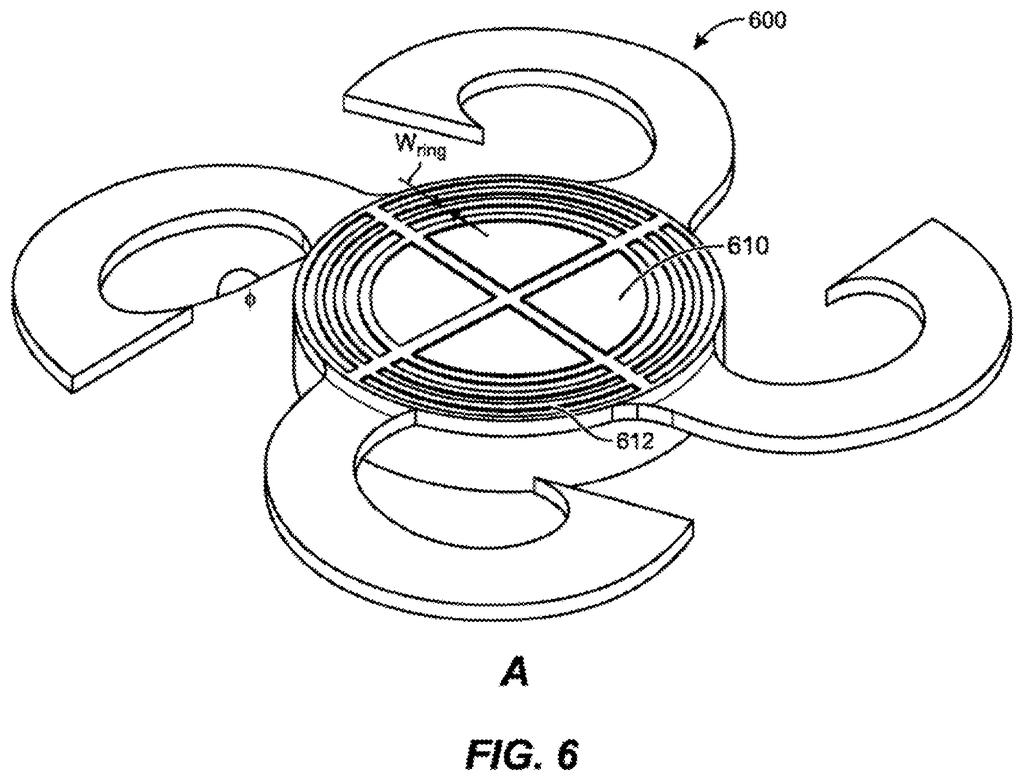
Meta's patent application removes those in-between pieces. Curved arms attach directly to the mirror body, so there is no joint where the stress gathers. The mirror is also lightened: holes pass all the way through it (and some versions add ribs on the back). That keeps it stiff enough not to distort while weighing less.
For you, the hoped-for result is a sharp, wide picture from a display small enough to fit in glasses, built around a part that lasts. The filing says that tuning the shape of the curved arms could cut peak stress by a factor of two or more compared with a baseline design.
… a stiffening structure integrated into the mirror body and comprising an aperture extending entirely through the mirror body; and a plurality of curved cantilevers extending directly from the mirror body.
Translation: The tiny mirror uses a hollowed out frame and curved arms to hold it in place.
How the curved arms and holes cut stress
Claim 1 covers an optical display built from scanning micromirrors (tiny chip-made mirrors that tilt rapidly to steer a beam of light). Each mirror has a body with a reflective face and a stiffening structure that includes at least one hole running all the way through. It also has several curved cantilevers (thin arms fixed at one end that bend) attached directly to the mirror body.
In the filing's examples, each arm is a thin stack: a bottom electrode, a layer of piezoelectric material (a crystal that bends when voltage is applied), and a top electrode. Pairs of arms are driven at the same frequency but 180 degrees out of phase, so the mirror rocks along two axes. Examples run at 20 kHz or higher (20,000 cycles a second), and the simulations use 30 kHz.
The filing describes several ways the design cuts stress and improves the image:
- The arms leave the mirror at roughly right angles with no linkage, so the stress hot spot where a joint would sit disappears.
- Tuning how far each arm curves around the mirror can cut peak stress by a factor of two or more. One set of simulations found a minimum near 180 degrees.
- Holes, or ribs and pillars on the back, make the mirror lighter without making it flimsy.
- Making one pair of arms 5 to 25 degrees longer than the other, or making the mirror slightly oval, keeps the two motion speeds close to, but not exactly, 1:1. The filing says this reduces image artifacts.
The shape of the cantilevers and the geometry of the interface between the cantilevers and the mirror body are configured to decrease peak stresses within the micromirror during operation …
Translation: The flexible arms are carefully shaped to reduce wear and tear when the mirror moves.
What this means for Meta's AR glasses displays
If you want AR glasses with a sharp, wide picture, the mirror in the display has to be large, fast and stiff. Those traits push stress into the parts holding it. The filing says that strain can hurt performance or even cause early failure, and the usual fix is a smaller mirror, which costs resolution. This design tries to keep the larger mirror and cut the strain instead.
The patent lists AR and VR devices and heads-up displays as uses, and claim 16 names augmented reality glasses. It is a component-level filing, so you would never see it directly. You would only notice a picture that holds up over time. A filing like this describes a design, not a product, and it says nothing about when or whether such a mirror would ship.
Meta's 81st filing we've tracked since May joins earlier applications like a wrist-rolling cursor band and mic shutoff in restricted areas in our Meta smart glasses watchlist.
Claim 1 is wider than the engineering detail around it suggests. It asks for an optical display with several scanning micromirrors, where at least one has a mirror body, a stiffening structure with a hole straight through, and curved arms attached directly to the body.
It does not mention piezoelectric materials, the number of arms, the vibration speed or the oval shape. Those show up in later claims. If granted as written, it would cover any display that combines the through-hole and the direct curved arms, whatever drives them. A mirror hung from straight beams, joined through a linkage, or with no holes in its body falls outside that wording.
Both features must appear together, and both are fairly specific. That makes this a focused claim about one mirror recipe. Meta also wrote a separate claim for glasses, so it clearly sees headsets as the natural home for it.
Get our take in your Top Stories
Liked this breakdown? Add Patentlyze as a preferred source on Google, and our plain-English take shows up more often in your Top Stories the next time Meta patent news breaks.
There are more where this came from
We read every patent application Big Tech publishes and send you the ones worth knowing. Plain English, free, every week.
The drawings
13 drawing sheets from US 2026/0327060 A1 · click any drawing to enlarge


Show the other 5 sheets


Want this weekly breakdown for a company we don't cover? Patentlyze Pro →
Be the first to weigh in