
Nvidia Files Patent to Clean Up Only the Pixels Your Car's Camera View Shows
Nvidia has filed a patent application for a car camera view that first works out which pixels you will actually see on screen, then fixes the picture for only those.
What Nvidia's surround view patent does
Imagine you're backing into a tight parking spot while your dashboard screen shows a bird's-eye view of your car. The picture is stitched together from four wide-angle cameras, and it can look grainy, with odd colors and ghostly smears where something moves.
Nvidia's patent application changes the order of the work. Many existing systems clean up each camera's full image first, then pick the part you'll see. Nvidia flips that: it first works out which pixels will show up on your screen, then cleans up only those.
The thinking is simple. If one side of a camera's picture is bright and the other is dark, a fix tuned to the whole image can make the dark part you're looking at worse. Tuning for just what's on screen should give a clearer view, with less computing wasted on pixels nobody sees.
generate at least one frame representing a reverse projection view of an environment surrounding an ego-machine based at least on reverse projecting from a two-dimensional ( 2 D) viewport to one or more frames of a plurality of frames of image data that represent at least partially overlapping views of the environment; …
Translation: The system stitches together overlapping camera feeds to build a unified view around the vehicle.
How Nvidia's reverse projection picks pixels
The system takes overlapping frames from cameras on a vehicle, for example four fisheye (extra-wide-angle) cameras at the front, left, rear and right. It models the surroundings as a 3D bowl. For each pixel in the 2D viewport (the virtual camera angle the driver picked), it traces a line back to the bowl and then to the matching camera pixel. That is the reverse projection: working backward from the screen to the camera images.
Image quality steps then run on that result. These include temporal noise reduction (averaging several frames to remove grain), color adjustment, tone mapping (balancing brightness and contrast), super resolution and anti-aliasing (smoothing jagged edges). Pixels outside the viewport are skipped.
The filing adds local tuning:
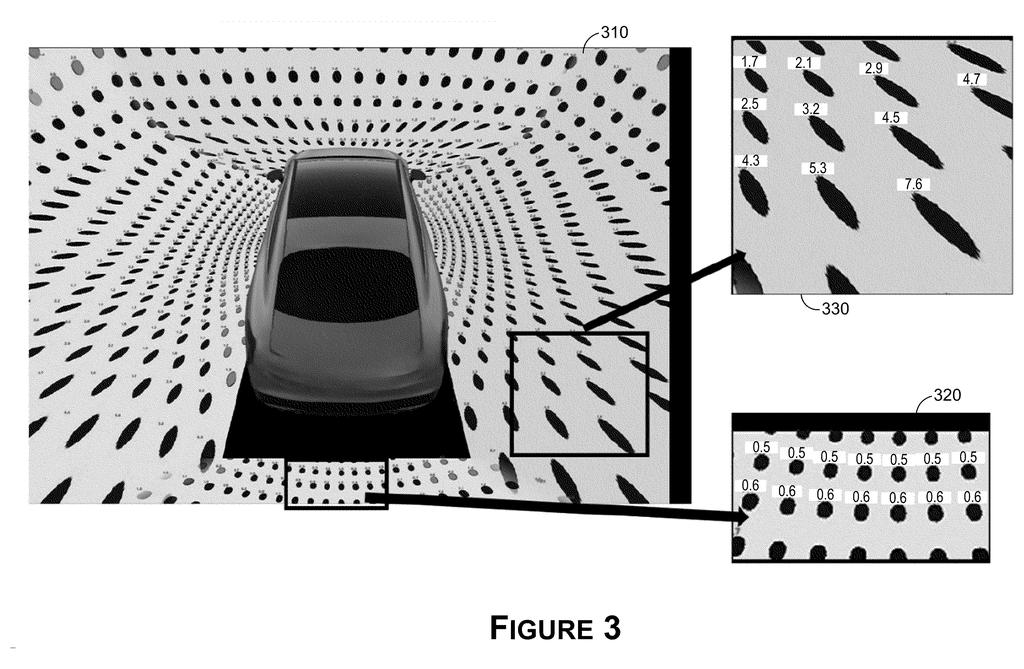
- A magnification map measures how much each region is stretched or shrunk, using a dot-pattern test image or by counting how many camera pixels feed each screen pixel.
- Stretched regions, usually far from the car, get stronger noise reduction and super resolution. Shrunk regions get downsampling and anti-aliasing, and can save work by projecting every other pixel and filling the gaps.
- Where two cameras overlap, noise reduction is adjusted to cut ghosting. If one camera supplies the whole view, color matching across cameras can be switched off.
Image quality processing may be performed on the pixels that are visible in the reverse projection view (e.g., instead of on the original image data).
Translation: The car cleans up only the pixels actually shown on screen to save processing power.
Why sharper parking views matter for drivers
If you drive a car with a bird's-eye parking view, you know the picture can be grainy at night and smeary where two cameras overlap. Nvidia's filing targets those flaws: it tunes the cleanup to what is on your screen, so a bright patch of sky or a dark wall outside your view stops skewing the colors. The filing also says skipping unseen pixels cuts the delay before the picture appears, which matters when you're creeping toward a curb.
Beyond cars, the claims list robots, remote operators who steer machines from a screen, and simulated vehicles used for testing. Nvidia sells chips and software for all of those, so a better way to prepare camera images fits its business. It is a filing, not a product, and the text names no car maker.
Nvidia's 97th filing we've tracked since May in our self-driving sensing race watch adds to a run that includes one on unlabeled object training and one on cameras in dim rain.
Claim 1 is short and wide. It covers a chip that builds a view by tracing each screen pixel back to the camera images, then runs image cleanup on the result. It never mentions noise removal, the 3D bowl or the dot-pattern map. Those details appear only in later claims.
As written, the claim reaches beyond cars to any machine carrying the cameras, which the filing says includes robots. Claim 16 even applies the same idea to a simulated car inside a simulation. If granted, claim 1 would cover a great deal of ground.
The specific tricks, like adjusting cleanup by how stretched each region is, live in the narrower claims. Claim 1 stakes out the basic order of operations: build the view first, clean it up second.
Get our take in your Top Stories
Liked this breakdown? Add Patentlyze as a preferred source on Google, and our plain-English take shows up more often in your Top Stories the next time Nvidia patent news breaks.
There are more where this came from
We read every patent application Big Tech publishes and send you the ones worth knowing. Plain English, free, every week.
The drawings
14 drawing sheets from US 2026/0330615 A1 · click any drawing to enlarge


Show the other 6 sheets


Want this weekly breakdown for a company we don't cover? Patentlyze Pro →
Be the first to weigh in