
Nvidia Patents a Camera View System That Switches 3D Modes While You Park
Your car's around-view camera already stitches together a bird's-eye picture of the ground. Nvidia is filing patents on a system that makes that picture dramatically more accurate by swapping between two entirely different ways of building that 3D scene depending on what your car is doing.
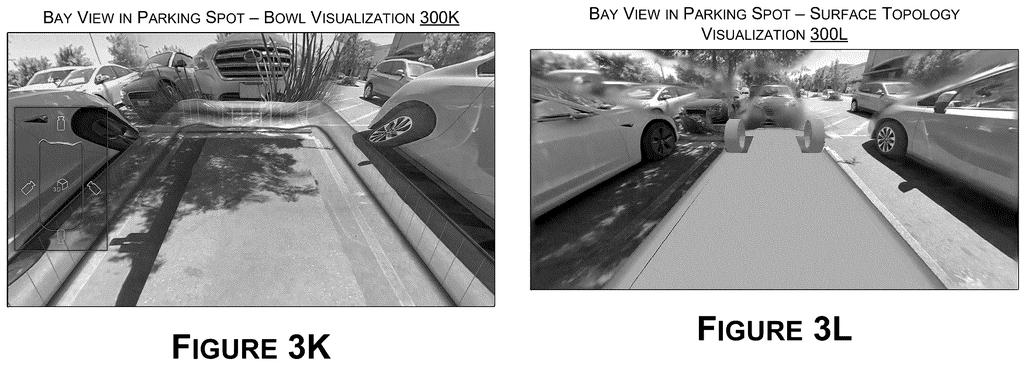
What Nvidia's switchable 3D surround view actually does
You're inching into a tight parking spot, watching the overhead camera view on your dashboard screen. The image looks fine on flat pavement, but the moment you pull up next to a curb, a speed bump, or a low wall, the picture goes flat and weirdly distorted. That's a real limitation in how most surround-view systems work today.
Nvidia's patent describes a pipeline that doesn't commit to one way of building that 3D picture. Instead, it watches what your vehicle is doing and switches between two different methods. One method, called a "bowl" model, treats the ground around the car as a simple curved dish shape. That's fast and cheap to calculate. The other method actually reads the real shape of the ground and nearby objects using sensor data, producing a more accurate picture when geometry gets complicated.
The system decides which method to use based on factors like how fast you're moving, how close you are to a detected object, and how good the resulting image is expected to look. The goal is a view that's accurate when it counts, without wasting computing power when it doesn't.
… switch, based at least on a state of the ego-machine, from generating a first visualization of the environment using a three-dimensional (3D) bowl model of the environment to generating a second visualization of the environment that uses a 3D surface topology model of the environment …
Translation: The system changes the 3D parking view depending on what the vehicle is currently doing.
How the system picks between a bowl model and a surface scan
The patent describes what Nvidia calls an environment visualization pipeline: a software layer that processes camera and sensor data from a vehicle (or robot) and decides how to construct a 3D view of the space around it.
At the core is a choice between two modeling strategies:
- 3D bowl model: The area around the vehicle is approximated as a curved bowl shape. Think of placing a salad bowl upside down around a toy car. It's a rough approximation, but it's computationally light and works well enough on flat, open ground.
- 3D surface topology model: The system uses sensor data to detect the actual shape of the ground and nearby objects, building a more geometrically accurate scene. This is more expensive to compute but far more faithful to reality when obstacles, curbs, or uneven surfaces are nearby.
The switch between the two modes is triggered by ego-machine state (meaning the vehicle's own status, such as its speed, what the cameras are detecting nearby, and the predicted quality of the resulting image). If you're cruising at highway speed with nothing around, the bowl is probably fine. If you're crawling next to a concrete barrier, the system flips to the topology model.
The patent covers this logic as applied to vehicles, robots, and other self-moving machines, and names parking systems and surround-view systems as the primary use cases.
… an environment around an ego-machine, such as a vehicle, robot, and/or other type of object, may be visualized in systems such as parking visualization systems, Surround View Systems, and/or others …
Translation: This technology creates camera views for parking assistants used in cars and robots.
What this means for parking cameras and driver-assist displays
Anyone who has used a parking camera knows the overhead view gets strange when real-world surfaces don't match what the software expects. A curb looks like it's floating. A ramp seems to fold incorrectly. Those glitches aren't cosmetic problems; they can make it genuinely hard to judge distances and can erode trust in driver-assist systems at exactly the moment when accuracy is most important.
the pattern in Nvidia's automotive-perception filings This patent addresses that by making the rendering method adaptive rather than fixed. For consumers, the practical effect would be a surround-view display that holds up better in messy real-world conditions. For automakers and robotics developers using Nvidia hardware, it represents a framework for tuning the tradeoff between image quality and processing cost on the fly.
Nvidia's 74th filing we've tracked in self-driving sensing since May adds to a body of work that includes one catching erratic driving and one reshaping camera views.
Anyone who has parallel parked using a car's overhead camera has seen the image do something unsettling near a curb or a wall, with objects warping or appearing at the wrong distance. That happens because the camera system is making a simplifying assumption about the ground being smooth, which is usually fine but breaks down exactly when you need the picture to be accurate.
What Nvidia is patenting is the ability to catch that moment of failure and automatically switch to a more honest rendering of what surrounds the car. The overhead view you lean on in slow, tight situations would show you what is actually there instead of a plausible but wrong approximation.
How quickly this reaches drivers depends on automakers integrating it into their products, but the frustration it addresses is one people already feel and notice today, which means the benefit is concrete rather than speculative.
There are more where this came from
We read every patent application Big Tech publishes and send you the ones worth knowing. Plain English, free, every week.
The drawings
15 drawing sheets from US 2026/0285348 A1 · click any drawing to enlarge


Want this weekly breakdown for a company we don't cover? Patentlyze Pro →
Be the first to weigh in