
Qualcomm Files Patent to Help Cameras Spot Corners and Edges More Precisely
Before software can match two photos, it has to pick landmarks, and the standard method tends to drop them just beside corners instead of on them. Qualcomm's application swaps in an edge-respecting blur to fix that.
What Qualcomm's edge-keeping blur actually does
You're holding two photos of the same building, shot from different spots, and your eyes instantly line up the corners of the windows. A computer has to do that the hard way: it first picks out spots in each picture, such as edges and corners, that it can find again in the other one.
The usual method blurs a photo by two different amounts and subtracts one from the other, which leaves behind the places where brightness changes. The side effect is that blurring washes out contrast, and the spots it picks tend to land near a corner instead of on it. Qualcomm's patent application swaps one of those blurs for an edge-respecting blur that smooths flat areas but leaves sharp boundaries alone.
In the filing's examples, that puts the marked spots right along the edges and corners of a checkerboard, where the old method scattered them nearby.
apply a Gaussian filter to an input image to generate at least a first filtered image; apply an inverse bilateral filter to the input image to generate at least a second filtered image; …
Translation: The system processes a photo using two different digital filters to prepare it for edge detection.
How two blurs get subtracted to find corners
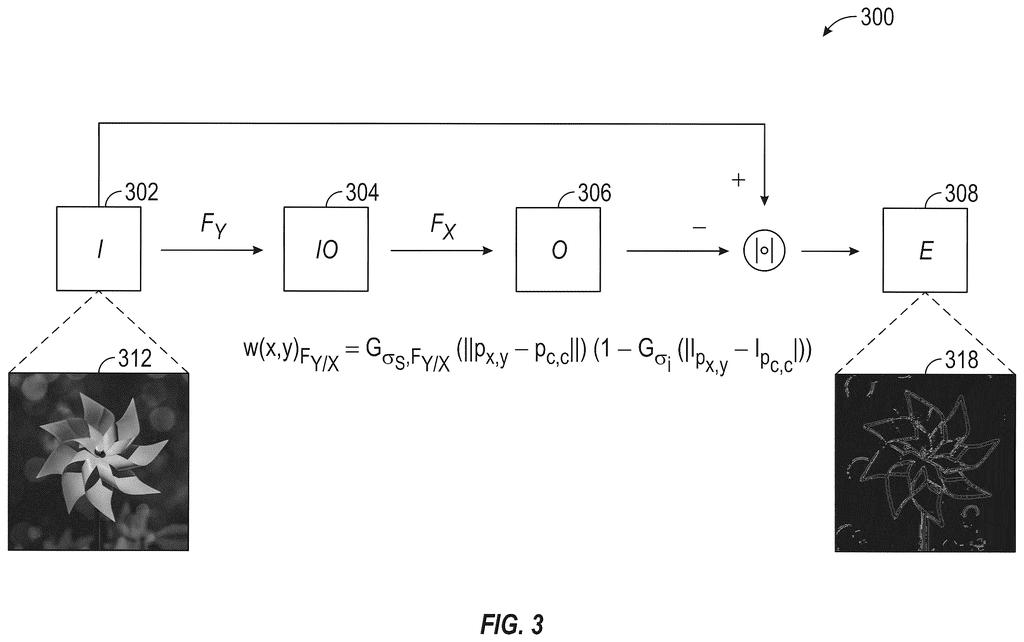
The claims cover a short recipe. Take an input photo and make two blurred copies of it. The first uses a Gaussian filter (a standard blur that mixes each pixel's brightness evenly with its neighbors). The second uses an inverse bilateral filter. Subtract one copy from the other to get an output image, which the claims say can be an edge map (a picture that highlights where brightness changes sharply), then pick the points of interest from it.
Here is why the second filter matters. An ordinary bilateral filter lets a neighboring pixel influence another only if it is both close by and similar in brightness, so flat areas get smoothed while edges survive. The inverse version flips the brightness-similarity part of that weighting. The filing describes the result as a blurred copy that still preserves edges.
The filing repeats this at several blur strengths (called scales) and stacks the results into a layered pyramid it calls a difference of inverse bilaterals. Layers can alternate between the two filters, or the bottom layers can use only Gaussian blurs, which helps catch points inside blobs as well as on corners and edges.
Bilateral filters are expensive, because every pixel needs weights for every neighbor. The dependent claims describe a cheaper two-pass version that filters vertically, then horizontally, with the second pass using weights from the original image to avoid over-blurring. The description points to 8K frames and high frame-rate video, and says the cheaper version could cut power use.
… generating a first output image based on a subtraction of the second filtered image from the first filtered image; and identifying one or more points of interest in the input image based on at least the first output image.
Translation: It subtracts the filtered images from each other to pinpoint exact corners and edges in the picture.
Why sharper landmarks matter for photo matching
When software lines up your photos, recognizes an object, or rebuilds a 3D scene from pictures taken at different spots, it starts by finding reliable landmarks in each image. The filing lists image matching, object recognition and 3D reconstruction as uses for these points. Landmarks that sit exactly on corners and edges could mean fewer slips in every step that follows.
The speed angle matters too. The filing says full bilateral filters are too costly for very large frames and fast video, and describes a two-pass version that trims computing and power use. It mentions running on mobile and edge devices. No product is named, so treat this as a building block for image software that you would rarely notice directly.
Qualcomm's 538th filing in our Qualcomm coverage since May adds to a run of 3D video work that includes shrinking 3D video before sending and faster photo-to-3D conversion.
The problem here is real but narrow. Programs that match photos, recognize objects or rebuild 3D scenes all begin by picking landmarks, and landmarks that sit a little off the true corner make every later step a little less exact. Across billions of photos and video frames, those small errors add up.
The fix is sized to match: one filter swapped for another in a recipe engineers have used for years. The filing shows two example images, a set of blobs and a checkerboard, and gives no accuracy numbers, so how much better it performs on messy real-world photos is unknown.
Expect this to end up inside chip and camera software where nobody sees it. That is a fair home for a sensible tweak with modest ambitions.
Get our take in your Top Stories
Liked this breakdown? Add Patentlyze as a preferred source on Google, and our plain-English take shows up more often in your Top Stories the next time Qualcomm patent news breaks.
There are more where this came from
We read every patent application Big Tech publishes and send you the ones worth knowing. Plain English, free, every week.
The drawings
9 drawing sheets from US 2026/0330601 A1 · click any drawing to enlarge


Show the other 1 sheets

Want this weekly breakdown for a company we don't cover? Patentlyze Pro →
Be the first to weigh in