
Qualcomm Files Patent to Help Headsets and Phones Run Many Camera AI Tasks at Once
When your headset watches the world through a camera, a dozen AI jobs may want the same frame at the same moment. Qualcomm's filing describes a way to park one summary of that frame in fast memory and let each job borrow it in turn.
What Qualcomm's shared-memory AI setup does
Right now, a phone or headset that watches a camera feed often has several AI jobs wanting the same frame at once: one spots objects, one reads your hand gestures, one tracks motion. Those jobs don't all need to run at the same speed, and the filing says forcing them onto one schedule either causes delays or wastes computing effort.
Qualcomm's answer is to split the chip's fastest memory into sections. One section holds a compact summary of the current video frame. Another section works like a loading bay: each AI job is swapped in, does its work by reading that summary, and then gets swapped out.
The summary stays put the whole time, so your overlays and gesture controls don't have to wait on repeated slow trips to the device's main memory.
… acquire, based on the representation output obtained in the first memory partition, a second memory partition of the plurality of memory partitions for a first decoding model of the two or more decoding models; load the acquired second memory partition with the first decoding model; and execute the loaded first decoding model …
Translation: The system grabs a fresh slice of memory for an AI task based on previous output and runs it.
How Qualcomm's memory slices pass work along
The setup has two stages. An encoding model (the AI step that turns a raw camera frame into a compact set of features) produces what the filing calls a representation output. Several decoding models (smaller AI steps, each built for one job such as object detection, gesture recognition, gaze tracking or pose estimation) then read that output to do their specific tasks.
The chip's fast on-chip memory, called execution memory, is divided into partitions. The representation output goes into the first partition. A second partition is then claimed and loaded with one decoding model from main memory. Instead of copying the data, the chip hands the model the first partition's identifier, which works like a pointer (a note saying where the data sits). When the model finishes, the second partition is freed and the next model is loaded, while the first partition stays until every needed model has run.
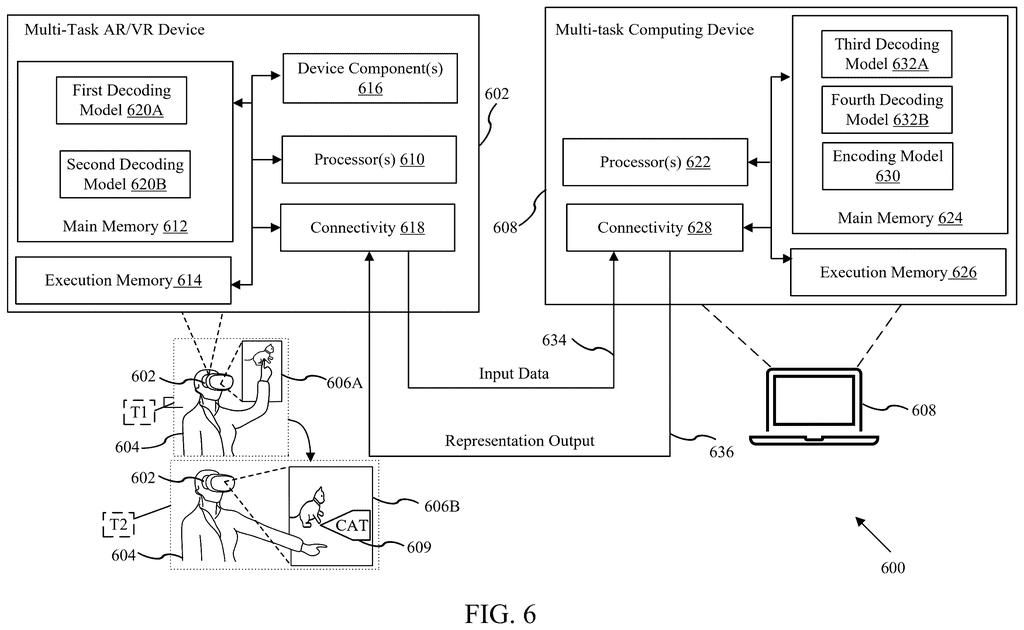
The models run at different rates. In the filing's example, video runs at 30 frames per second: object detection handles every frame, motion estimation every second frame, and action recognition every third. Frame 0 triggers all three, while frame 1 triggers only object detection. That lets the encoder run at the fastest rate. With a third partition, two models can run side by side, and the chip tracks each partition as unclaimed, claimed or decoding. The filing also covers splitting the work between a headset and a laptop or console.
A representation output is obtained in a first memory partition of a plurality of memory partitions of an execution memory of a device. Based on the representation output obtained in the first memory partition, a second memory partition of the plurality of memory partitions is acquired for a first decoding model …
Translation: The device uses data from one memory section to set up and run a specific AI model in another section.
What this means for AR glasses and phones
The practical payoff is for devices that do many things with a camera at once, like AR glasses or a phone. In the filing's example, a headset wearer points at an object, one model finds the hand, another recognizes the gesture, and a label appears over what was pointed at. Less back-and-forth with main memory means less waiting between your gesture and the response.
The filing also says new AI models could be added through over-the-air updates without disturbing the ones already running. That could let a device pick up new camera features later. For Qualcomm, this is plumbing that sits beneath whatever features device makers build, and the filing lists phones, tablets, smart TVs and headsets as possible homes for it.
Qualcomm's 61st filing we've tracked in the AI chip race since July adds to a run that includes one on camera AI math and one on pre-arranging AI data.
If this works as described, you would notice it as a headset overlay that keeps up with your hand. The failure it prevents is lag: several AI jobs queuing for the same data while the scene you are looking at has already moved on.
Most people will never see the memory shuffling itself. What they feel is whether a label lands where they pointed, and whether a device running many camera features at once stays responsive. The filing gives no speed or battery numbers, so the size of the benefit is unknown.
For everyday users the benefit is modest and indirect. It sits in a useful spot, though: the part of the chip that decides whether many AI features can share one camera without stepping on each other.
Get our take in your Top Stories
Liked this breakdown? Add Patentlyze as a preferred source on Google, and our plain-English take shows up more often in your Top Stories the next time Qualcomm patent news breaks.
There are more where this came from
We read every patent application Big Tech publishes and send you the ones worth knowing. Plain English, free, every week.
The drawings
17 drawing sheets from US 2026/0329641 A1 · click any drawing to enlarge


Show the other 9 sheets


Want this weekly breakdown for a company we don't cover? Patentlyze Pro →
Be the first to weigh in