
Apple Files Patent for Touch Controls Small Enough for a Stylus or Headphones
Apple's filing shows how to read a 7-by-9 grid of touch spots with far fewer chip connections than the 63 a standard layout would need, so tiny gadgets can still tell several fingers apart.
What Apple's slimmed-down touch grid actually does
A stylus has almost no spare room inside, and that includes room for the chip that reads your touch. Headphones and watches have the same squeeze. Yet you still want to tap, swipe and squeeze on them the way you do on a phone.
Apple's filing is about reading touch on small devices with a much smaller chip. A normal grid of touch spots wants one wire per spot, so a modest 7-by-9 grid needs 63 connections. Apple's design wires groups of spots together and reads the grid in a series of quick passes. The result is the same level of detail with far fewer connections.
It also tackles a messy real-world problem. When you grip a pen, several fingers sit close together and may not be well connected to ground, which can create phantom touches. Apple holds the idle spots at ground to cut those false readings.
a touch sensor panel including one or more discrete electrodes in a particular region of one or more regions separated by at least one discrete electrode associated with a different region of the one or more regions; and a touch controller communicatively coupled with the touch sensor panel …
Translation: The system uses separated tiny electrodes and a controller to track tiny touches.
How the grouped touch zones get scanned in turn
Think of the panel as a grid. Row electrodes (long metal strips running across the full width) each serve one row. Small separate pads, called column electrodes, sit inside those strips. Each pad plus the strip around it forms one touch spot.
The trick is in the wiring. In each column, pads are tied together into regions, and the pads of one region are interleaved with pads from other regions. In Apple's 7-by-9 example, each column has three regions of three pads, so three wires serve nine spots.
A touch controller then runs a scan plan:
- 21 mutual-capacitance scans: one region at a time gets a signal while the rows it sits in are read (mutual capacitance means the signal passing between a pad and its strip, which a finger dampens).
- 7 self-capacitance scans: the rows are read in three groups, then the regions, six at a time (self-capacitance means how strongly a single conductor reacts to a nearby finger).
Pads and rows not in use are held at ground, giving a finger's stray charge somewhere to go. That reduces "negative pixels," false readings from poorly grounded hands. The second set of scans can confirm or correct the first.
A touch sensor panel operable within small form factor devices utilizes a plurality of discrete column electrodes arranged in a plurality of columns, and a plurality of continuous row electrodes arranged in a plurality of rows.
Translation: Tiny touch sensors are built using a grid of rows and columns designed for small devices.
Why a stylus or earbud could get better touch
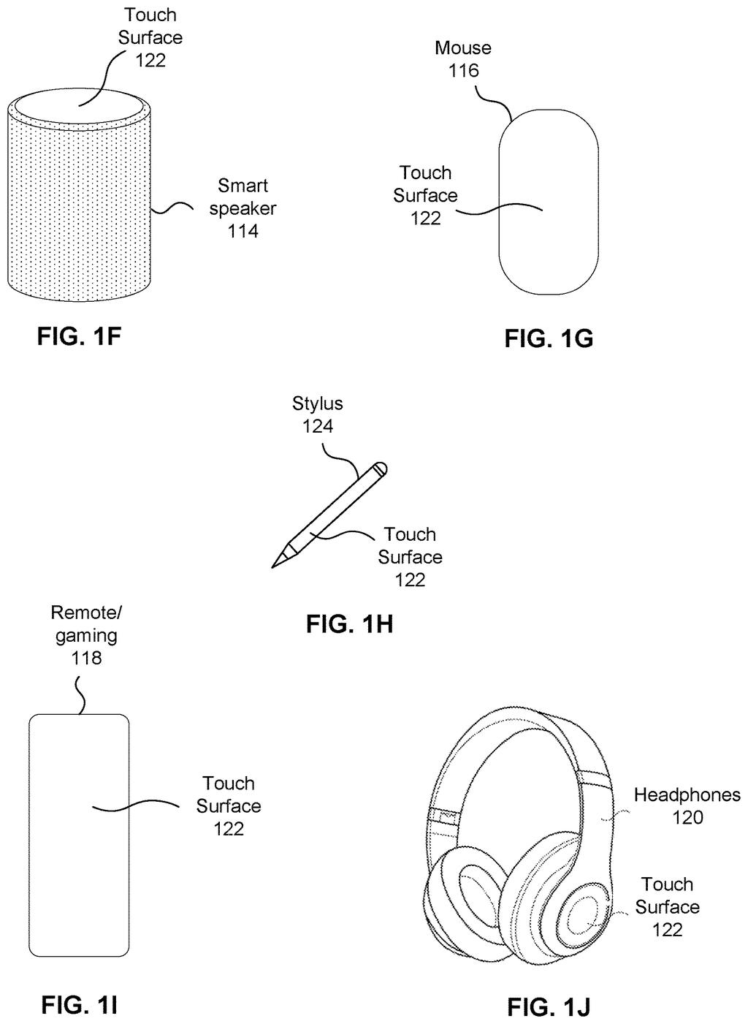
The practical payoff is room. The filing lists a stylus, headphones, a smart speaker, a mouse, a remote control and a watch as places this layout could go. It says the saved chip connections could be used for other functions. It also notes that a small device might be stuck with an existing chip that has few connections and no multi-touch support.
For you, the result would be touch controls on small, curved things that follow your fingers better, even when you hold a stylus in a pen grip with several fingers close together. It's a patent application, not a product, and the document doesn't say where Apple would use it.
Apple's 24th chip filing we've tracked since May continues a run that includes one on slice-by-slice image processing and one on hiding dropped video frames.
The problem is small but stubborn. A tiny gadget can only hold so many wires between its touch surface and its chip. A hand wrapped around a stylus can also make fingers look like they're in the wrong places.
Apple's answer fits that scope. Grouping touch spots together and scanning the grid in 28 quick passes is a modest piece of wiring cleverness, and the extra grounding step goes straight at the phantom-touch issue.
You will probably never see any of it. If it works, a touch strip on a stylus or a pair of headphones just behaves, and that is about the best a piece of plumbing like this can hope for.
Get our take in your Top Stories
Liked this breakdown? Add Patentlyze as a preferred source on Google, and our plain-English take shows up more often in your Top Stories the next time Apple patent news breaks.
There are more where this came from
We read every patent application Big Tech publishes and send you the ones worth knowing. Plain English, free, every week.
The drawings
12 drawing sheets from US 2026/0329399 A1 · click any drawing to enlarge


Show the other 4 sheets


Want this weekly breakdown for a company we don't cover? Patentlyze Pro →
Be the first to weigh in