
Apple Files Patent for Covering Up Dropped Video Pieces Before You Notice
Apple has filed a patent for hiding video glitches by reusing the last good picture data. It also adds a status board that tells the sending chip exactly which piece went missing.
What Apple's dropped-frame cover-up does
Right now, when part of a video frame shows up late or never arrives, a screen can appear to freeze or flash a visual glitch while it waits. The cause can be a failed transmission, a late rendering job, or a traffic jam inside the hardware. Apple's filing tries to hide those gaps from you.
The receiving chip reuses frames it already got, or drops in a plain placeholder color, so the picture keeps moving. At the same time it updates a status board, which Apple calls a dashboard, that records which stream and which frame went wrong, and when.
The sending chip can read that board, resend the missing piece, or change how early it starts drawing the next frame. The goal is a picture that stays smooth without adding noticeable delay.
identify one or more frames of the image data that comprise the missing or erroneous image data based on the feedback data; and repeat transmission of the one or more frames of the image data that comprise the missing or erroneous image data to the first integrated circuit.
Translation: It spots broken video frames and quickly asks for them to be sent again.
How the per-frame status board works
The filing describes two chips: a producer that draws or captures the image, and a consumer that receives it and passes it to the display. Frames are cut into horizontal strips called tiles (the description gives 64 lines as one example), compressed, and sent over a wired or wireless link.
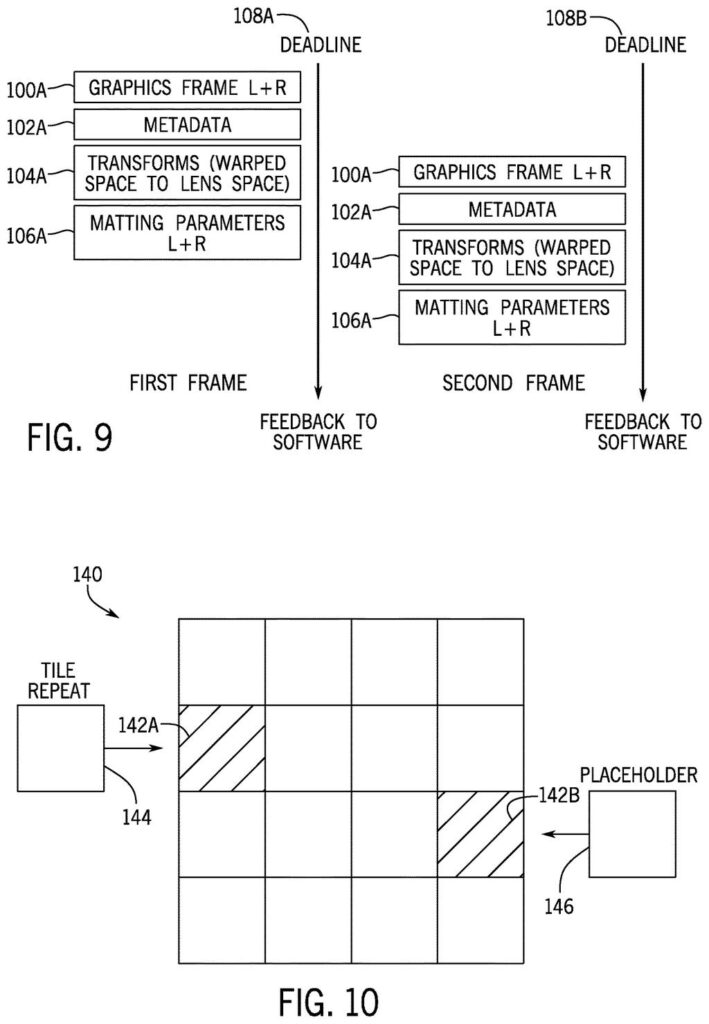
The receiving chip knows how many tiles to expect per frame. If some are missing or incomplete, it performs error concealment (covering up the gap). It can repeat earlier frames, repeat the last pixel, or insert a placeholder color such as gray, green or black.
It also keeps a dashboard, a small table in memory with one entry per stream. Each entry holds a stream ID, a frame reference, a timestamp, and flag bits such as "dropped" and "new." The sender reads it, sometimes at set deadlines, and can resend missing frames using earlier frame descriptors (saved instructions for how to send a frame), regroup the data, or start rendering earlier.
One example: if the data that maps the image onto the lens for frame two is late, the system resends the version from frame one. If only configuration metadata is missing, the sender carries on. If image data is missing, it restarts the frame. The claims cover the sender side, the receiver side, and a two-device system that displays the patched result.
… store a dashboard including dashboard entries indicating a state of the image data to the image data rendering circuitry, wherein the image data rendering circuitry is configured to operate based at least in part on feedback from the dashboard.
Translation: A status board tracks video health so the system knows when to fix glitches.
Why a frozen picture matters on a headset
If you wear a headset that blends camera views with computer graphics, a hiccup in the video stream is hard to ignore. The filing says processing has to stay fast enough that camera-based images look live against the real world, which leaves very little room to wait for late data.
Reusing the last good data buys time without a visible freeze. The dashboard also lets the sender learn from each miss, for example by starting its work earlier on the next frame. The filing lists phones, laptops, watches and headsets as possible devices, though its examples lean toward headsets and camera video.
Apple's 23rd filing we've tracked since May in our chip design coverage follows work like slicing images to save memory and keeping idle parts updated.
A frozen or glitchy picture is a small annoyance on a laptop video. On a headset that shows you the real world through cameras, a stall is far more obvious, and the filing itself says the image has to keep up with real time. That makes this a real problem for any device built that way.
The fix fits the size of it. It assumes some pieces will arrive late and gives the system a cheap way to cover the gap and learn from it, instead of chasing a perfect connection that will never exist.
The claims are chip-level plumbing, and the filing shows no finished product. If it works, you would simply see fewer flickers and freezes, which is the entire goal.
Get our take in your Top Stories
Liked this breakdown? Add Patentlyze as a preferred source on Google, and our plain-English take shows up more often in your Top Stories the next time Apple patent news breaks.
There are more where this came from
We read every patent application Big Tech publishes and send you the ones worth knowing. Plain English, free, every week.
The drawings
6 drawing sheets from US 2026/0313166 A1 · click any drawing to enlarge


Want this weekly breakdown for a company we don't cover? Patentlyze Pro →
Be the first to weigh in