
Samsung Files Patent for AI That Predicts Your Phone Signal Before It Drops
Your phone mostly reacts to a bad signal after it happens. Samsung's patent application describes an AI that guesses what the signal will look like next, using several clues at once.
What Samsung's signal-forecasting AI actually does
Ever walked around a corner and watched your video call freeze? The signal didn't fail without warning. Conditions were shifting for a few moments before it happened, and your phone just had no way to see it coming.
Samsung's filing describes an AI that watches the short test signals a phone and a cell tower already swap back and forth. It tracks three things at once: how strong the signal is compared with background noise, how smeared the signal gets as it bounces around, and whether there is a clear line of sight between the phone and the tower.
The key idea is that these three things are linked. A clear line of sight usually means a stronger, cleaner signal. So the AI looks at them together and predicts what each will do next, instead of guessing each one alone.
… generate at least two latent representation sequences representing at least two different channel features …
Translation: The device creates multiple internal data streams that track different aspects of your cellular connection.
How Samsung turns radio signals into forecasts
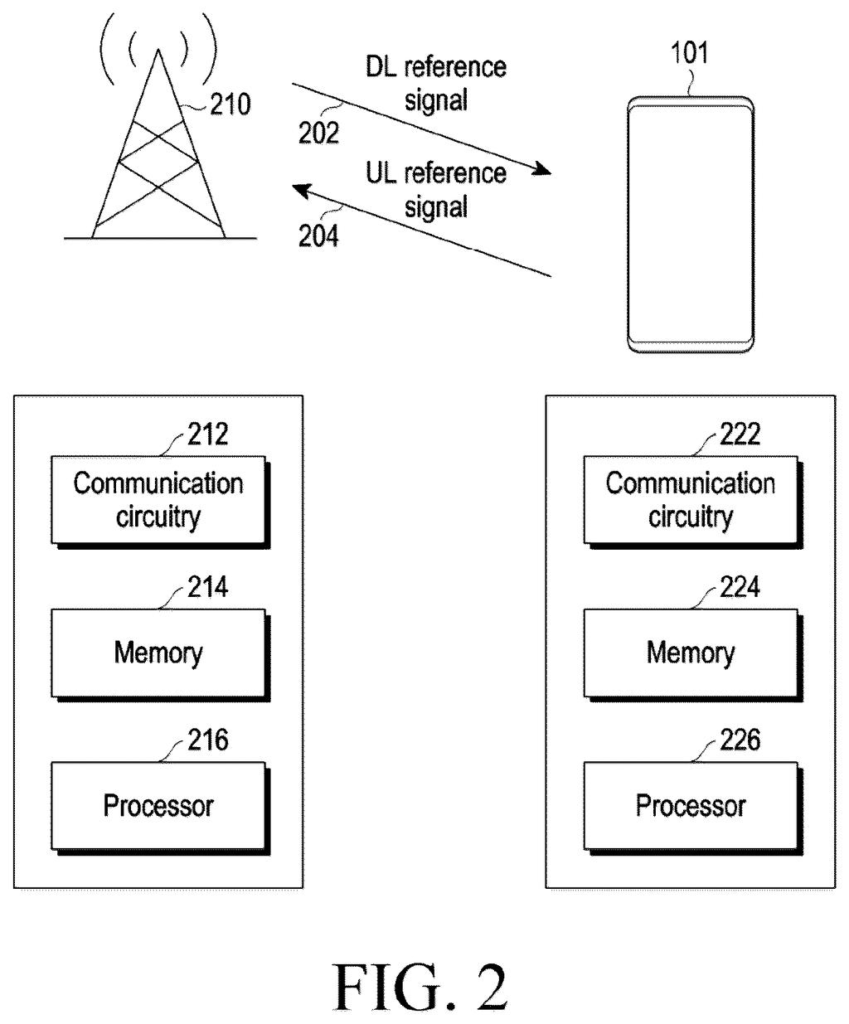
The device (a phone or a base station, meaning the cell tower) receives reference signals. These are short, pre-agreed test patterns that the two sides send each other so they can measure the connection.
From those signals, small encoders (AI components that squeeze raw data into a compact summary) produce one latent sequence for each channel feature. A latent sequence is a running list of compressed numbers, one per measurement. The example in the filing uses three features and eight past measurements each, giving 24 numbers in total. Each feature gets its own number range (0 to 7, 8 to 15, 16 to 23), so the model can tell them apart.
Those 24 numbers go into a latent transformer, the same family of AI used in chatbots. Its attention layer (the part that decides which inputs relate to which) lets it weigh how strongly one feature influences another. The output is forecasted data for at least two different features.
- One output layer forecasts line of sight versus blocked, using a sigmoid function to give a soft score between 0 and 1.
- Another forecasts delay spread, meaning how long signal echoes linger.
The filing says the model is trained on standard simulated city and countryside radio models. It reports 95% or higher accuracy on line of sight and delay spread forecasts.
… output, through a latent transformer configured to obtain relationships between the at least two latent representation sequences, first forecasted data and second forecasted data …
Translation: An internal AI model analyzes how these connection factors interact to predict what will happen next to your service.
Why a signal forecast could help your calls and video
For you, the payoff would be a connection that adjusts before trouble arrives. If a tower knows a user is about to lose line of sight, it can pick better settings or schedule data differently. The filing says forecasts can be used for scheduling or shared with the other device.
This is network plumbing, so you would feel it as fewer stalls rather than a new feature. Samsung sells both phones and network equipment, and the filing says the AI could run on either a phone or a base station. It also points to 6G research, where signals are faster but more easily blocked, which makes advance warning more useful.
Samsung's 92nd filing we've tracked in our 5G and network push since May adds to work including dual plans on one eSIM and satellite timing on phones.
If this works as described, you would mostly notice nothing, and that is the point. The video that would have frozen just keeps playing, because the network saw the dip coming and adjusted.
The most believable part is the idea of predicting three linked signal readings together. A drop in line of sight tells you something about what the signal will do next, and the model gets to use that clue instead of ignoring it.
The caveat is that the 95% accuracy figure comes from the company's own description, and the filing trains on simulated radio conditions. Real streets are messier. Still, for anyone who has lost a call walking between buildings, a phone that sees it coming is a benefit worth wanting.
Get our take in your Top Stories
Liked this breakdown? Add Patentlyze as a preferred source on Google, and our plain-English take shows up more often in your Top Stories the next time Samsung patent news breaks.
There are more where this came from
We read every patent application Big Tech publishes and send you the ones worth knowing. Plain English, free, every week.
The drawings
9 drawing sheets from US 2026/0330189 A1 · click any drawing to enlarge


Show the other 1 sheets

Want this weekly breakdown for a company we don't cover? Patentlyze Pro →
Be the first to weigh in