
Apple · Filed Nov 21, 2025 · Published Oct 22, 2026

Apple Files Patent for AR Glasses Tint That Darkens Faster and Uses Less Power

Apple has filed a patent application for the electronics that run a sunglasses-style layer on AR glasses, so the projected picture does not wash out in daylight. The interesting part is how the layer switches shades faster and wastes less power.
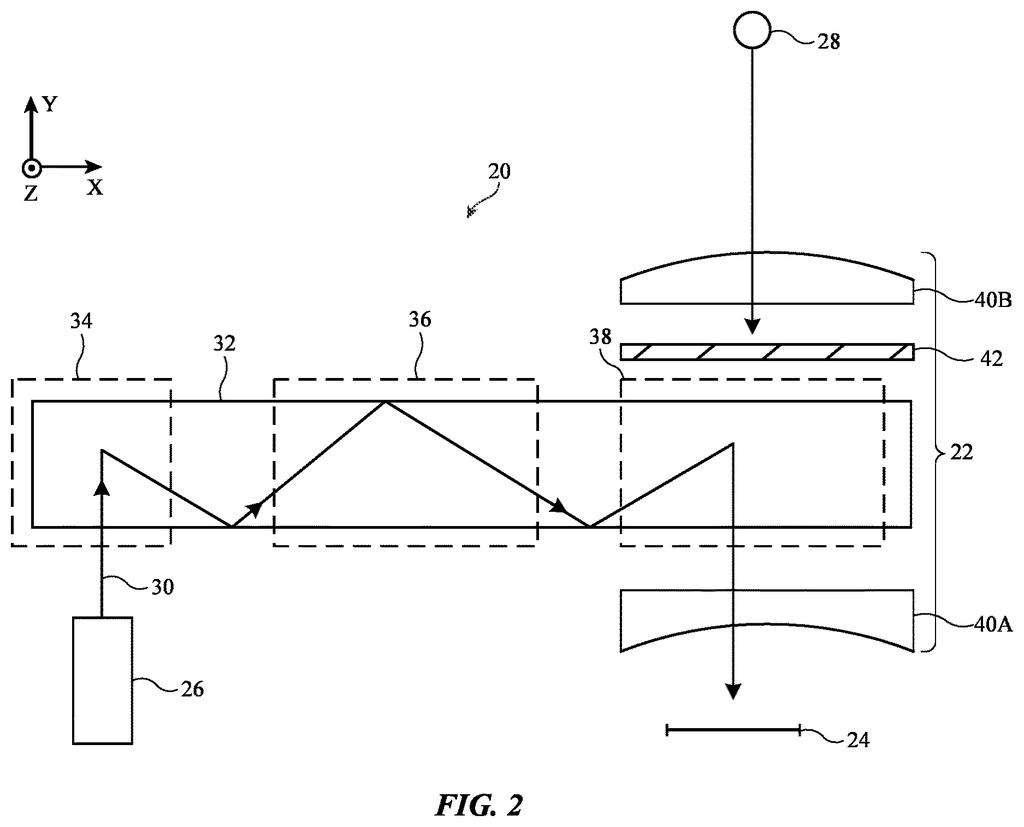
Smart glasses lenses mix digital graphics with outside sunlight while an electric tint layer dims glare for the wearer. Drawing from patent filing US 2026/0329090 A1.
Smart glasses lenses mix digital graphics with outside sunlight while an electric tint layer dims glare for the wearer.
See all 26 drawings from this filing ↓
Publication number US 2026/0329090 A1 US20260329090A1
Applicant Apple Inc.
Filing date Nov 21, 2025
Publication date Oct 22, 2026
Inventors Zachary M Beiley, Sean E Doris, Youngbae Son, Chun Ge, Johan L Piper, Ganghun Kim, Pei-Yu Hou, Xiaonan Wen, Alexander D Schlaupitz, Shungneng Lee, Ashkan Olyaei, Adam Adjiwibawa
US classification 359/630
Status when we published Waiting for an examiner (Jul 31, 2026)
Parent application is a National Stage Entry of PCTUS2024034709 (filed 2024-06-20)
Document 20 claims

What Apple's switchable lens tint actually does

You walk out of a coffee shop wearing a pair of augmented reality glasses, and the floating text in front of you disappears into the glare. Bright daylight overpowers the tiny projected image, so you squint at nothing.

Apple's filing describes a thin, electrically controlled tint layer that sits in front of the display, like sunglasses you can switch on and off. When the world gets too bright, the layer darkens so the image stays readable. When you want a clear view, it clears again.

Most of the filing is about the electronics that run that tint. Apple describes giving it a quick extra jolt of power so it changes shade faster, then briefly disconnecting it while it holds a dark shade to save battery. It also spreads the connections around the edge so the shade looks even across the lens.

From the filing · CLAIM 1
… a tint layer overlapping the optical coupler and configured to pass second light to the waveguide, the tint layer having first and second electrodes and an electrochromic material between the first and second electrodes …

Translation: The glasses use a special color changing material over the lenses to control incoming light.

How Apple's driver speeds up the tint change

The glasses use a waveguide (a clear plate that carries light from a tiny projector) and an output coupler (the part that bends that light toward your eye). The tint layer sits in front of the coupler and filters outside light. It is made of electrochromic gel, a material that absorbs more or less light as electric charge passes through it, held between two transparent electrodes.

The claims focus on the driver that supplies that charge:

  • Two separate circuits, one per electrode, both working from the same reference voltage.
  • A single adjustable circuit that drives both electrodes.
  • A current driver and a voltage driver that take turns, one pushing a set amount of current and the other holding a set voltage.

The description adds more. The driver can overdrive (briefly push a higher voltage than needed) to darken the layer faster, and underdrive (briefly push the opposite way) to clear it faster. Once a shade is set, a switch can periodically disconnect the electrodes to save power, since the gel fades only slowly.

It also describes driving the layer from several points around its edge for an even shade, and a sensor near the center, over the output coupler, to check the shade you actually see.

From the filing · THE ABSTRACT
The driver may overdrive or underdrive the tint layer to accelerate a transition time of the tint layer. The driver may be periodically floated relative to the electrodes to save power.

Translation: The system speeds up shade changes and saves battery by temporarily cutting off power.

Why daylight is the hard part for AR glasses

The practical payoff goes to anyone who wants to read projected text in daylight. A tint that reacts quickly means less waiting after you step into the sun, and the power-saving tricks matter because every bit of energy a pair of glasses spends on tint is energy not spent on everything else. Even shading across the lens also means you are less likely to see a dark patch near the edges.

For Apple, the filing shows how much work hides underneath a simple-sounding feature. Making a lens darken is one thing. Making it change quickly, evenly and cheaply in power is the hard part. Treat this as an application describing options, not a confirmed product plan.

Apple's 104th filing we've tracked in our AR glasses watch since May adds to a picture that includes heat shielding for electronics and 3D object markup.

Editorial take

You would notice this patent mostly by what does not happen. The text stays readable when you walk into sunlight, the lens clears quickly when you duck indoors, and no dark patch hangs around the edges of your view.

The speed trick matters most. A tint that lags behind the sunlight feels broken, and the extra-voltage pulse goes straight at that wait. The power-saving disconnect matters too, since a tint that drains the battery would shorten your time between charges.

Nothing here tells you when, or whether, this shows up in a product. It is circuit-level engineering behind the lens, and you only benefit if glasses like this ship. If you like the idea of sunglasses built into your display, these are the details that decide whether it feels good to wear.

Get our take in your Top Stories

Liked this breakdown? Add Patentlyze as a preferred source on Google, and our plain-English take shows up more often in your Top Stories the next time Apple patent news breaks.

There are more where this came from

We read every patent application Big Tech publishes and send you the ones worth knowing. Plain English, free, every week.

The drawings

26 drawing sheets from US 2026/0329090 A1 · click any drawing to enlarge

Main components inside the augmented reality headset, drawing sheet 1 from US 2026/0329090 A1
Sheet 1 Main components inside the augmented reality headset
How the adjustable tint layer sits over the lens, drawing sheet 2 from US 2026/0329090 A1
Sheet 2 How the adjustable tint layer sits over the lens
Front view of an electrically tintable lens insert, drawing sheet 3 from US 2026/0329090 A1
Sheet 3 Front view of an electrically tintable lens insert
Driver circuit applying voltage across the tint gel, drawing sheet 4 from US 2026/0329090 A1
Sheet 4 Driver circuit applying voltage across the tint gel
Single ribbon cable powering both transparent electrodes, drawing sheet 5 from US 2026/0329090 A1
Sheet 5 Single ribbon cable powering both transparent electrodes
Separate ribbon cable connectors powering each electrode, drawing sheet 6 from US 2026/0329090 A1
Sheet 6 Separate ribbon cable connectors powering each electrode
Thin conductive wires directly contacting the tint layers, drawing sheet 7 from US 2026/0329090 A1
Sheet 7 Thin conductive wires directly contacting the tint layers
Voltage regulators working together to drive the tint, drawing sheet 8 from US 2026/0329090 A1
Sheet 8 Voltage regulators working together to drive the tint
Show the other 18 sheets
Dual power converters driving both sides of the tint film, drawing sheet 9 from US 2026/0329090 A1
Sheet 9 Dual power converters driving both sides of the tint film
A single multiport power chip driving the lens tint, drawing sheet 10 from US 2026/0329090 A1
Sheet 10 A single multiport power chip driving the lens tint
Analog control circuits smoothly altering the tint level, drawing sheet 11 from US 2026/0329090 A1
Sheet 11 Analog control circuits smoothly altering the tint level
Separate digital converters tuning each side of the glass, drawing sheet 12 from US 2026/0329090 A1
Sheet 12 Separate digital converters tuning each side of the glass
Three digital converters sharing control between both eyes, drawing sheet 13 from US 2026/0329090 A1
Sheet 13 Three digital converters sharing control between both eyes
Independent tunable driver blocks powering the tint layer, drawing sheet 14 from US 2026/0329090 A1
Sheet 14 Independent tunable driver blocks powering the tint layer
Driving left and right lenses using three tunable circuits, drawing sheet 15 from US 2026/0329090 A1
Sheet 15 Driving left and right lenses using three tunable circuits
Reversing polarity across the lens with an H-bridge switch, drawing sheet 16 from US 2026/0329090 A1
Sheet 16 Reversing polarity across the lens with an H-bridge switch
Boosting initial voltage speeds up lens darkening and clearing, drawing sheet 17 from US 2026/0329090 A1
Sheet 17 Boosting initial voltage speeds up lens darkening and clearing
Ramping voltage gradually softens the transition between light and dark, drawing sheet 18 from US 2026/0329090 A1
Sheet 18 Ramping voltage gradually softens the transition between light and dark
Pausing power between pulses keeps lenses dark while saving battery, drawing sheet 19 from US 2026/0329090 A1
Sheet 19 Pausing power between pulses keeps lenses dark while saving battery
Combined current and voltage circuits with sensors to track tinting, drawing sheet 20 from US 2026/0329090 A1
Sheet 20 Combined current and voltage circuits with sensors to track tinting
Switching from current drive to voltage drive as lenses darken, drawing sheet 21 from US 2026/0329090 A1
Sheet 21 Switching from current drive to voltage drive as lenses darken
Stepping down drive current quickly pushes charge into the lens, drawing sheet 22 from US 2026/0329090 A1
Sheet 22 Stepping down drive current quickly pushes charge into the lens
Multiple edge contacts and a center sensor ensure uniform shading, drawing sheet 23 from US 2026/0329090 A1
Sheet 23 Multiple edge contacts and a center sensor ensure uniform shading
Continuous border strips spread tinting power evenly across the lens, drawing sheet 24 from US 2026/0329090 A1
Sheet 24 Continuous border strips spread tinting power evenly across the lens
Circuit parts that switch between high efficiency and high accuracy, drawing sheet 25 from US 2026/0329090 A1
Sheet 25 Circuit parts that switch between high efficiency and high accuracy
How smart glasses balance battery life and lens tint, drawing sheet 26 from US 2026/0329090 A1
Sheet 26 How smart glasses balance battery life and lens tint
Browse all the drawings 26 drawing sheets
Patent filing page

Source. Full patent text and figures from the official USPTO publication PDF.
Reader comments

Be the first to weigh in

Start the discussion

Real name or a handle, either is fine. Comments are read by a person before they appear, so allow a little time. Keep it about the filing.