
Apple Files Patent for a Barrier That Shields Glasses Electronics From Hot Plastic
Before a pair of smart glasses ever reaches your face, its cameras and speakers may have to survive a flood of hot, molten plastic. Apple's filing describes a small wall that protects them.
What Apple's heat-shielding dam actually does
Imagine pouring hot, runny plastic around a tiny camera and hoping it survives. That is roughly the challenge in building smart glasses. One way to make the frame is to mold plastic around the electronics inside, and cameras, sensors and speakers can be sensitive to heat and pressure.
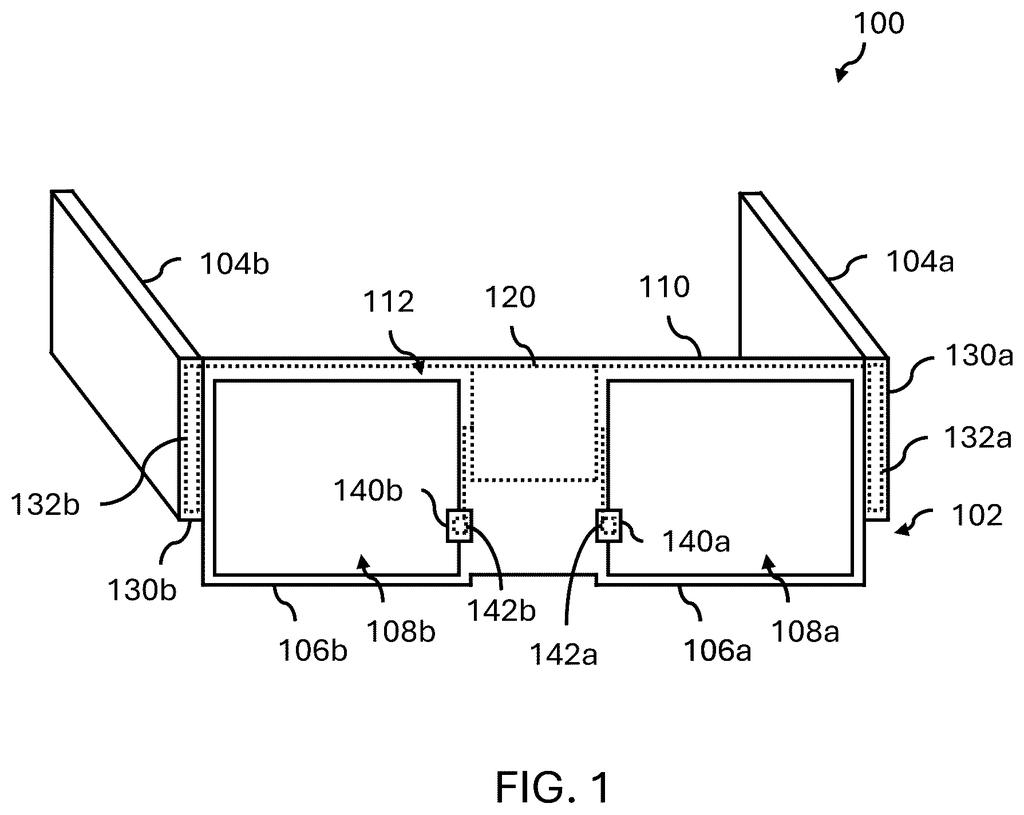
Apple's filing describes a small wall, called a material dam, that sits between the pocket holding a part and the rest of the frame. When the frame material flows in, the dam keeps it out of the pocket, so the part stays protected. The dam can also hold the part steady if you drop your glasses.
The patent also covers a bendable ribbon of wiring that pokes into the pocket like a diving board. It can swing out so a second part gets attached, then swing back in, and a cover or nose pad closes everything up.
… a material dam coupled to the first portion and defining a boundary between the internal frame volume and the first portion.
Translation: A physical barrier sits inside the frame to separate the sensitive electronics from the outer shell.
How the dam and bendable wiring fit together
The core idea is a material dam: a wall of flowable material (an adhesive, epoxy or plastic) at the boundary between a small component pocket and the main frame. The frame is built by filling its interior with plastic, such as nylon, using a low-pressure overmolding process (melted plastic is flowed around parts so they end up sealed inside). The dam keeps that plastic out of the pocket and can also act as thermal insulation.
The claims cover three versions:
- A frame with a housing near the nose or temple, a dam marking the boundary, and a part inside such as a speaker, charging module, camera, gyroscope or LED.
- A frame with a wiring channel, where a flex (a thin, bendable strip of circuitry) runs through the channel and ends in a cantilever portion (a free-hanging tip) held by the dam. That tip can bend up to about 90 degrees.
- A separate component housing, or pod, that is loaded with parts, closed with a cover, and attached to the frame afterward.
In the nose-area example, the flex swings out through an opening, a second part such as an inward-facing camera, LED or motion sensor is attached, and the flex rotates back into the pocket. A nose pad or cover closes it, and adhesive can hold everything still.
The description adds that the dam can be made before the frame, leaving connection points exposed for the part.
Why lighter smart glasses start in the factory
If you wear a headset or glasses for hours, every gram counts, and this filing is about packing electronics into the frame without adding bulk. Molding plastic around the parts lets the whole thing be compact, and the dam keeps that process from damaging the delicate pieces. It could also help a pair survive an accidental drop, since the dam holds parts in place.
For Apple, the benefit shows up mostly in the factory: fewer damaged parts during assembly and more freedom to tuck cameras and sensors near your nose and temples. The filing names smart glasses and virtual reality goggles as examples but does not describe any specific product.
Apple's 103rd filing we've tracked in our AR glasses watch since May builds on scribbles on 3D objects and seeing friends through walls.
The route to a product here runs straight through the factory. This is a build recipe using plastic molding, adhesive and bendable wiring that electronics makers already know well, with no new software or new science required.
A design team has to first commit to a glasses or headset frame packed tightly enough that heat from assembly becomes a real risk. That is a hardware decision made long before anyone outside the company sees the device.
You will never see the dam itself, but you might notice a lighter frame or a camera that survives a drop. A sensible, modest piece of engineering whose value shows up in how many frames survive assembly and how little the finished pair weighs.
Get our take in your Top Stories
Liked this breakdown? Add Patentlyze as a preferred source on Google, and our plain-English take shows up more often in your Top Stories the next time Apple patent news breaks.
There are more where this came from
We read every patent application Big Tech publishes and send you the ones worth knowing. Plain English, free, every week.
The drawings
7 drawing sheets from US 2026/0329095 A1 · click any drawing to enlarge


Want this weekly breakdown for a company we don't cover? Patentlyze Pro →
Be the first to weigh in