
Samsung Files Patent for a Recent-Apps Screen That Lists Your Chats, Files and Searches
Samsung wants the screen you use to switch apps to show what you were doing inside each one, not just which app it was. Tap a chat, a search, a draft or a washing machine setting, and you land right where you left off.
What Samsung's recent-apps screen would show
Ever switched away from a messaging app and then couldn't remember where that one PDF ended up? Today your phone's recent-apps screen shows a card for the app and not much else, so you tap it and start hunting again.
This Samsung patent application adds a second panel next to the big app card. It lists what you actually did in that app: the three chats you had going, the files you downloaded, the searches you ran, or a half-written memo. Tap one and the app opens right at that spot.
The filing also gets personal. Tasks you use over and over, like a meditation session in a health app, can be pinned automatically, and the phone can nudge you about a downloaded file you never touched.
… generating a user interface including: a primary display region configured to present a most recently executed application from the at least one recently executed application; and a secondary display region configured to display task information associated with the most recently executed application …
Translation: It builds a screen split into sections for your latest app and the specific tasks you did inside it.
How the task panel sits beside each app
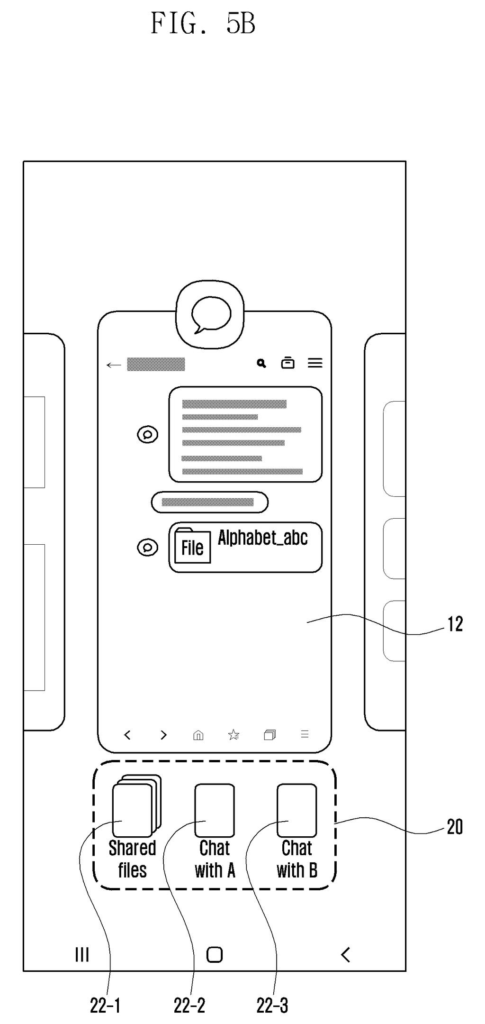
When you ask your device to show recent apps, it builds a screen with two parts. A primary region shows the app you used last. A secondary region (the task area) lists tasks you did inside that app, each one a tappable item. The description says you can swipe the main card to switch apps, and the task list changes with it.
What counts as a task depends on the app:
- Messenger: individual conversations (chat with A, B or C) and downloaded files.
- Search: earlier searches, such as camping or restaurants, plus downloaded files.
- Memo or community apps: unfinished drafts that were saved temporarily.
- Health and smart-home apps: actionable tasks, such as a 30-minute treadmill setting or a washing machine at 40 degrees, three rinses and high spin.
To make this work, the device saves a small record for each task: a link back to it, its type, a file name, and its last state. Tapping a task opens the app and shows that last state. Tapping a file offers open, go to (jump to the folder it lives in) and delete. If a downloaded file sits untouched for a preset time, the device shows a message about it. The description gives seven days as an example.
The device also tracks habits. A task you use a preset number of times becomes a frequent-use task, and you can register tasks yourself. It can also link apps you run back to back, such as a points app and a membership app.
… a main area which indicates a first application among the at least one application, and a task area which indicates information on at least one task executed in the first application …
Translation: The view separates your top app from the specific chats or files you had open.
Why your recent-apps screen could do more
The practical change is where a tap takes you. Today the recent-apps screen gets you back to an app and leaves you to find the thing inside it. Here, it could take you straight to that chat, that half-written post, or the washing machine settings you used last time. If you juggle a lot of apps, that cuts a lot of tapping and remembering.
For Samsung, this screen is one every phone owner sees daily, so small changes reach a lot of people. The filing traces back to Korean applications from 2023, and the description lists phones, wearables, cameras and home appliances as possible devices.
Samsung's 1531st filing in our Samsung coverage since May follows patents like sliding car screens and app-grouping phones.
Claim 1 is short and wide. It asks for three things: a request to see recent apps, a main region showing the app you used last, and a second region with at least one tappable item from inside that app. It names no app type, no learning feature and no special hardware.
That breadth is the whole story. If granted, the wording would reach any device whose recents screen pairs the latest app with shortcuts to things done inside it. The details that make the idea feel inventive sit in the dependent claims instead: the reminder about unopened files, the frequent-use tasks, and the pairing of a points app with a membership app.
A sensible convenience feature, then, with a main claim wide enough to draw close scrutiny. The narrower claims are where the specific ideas live.
Get our take in your Top Stories
Liked this breakdown? Add Patentlyze as a preferred source on Google, and our plain-English take shows up more often in your Top Stories the next time Samsung patent news breaks.
There are more where this came from
We read every patent application Big Tech publishes and send you the ones worth knowing. Plain English, free, every week.
The drawings
33 drawing sheets from US 2026/0329601 A1 · click any drawing to enlarge


Show the other 25 sheets


Want this weekly breakdown for a company we don't cover? Patentlyze Pro →
Be the first to weigh in