
Samsung Files Patent for a Wearable Whose Angled Glass Edges Read Your Fingertip
Samsung's filing tilts the edges of a wearable's front glass so a fingertip can rest on a sensor while the screen stays in view. Behind that single sheet of glass sit both light-based and electrical health sensors.
What Samsung's angled-glass sensor setup does
Ever tried to take a health reading on a wrist gadget and found your finger sitting right on top of the screen? Samsung's patent application tackles that by moving the sensors off the display and onto the angled edges of the glass beside it.
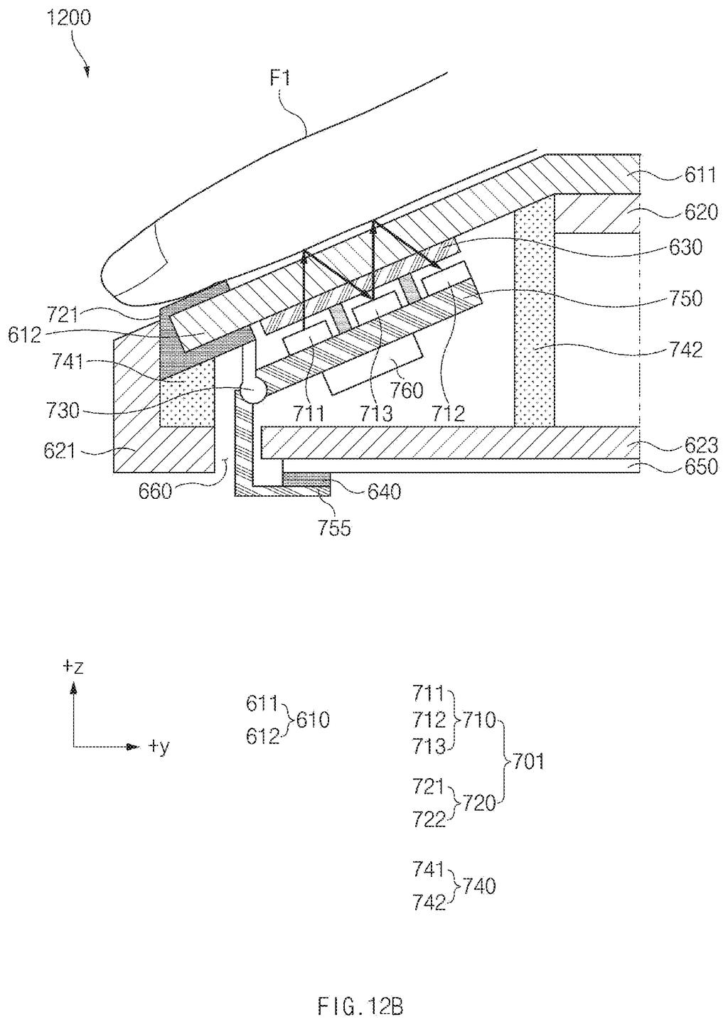
The front glass is one piece, but its outer edges tilt down toward the sides. You rest a fingertip from your free hand on a tilted edge. Hidden behind the glass are tiny lights and a light sensor that read your pulse and blood flow, plus thin metal coatings on the glass that pick up electrical signals, the kind used for a heart-rhythm trace.
The filing says fingertips sit closer to blood vessels than your wrist does, so readings can be cleaner with less light, which saves battery. The front of the device still looks like one smooth sheet of glass.
a front plate being partially inclined, a rear plate facing in a direction opposite to the front plate, and a side member surrounding an inner space between the front plate and the rear plate …
Translation: The device uses a tilted glass front and a protective casing to enclose its internal parts.
How the fingertip sensors share one sheet of glass
The core idea in the claims is a housing with a front glass plate that is partly tilted. Inside, a molding member (a molded divider, described as an opaque, springy material such as silicone) splits the interior into two zones. The display sits in one zone and the sensor assembly sits in the other, never overlapping the screen. The same front glass covers both.
The sensors come in two kinds:
- Optical unit: light emitters shine onto a fingertip resting on the tilted glass, and a light receiver (a photodiode, a part that turns light into an electrical signal) catches what bounces back. An optical film steers the light, and small walls stop emitted light from leaking straight to the receiver.
- Electrical unit: thin metal coatings on the outer and inner faces of the glass act as electrodes (contacts that pick up the body's tiny electrical signals). They connect to each other and to a flexible circuit board tilted at the same angle as the glass.
A processor reads both units and can estimate things such as heart rate, an electrocardiogram (a trace of the heart's electrical rhythm), body fat and skin resistance. If a reading looks abnormal, the filing says the device could show a warning or send the data to a hospital.
The description suggests the coatings could be laser-etched titanium or aluminum, and gives at least 25 square millimeters of electrode area as an example to keep resistance low.
… a molding member disposed between the front plate and the rear plate, the molding member dividing the inner space into a first inner space and a second inner space …
Translation: An internal divider splits the inside of the housing into two distinct compartments.
Why checking your heart might stop blocking the screen
For you, the payoff is a quicker, less awkward health check. Instead of pressing a finger over the screen or a side button, you rest a fingertip on the angled edge while the display stays readable. The filing also says fingertip readings can be cleaner than wrist readings, since blood vessels sit closer to the skin there, and that they need only a small amount of light, which helps battery life.
The design angle matters too. One sheet of glass over both the screen and the sensors keeps the front looking clean, and the sensors leave the side buttons free. The description mentions heart rate, body fat and skin-based measures, plus substances tied to blood sugar management. Keep in mind this is a patent application, so it shows a design direction, not a product.
Samsung's 30th filing we've tracked since June in our wearables that read your body watch list follows a patent on spin recalibration and one on heartbeat identification with yet another body-sensing ring application.
Almost everything here is hardware, so no software update could deliver it. A watch would need a new front glass with tilted edges, metal coatings printed and etched onto that glass, and a sensor board angled to match.
The good news for a shipping path is that the parts are familiar: LEDs, light sensors, electrodes, silicone and flexible circuit boards all exist in modern wearables. The open question is whether the coatings and seals survive sweat, scratches and constant fingertip contact while keeping the clean look the filing promises.
The shortest route to a product is the heart rate and electrical reading features, which are well understood. The blood sugar related measurements in the description would need far more proof before anyone could rely on them, so expect those to come last, if ever.
Get our take in your Top Stories
Liked this breakdown? Add Patentlyze as a preferred source on Google, and our plain-English take shows up more often in your Top Stories the next time Samsung patent news breaks.
There are more where this came from
We read every patent application Big Tech publishes and send you the ones worth knowing. Plain English, free, every week.
The drawings
17 drawing sheets from US 2026/0325070 A1 · click any drawing to enlarge


Show the other 9 sheets


Want this weekly breakdown for a company we don't cover? Patentlyze Pro →
Be the first to weigh in