
Salesforce Files Patent to Let AI Agents Show Their Work Before They Finish a Job
Right now, AI agents working as a team usually hand over only a final answer, so a bad assumption can go unnoticed until the work is done. Salesforce's patent application has helper agents send their thinking along the way, so the lead agent can step in early.
What Salesforce's agent reasoning-sharing does
Today, when a team of AI agents tackles a job together, each one usually hands back only its final answer. Nobody sees how it got there, and the agent in charge often doesn't tell the helpers what the bigger goal is. If one agent takes a wrong turn, it gets caught at the end, and the work is redone.
Salesforce's filing describes a fix. A lead agent splits your request into pieces, hands each piece to a helper agent, and tells that helper the overall goal. Say you ask for the fastest, most fuel-efficient drive with rest stops. The helper hunting for rest stops would know the route matters too.
Helpers keep a running log of their thinking and send it back when something triggers it, such as a step they're unsure about. The lead agent checks whether that thinking is drifting from the goal and sends a nudge before the helper finishes.
… generating, based at least in part on a triggering event, a report associated with the execution of the first sub-task at the first AI agent, wherein the report comprises a detail level of a plurality of detail levels …
Translation: The system creates a progress update about an active subtask depending on how much detail is requested.
How a Salesforce helper agent files its report
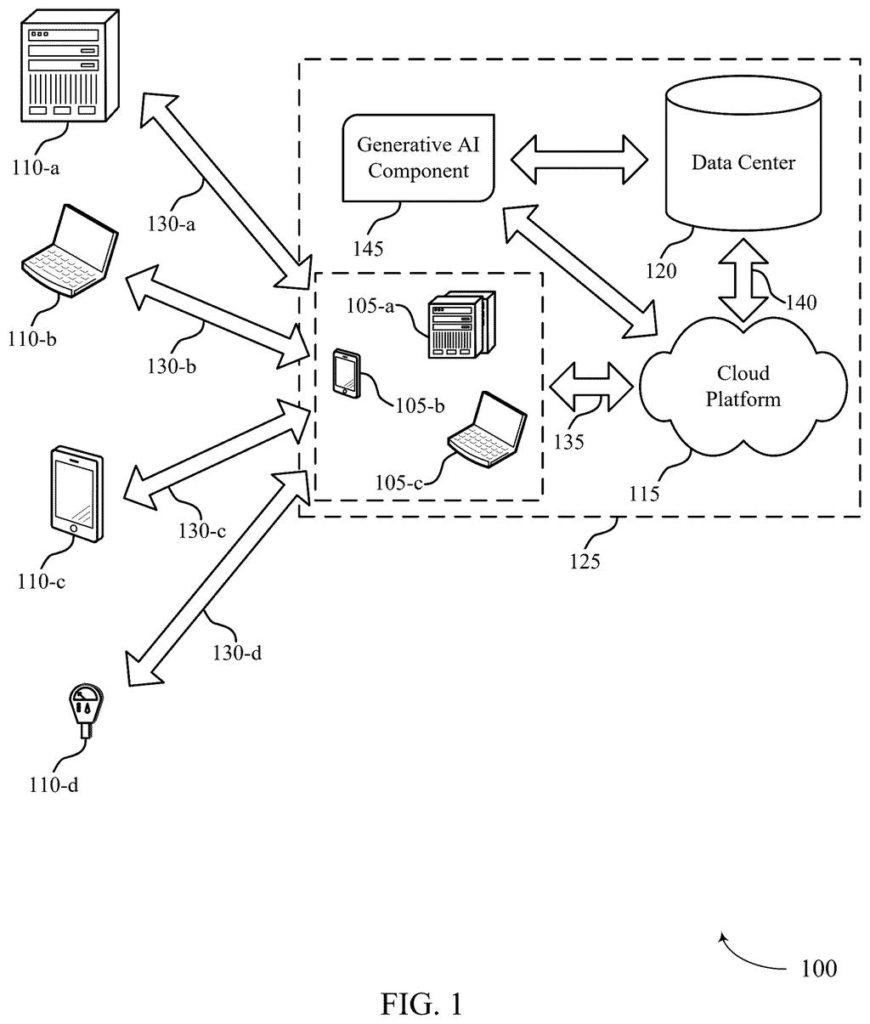
The filing describes a multi-agent system: several AI agents (programs built on large language models, the same tech behind chatbots) that split up a big job. One acts as the orchestrator, breaking the task into sub-tasks and passing each to a helper along with a goal condition, a statement of what the overall job is trying to achieve.
Claim 1 covers the helper's side. When a triggering event happens, the helper writes a report at one of several detail levels, chosen by an inter-agent reporting configuration (a set of rules that weighs each agent's abilities, setup and relationship). Triggers named in the claims:
- A step finishes
- A confidence score drops below a threshold
- The other agent asks for a report
- A deviation from the goal is flagged
- A resource conflict, such as two agents reaching for the same resource at once
The report can be a summary, a chosen subset (which can leave out ideas the agent rejected), or a full reasoning log. The description says logs can be a chain of thought (a straight line of steps) or a tree of thoughts (branching paths considered). Sensitive data can be included, left out, or anonymized.
The filing also describes what the orchestrator does next. It turns the goal and each step into embeddings (lists of numbers that capture meaning), measures the distance between them, and when the gap passes a threshold, sends a correction message with extra grounding data.
The first agent may calculate a deviation metric to quantify a deviation between the goal condition and at least one intermediate step.
Translation: The system measures how far off the AI is from its target while it is still working.
Why Salesforce wants AI agents to show their work
If you ever rely on a team of AI agents at work, you'd want to know why they reached an answer, not only what the answer was. The filing points to legal and healthcare settings, where the reasoning can matter as much as the result. A shared log also gives people something to audit and debug.
There's a cost angle too. Catching a wrong turn mid-task means a helper doesn't have to redo its whole sub-task, which saves time and computing power. And because the detail level can change with the relationship between agents, an agent could share a summary with an outside agent and a full log with one inside the same company, with sensitive data left out or anonymized.
This is the 13th Salesforce filing we've tracked since July in our AI models working in teams, following adding AI apps without rewriting and one AI grading another.
Claim 1 is wider than the headline idea suggests. It asks for three things: an agent gets a sub-task from another agent, it writes a report when a trigger fires, and the report's detail level follows a reporting configuration. Nothing in that wording requires a correction message, a distance score, or even a full reasoning log.
Those pieces show up only in the dependent claims and the description. If granted as written, claim 1 would cover any setup where one AI agent reports to another at adjustable detail levels, which could describe many ways of building agent teams. It also names no specific trigger and no specific way to set the detail level.
That breadth is the interesting part and the shaky part. Wide wording often gets narrowed during review, and the most memorable idea here, catching drift early by measuring distance from the goal, sits in the description. It may end up as the version that survives.
Get our take in your Top Stories
Liked this breakdown? Add Patentlyze as a preferred source on Google, and our plain-English take shows up more often in your Top Stories the next time Salesforce patent news breaks.
There are more where this came from
We read every patent application Big Tech publishes and send you the ones worth knowing. Plain English, free, every week.
The drawings
13 drawing sheets from US 2026/0342677 A1 · click any drawing to enlarge


Show the other 5 sheets


Want this weekly breakdown for a company we don't cover? Patentlyze Pro →
Be the first to weigh in