
Apple Files Patent to Stop Phone Plan Downloads From Failing When Storage Runs Out
Your phone's SIM chip is surprisingly cramped, and when a new plan doesn't fit, today's download just fails. Apple's filing describes a way to shrink the plan or make room in the middle of the download.
What Apple's eSIM storage patent actually fixes
You're in an airport abroad, tapping to add a local data plan to your phone. The progress bar crawls, then stops with an error. The plan never installs, and you have to start over from scratch.
One cause is that the tiny secure chip holding your digital SIMs (called eSIMs) has very little room. It also stores things like payment cards and transit passes. The filing says today's phones don't handle running out of space gracefully: the install fails and the download session is lost.
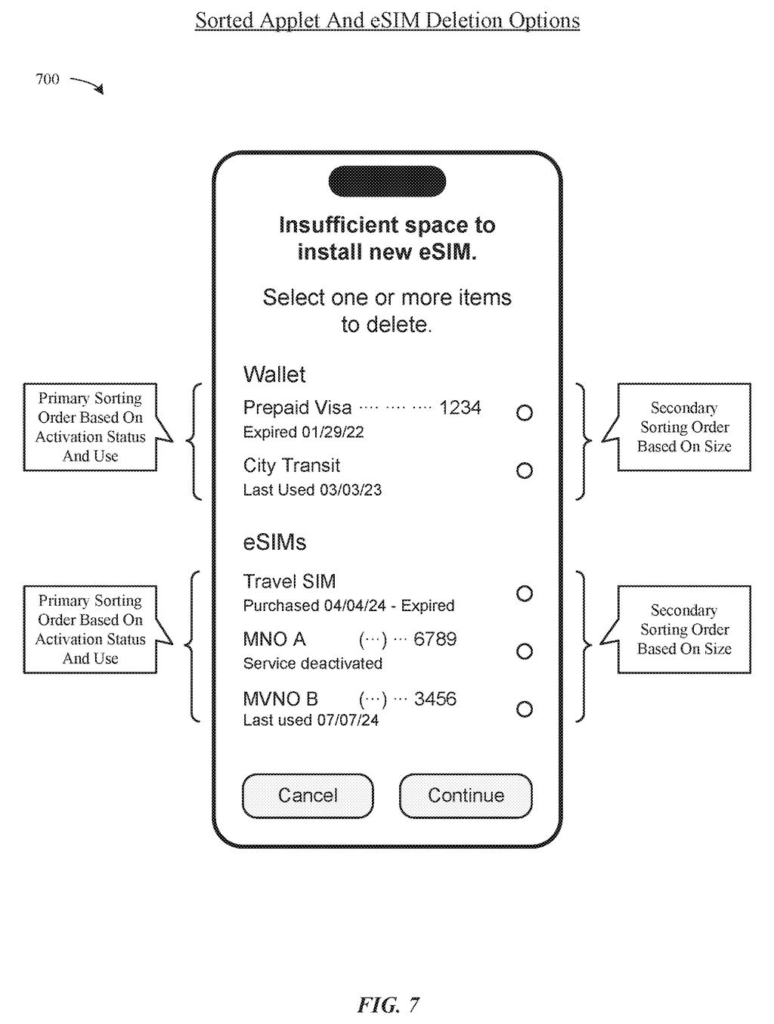
Apple's patent describes two fixes. The phone can tell the carrier's server it needs a smaller version of the same plan, and install that. Or it can pause the download, ask you to clear out something old, like an expired plan or an unused card, and then pick up where it left off.
… responsive to a determination that the estimated installed memory size for the first eSIM profile does not satisfy a memory requirement of a memory of the secure element, sending to the network provisioning server, a message that comprises an indication that a smaller size eSIM profile is required; …
Translation: When the phone realizes there is not enough room for the cellular plan, it automatically asks the carrier for a smaller version.
How the phone shrinks or clears a plan download
The filing covers three related methods. Each starts when the carrier's provisioning server (the computer that hands out eSIM plans) sends metadata, basic details about the plan, including how much memory it will take once installed.
- Ask for a smaller plan: if the estimated size won't fit in the chip's memory, the phone sends the server a message saying a smaller profile is required. It can use a "smaller profile" flag and name a preferred size. The server replies with details for a smaller version of the same cellular service, and the phone installs that one.
- Clear space first: if the plan won't fit, the phone removes eSIM profiles or applets (small programs that live on the chip, such as payment cards) and then installs the plan.
- Recover from an error: if the chip reports mid-install that it is out of memory, the phone pauses, cleans up, and resumes.
Pausing relies on new "pause session" and "resume session" messages between the phone's profile software and the chip. The filing says the session's security keys can be kept so the download doesn't restart.
For cleanup, the phone can rank what's on the chip by whether it is active or expired, how recently it was used, and how much space it takes. You pick what to delete, or the phone can offload items to its regular storage.
… characterizing usage and memory utilization of various eSIM profiles and/or applets to provide ordered rankings for management of the memory of the secure element.
Translation: The system tracks how much space each digital SIM card uses so it can prioritize and organize the device storage.
Why a full SIM chip matters for your next plan
If you hold several eSIM plans, or your phone carries payment cards and transit passes on the same chip, you could someday hit a wall just when you need a new plan. The filing says the chip's operating system is growing, plans carry more applets, and eSIM-only phones are arriving. All of that squeezes the same small memory.
With this approach, a full chip becomes a prompt to pick what to remove, or a quiet swap to a smaller plan file, rather than a dead end. The smaller-plan route depends on the carrier having a smaller version to offer, so the cleanup route gives phones a fallback.
This is the 593rd Apple filing in our Apple coverage since May, adding to work like the headset video patent and the curved glass coating one.
The problem is small in size but nasty in effect. A chip with a fixed amount of room runs out, the install fails, and the filing says the download session is lost. Anyone who has needed a local plan in a hurry can see how bad that moment is.
The filing argues that the chip's operating system, the number of plans people hold, and the size of wallet-style programs are all growing faster than the chip's memory. If that holds, the problem gets bigger each year.
The fix fits that size. Asking for a smaller plan file, or pausing to make room and then resuming, addresses the exact failure without redesigning anything. The first path depends on the carrier having a smaller version to offer, which is why the cleanup path matters.
Get our take in your Top Stories
Liked this breakdown? Add Patentlyze as a preferred source on Google, and our plain-English take shows up more often in your Top Stories the next time Apple patent news breaks.
There are more where this came from
We read every patent application Big Tech publishes and send you the ones worth knowing. Plain English, free, every week.
The drawings
16 drawing sheets from US 2026/0343214 A1 · click any drawing to enlarge


Show the other 8 sheets


Want this weekly breakdown for a company we don't cover? Patentlyze Pro →
Be the first to weigh in