
Nvidia Files Patent to Help Self-Driving Cars Read Blinking Turn Signals
A flashing turn signal is lit in one camera frame and dark in the next, which makes it surprisingly hard for a car to read. Nvidia's filing gives the car a short memory so it can watch the blinking over time.
What Nvidia's turn-signal reading patent does
Ever glanced at the car ahead and couldn't tell whether its blinker was on or just caught between flashes? A single photo can't tell you. A blinking light looks on in one frame and off in the next, and a truck or a parked van can hide the bulb altogether.
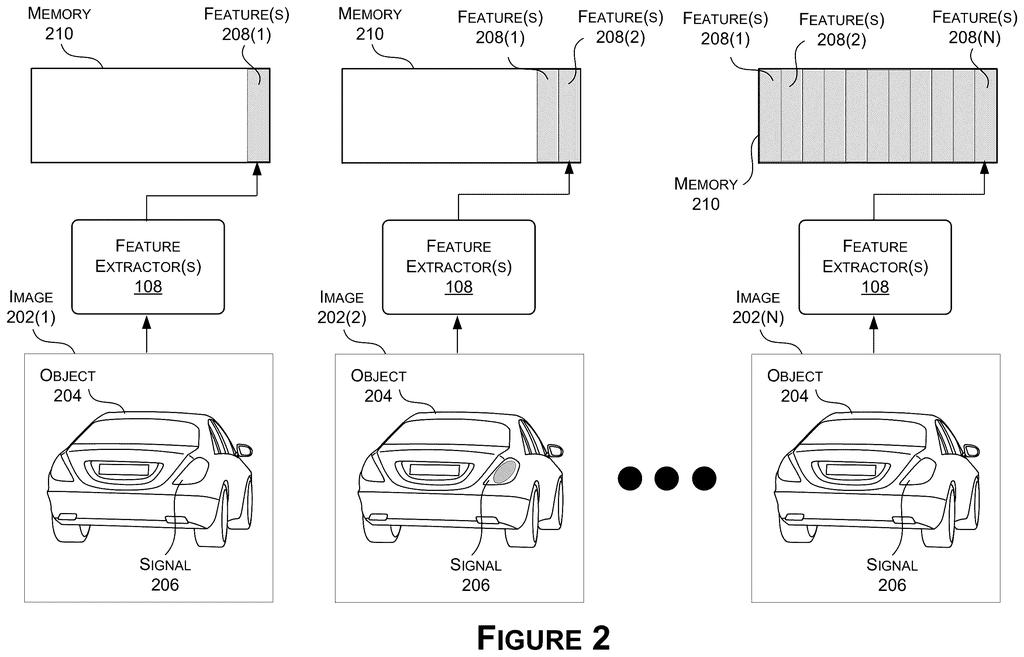
Nvidia's filing describes a way for a self-driving system to solve that by remembering. As the car's cameras photograph a vehicle ahead, the system boils each picture down to a compact set of visual details and keeps the most recent batch in a short running memory. Then it looks at the whole batch at once to decide what the lights are doing: blinking, braking, reversing, hazards, or an emergency vehicle's flashers.
Once it knows, the car can plan around it, such as giving room to a vehicle that is about to turn.
… determining, using one or more CNN classifiers and based at least on the plurality of instances of spatial features, one or more states associated with one or more light signals of the object; and causing a machine to perform one or more planning, navigation, or control operations based at least on the one or more states of the one or more light signals.
Translation: The car figures out if a signal is flashing and then decides how to drive based on that information.
How the car keeps a rolling memory of frames
Each time a camera frame arrives (often cropped to show mainly the other vehicle), a CNN feature extractor (an image-analyzing neural network that turns a picture into a compact set of numbers describing what it shows) produces what the filing calls spatial features. These are saved in memory in the order they arrive. The memory holds a fixed number of frames; the filing gives examples of ten, eleven and fifteen. When it is full, the oldest entry is dropped, like a rolling buffer.
To avoid waiting for the memory to fill, the system can pad it with placeholder values (such as all zeros) or with copies of early frames, and swap those out as real frames come in.
Next, CNN classifiers stack the stored features together and read them all at once to decide the state of the object's lights. The claims list states such as left turn, right turn, brake, reverse, hazard, emergency, warning, on, off and cycling. A separate step can also classify the object itself. The machine then uses the result for planning, navigation or control.
The filing says this avoids the older approach of a recurrent neural network (one that handles frames one at a time and carries a hidden running summary). It cites simpler deployment and fewer training problems. Training uses labeled videos, with randomly varied frame rates and randomly dropped frames to mimic camera glitches.
Why blinking lights matter for self-driving
If you ride in a self-driving car or share the road with one, this comes down to a basic courtesy: noticing your blinker. A car that reads turn signals, brake lights and hazard lights reliably can leave room for a merging truck, wait for a car backing out, and pull over for an ambulance. The filing also describes the same memory approach for traffic lights and for tracking how a pedestrian is moving.
The filing argues that using an ordinary CNN, instead of the recurrent design it criticizes, makes deployment simpler and training easier. The claims also cover robots and other machines, so the idea reaches beyond cars. Whether it ever ships in a product is unknown; it is a patent application, not a product.
That makes this Nvidia filing the 101st we've tracked since May in our self-driving sensing race watch, building on earlier applications like one on parking spot edges and one on flat map placement.
Turn signals are how drivers tell each other what they are about to do, and a self-driving car that misreads one pays in either direction. Read a blinker as off and the car may stay in the way of a merge. Read it as on and it may brake hard for no reason. A single camera frame often can't settle the question, because a flashing bulb is lit in one frame and dark in the next.
For a problem this narrow and this frequent, a short memory of recent frames is a proportionate answer. It adds little machinery and mirrors what a person does: watch for a moment before deciding.
The filing gives no accuracy figures, so the size of the improvement over older methods stays unknown. The need is clear, the fix fits it, and correct blinker reading is a basic requirement for any car sharing a road.
Get our take in your Top Stories
Liked this breakdown? Add Patentlyze as a preferred source on Google, and our plain-English take shows up more often in your Top Stories the next time Nvidia patent news breaks.
There are more where this came from
We read every patent application Big Tech publishes and send you the ones worth knowing. Plain English, free, every week.
The drawings
17 drawing sheets from US 2026/0341041 A1 · click any drawing to enlarge


Show the other 9 sheets


Want this weekly breakdown for a company we don't cover? Patentlyze Pro →
Be the first to weigh in