
Qualcomm Files Patent for a Phone Camera That Predicts Your Hand Shake
Your phone's camera spends a surprising amount of time waiting to hear where its own stabilizer lens ended up. A new Qualcomm patent application would skip the wait by forecasting the answer from your hand motion.
What Qualcomm's stabilization forecast does
Imagine you're walking along a sidewalk, filming a friend. Your phone's camera has a tiny motor that slides the lens around to cancel out your hand shake, but the software that cleans up each frame normally has to wait until it knows exactly where that lens ended up. That waiting adds delay between what the camera sees and what you see on screen.
Qualcomm's patent application skips the wait. The phone reads its motion sensors, guesses where the stabilizer lens will be a split second from now, and starts lining up video frames using that guess.
It also grades its own guess. When it's confident, it moves ahead early. If you jerk the phone suddenly and the guess looks shaky, it holds off until the real lens readings arrive, so a bad prediction doesn't wreck the shot.
… determine, based at least in part on the sensor data, one or more predicted future parameters for an image stabilization system of the image capture device …
Translation: The phone guesses how your hands will shake before you press the button.
How the phone decides when to trust its guess
Many phone cameras use optical image stabilization (OIS), a tiny motor that slides the lens around to cancel out your hand shake. The catch is timing: the software that aligns and cleans up frames normally waits until it knows where the lens actually sat for each frame, and that wait adds delay.
Qualcomm's filing reads motion sensors (a gyroscope for rotation, an accelerometer for shakes and sudden shifts) and forecasts where the phone is headed. It converts that forecast into predicted lens positions using a physical model of the stabilizer (a math description of how the lens responds to commands), then aligns two or more frames with those predictions. The forecast can come from machine learning or polynomial fitting (extending a curve through recent readings), and it can factor in whether you're standing, walking, running or panning.
The filing adds some safeguards:
- Near the edge: if the lens nears its travel limit (the example is ±2 millimeters, with a 0.2 millimeter warning zone), the system shortens how far ahead it predicts or updates faster, such as from 1,000 to 2,000 times a second.
- Confidence check: a high score means go ahead early, and a low one means wait for real readings.
- Split work: a small controller beside the lens makes the predictions and hands them to the main processor with time stamps and confidence labels.
Aligned frames can then be merged for HDR (blending different exposures) or noise reduction (averaging frames to cut grain).
An image stabilization control process may be applied, and may utilize a physical model of the image stabilization system.
Translation: Software simulates the actual physics of the camera hardware to counteract motion.
Why Qualcomm's camera patent matters for video
If this works, your phone's live preview and video recording could keep up with your hand sooner, because less time is lost waiting for exact lens readings. Low-light shots and HDR photos depend on lining up several frames, so a faster alignment step could help there too.
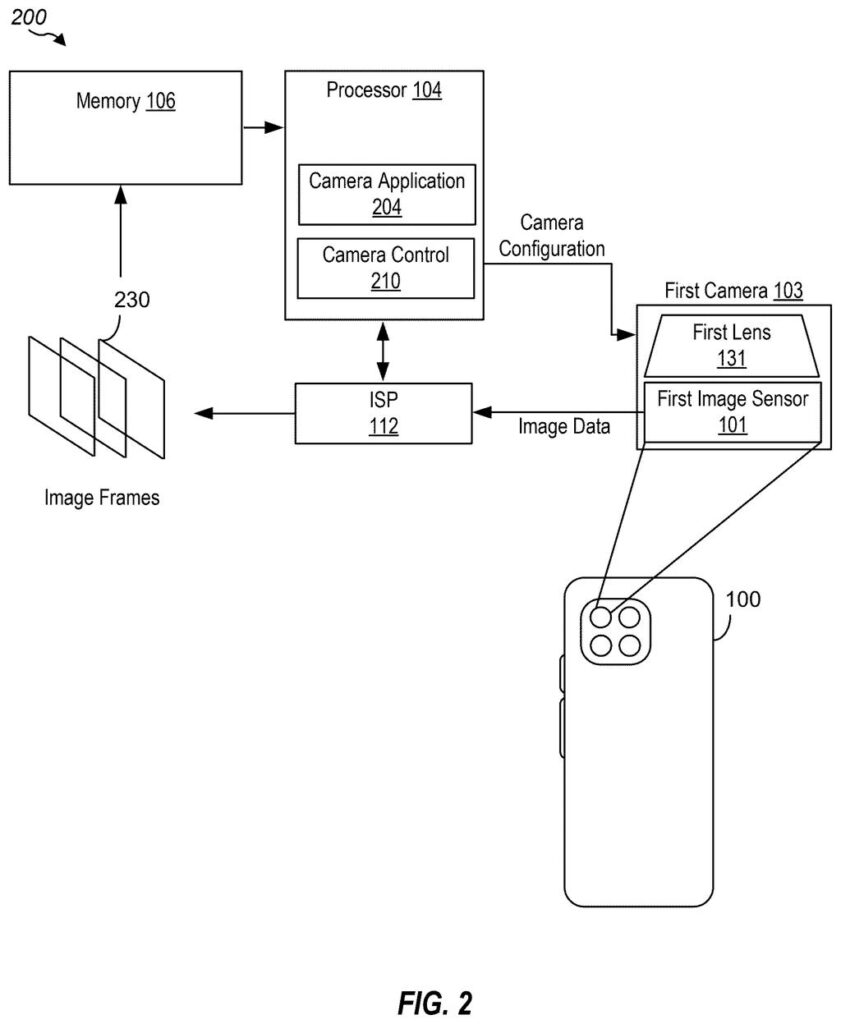
The filing describes a phone-style design, with a small controller beside the lens and a main processor running the camera app, though it also covers tablets, webcams and surveillance cameras. The examiner's first review rejected the claims as filed, which is routine and usually followed by amendments, so the wording may change. For now it shows how Qualcomm is thinking about shaving delay out of the camera pipeline.
This is the 66th Qualcomm patent in our cell phone coverage since May, a topic that already includes work on cutting echo with inaudible sound and routing calls to one earbud.
The shortest road to a product here runs through software. A phone with optical stabilization already has motion sensors, a motor that moves the lens, a small controller for that motor, and a main processor. The patent asks those parts to share forecasts instead of waiting on measurements, which means changes to firmware and camera code rather than a new part.
The hard part is trust. The phone needs a way to score its own guesses, and the filing's answer is to wait for real numbers whenever the score is low, so the gains should show up mostly during smooth movement like walking. Camera makers would also have to test it on many lens modules, since each one behaves a little differently near its travel limits.
Bottom line: a plausible, modest speedup that most people would never see by name, only as a preview that keeps up with their hands.
Get our take in your Top Stories
Liked this breakdown? Add Patentlyze as a preferred source on Google, and our plain-English take shows up more often in your Top Stories the next time Qualcomm patent news breaks.
There are more where this came from
We read every patent application Big Tech publishes and send you the ones worth knowing. Plain English, free, every week.
The drawings
5 drawing sheets from US 2026/0343095 A1 · click any drawing to enlarge


Want this weekly breakdown for a company we don't cover? Patentlyze Pro →
Be the first to weigh in