
A New Adobe Patent Keeps AI-Made People Looking Right When the Camera Zooms and Pans
AI-generated video of a person tends to fall apart the moment the camera moves in close or swings around. Adobe's new filing tries to fix that by feeding the system several photos of the same person and teaching it which parts of each photo to trust.
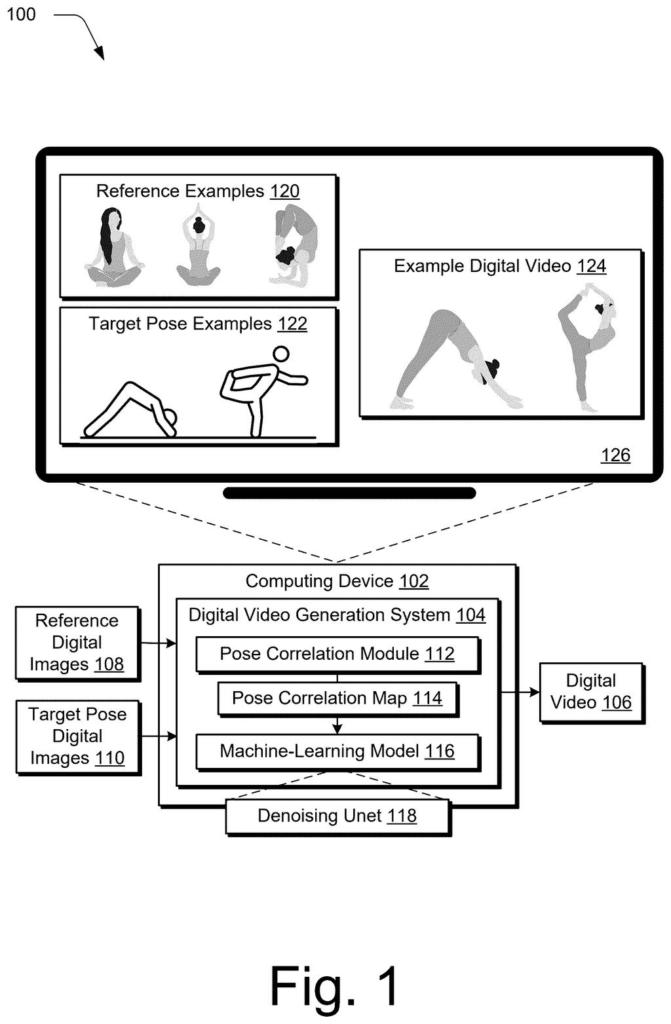
What Adobe's pose-matching video patent does
You're scrolling past an AI-made clip of someone doing yoga. It looks fine from the front, but as the camera swings to the side, an arm vanishes and the face goes soft. That glitchiness is a common problem with today's generated video.
Adobe's filing starts from a simple observation: one photo only shows one side of a person. A close-up of a face says nothing about the legs, and a far-away full-body shot lacks fine facial detail. So the system takes several photos of the same person from different angles and distances.
It then compares the poses in those photos with the poses the finished video needs. That comparison produces a guide that says, in effect, look at this part of this photo for this frame. The result is a person who stays consistent as the camera zooms and pans.
… computing, using the one or more machine-learning models, a pose correlation map based on a reference pose of the reference object and a target pose of the target object from the one or more digital images …
Translation: The system maps how a person or object changes position between different images.
How Adobe matches poses to reference photos
The patent describes a system that makes a video of a person (the "reference object") copying the movements of a stick-figure-style pose sequence (the "target"). The example in the filing shows a woman, photographed from several angles, performing yoga poses drawn as stick figures.
Two kinds of information are pulled from the inputs. One network pulls out spatial features (detailed appearance, like clothing and body shape) from the reference photos. A second network, a CLIP encoder (a model that links images to meaning), pulls out semantic features (a more general sense of what is shown).
The key piece is the pose correlation map. Two pose encoders (small networks that turn a body pose into numbers) process the reference poses and the target poses. A transformer (a model that works out which pieces of data relate to each other) then scores how relevant each region of each reference photo is to each video frame.
The video itself is made by a diffusion model (an AI that starts with random noise and cleans it up into frames). Those scores act as a filter. Only the most relevant reference features are passed to later stages of the model, which keeps the cost from climbing with every extra photo.
The filing also covers how to build training data: cutting talk and lecture videos into single-camera clips, discarding clips without one clear person, and labeling the poses.
A digital video is generated having a plurality of frames based on the reference features, the target features, and the pose correlation map and presented for display in a user interface …
Translation: The software builds a smooth video sequence using the extracted features and movement data.
Why AI video of people could look less glitchy
If you make videos, animations, or social clips, the practical payoff is characters that keep their look when you change the camera. Zooming from a full-body shot to a close-up, or circling around a figure, is exactly where generated video tends to show jitter and missing pieces. The filing says this approach lets you do both from one set of reference photos.
It also points at cost. Adding more reference images normally makes the computer work much harder, and the filter is meant to avoid that. Adobe makes creative software, so tools for animation and short video are an obvious home for this, though the filing names no product. Like most patent applications, it may never ship in any form.
That makes this Adobe's 56th filing we've tracked since May in the AI photo editing race, a group that includes patents on fixing blurry photos and syncing lips to audio.
To keep the system fast, it picks only the highest-scored details from each reference photo rather than using everything. That speed comes at a real cost: a tattoo, a logo on a shirt, or the back of a jacket that only one photo captures could get silently discarded, and the video would simply lack it.
The training footage is another honest limitation. Most of the examples are people standing and talking in front of a camera, which means dancing, sports, or any pose that pushes the body to its limits may expose gaps the system has never practiced closing.
Even so, the core trade reads as sound. Letting the system draw on many reference photos cheaply, rather than one photo expensively, is a practical way to solve the real problem of characters that drift or blur mid-video, and that problem matters to anyone trying to make AI footage feel trustworthy.
Get our take in your Top Stories
Liked this breakdown? Add Patentlyze as a preferred source on Google, and our plain-English take shows up more often in your Top Stories the next time Adobe patent news breaks.
There are more where this came from
We read every patent application Big Tech publishes and send you the ones worth knowing. Plain English, free, every week.
The drawings
13 drawing sheets from US 2026/0340355 A1 · click any drawing to enlarge


Show the other 5 sheets


Want this weekly breakdown for a company we don't cover? Patentlyze Pro →
Be the first to weigh in