
Adobe Patents AI Video Generator That Keeps Scenes Consistent Across Frames
Generating a long AI video without the whole thing falling apart is genuinely hard. Adobe's new patent describes a way to keep every frame aware of the big picture without the model having to process every other frame at once.
How Adobe's video AI keeps long clips coherent
Every time an AI video tool renders a new frame, it has to answer a question: does this frame still match everything that came before it? For short clips that's manageable, but the longer the video, the heavier that bookkeeping gets.
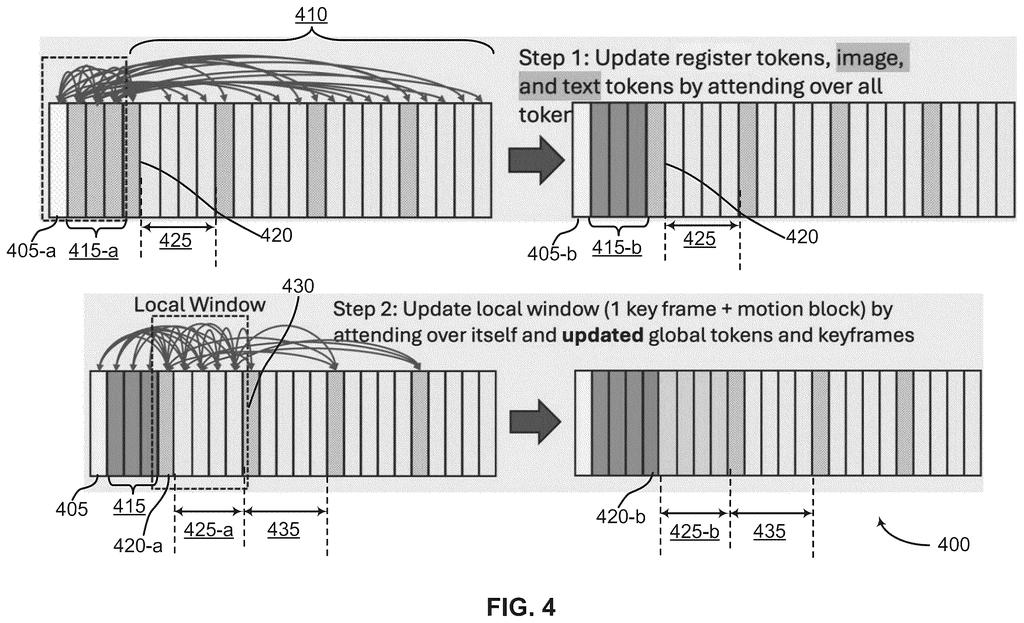
Adobe's patent describes a two-level system. One part of the model maintains a global token, a compact summary of the entire scene based on your text prompt. Each frame then only needs to look at that global summary plus a small local window of nearby frames, not the whole video at once. Think of it like a writer who keeps a one-page outline on their desk and only re-reads the last chapter before writing the next one.
The result is that the model can stay consistent across a longer video without the processing cost ballooning out of control. For you as a creator, that could translate into longer, more coherent AI-generated clips from a single text description.
How global tokens and local windows split the work
The patent describes a video generation model that processes a text prompt and produces a synthetic video through two distinct attention passes.
First, the model runs an attention process (a mechanism borrowed from large language models where every element weighs how relevant every other element is to it) across all frame tokens to produce a single global token. That global token is essentially a compressed, scene-level representation of the whole video.
Second, when generating any individual frame, the model performs a second attention process that looks at two things:
- The global token, for scene-level consistency (lighting, characters, setting)
- A local window of nearby frame tokens, for short-range motion and visual continuity
This two-stage design is called windowed attention. Standard full attention would require each frame to attend to every other frame simultaneously, which scales poorly as video length grows. By restricting local attention to a window and offloading global coherence to a single token, the computational cost grows much more slowly with video length. The claim covers the generation of both the global token and the windowed frame token as distinct steps, with the final video derived from those frame tokens.
What this means for AI video tools and creators
For anyone using AI video tools today, one of the most common frustrations is that characters drift, backgrounds shift, or the lighting changes mid-clip for no reason. Adobe's approach directly targets that problem by separating the job of remembering the scene from the job of drawing the next frame, which should make longer outputs more stable without requiring proportionally more computing power.
Adobe already sells video tools through Premiere Pro and Firefly, so this kind of efficiency work has an obvious home in their product lineup. Video AI generation is one of the faster-moving areas across the latest Big Tech patents, and Adobe's filing shows the company is investing in the architectural foundations needed to make it practical at longer durations and for everyday creators, not just research demos.
Claim 1 is written at a high level of abstraction: it covers any video generation method that produces a global token via full-frame attention and then generates per-frame tokens using that global token plus a local window subset. That breadth could give Adobe a meaningful stake in one of the dominant architectural patterns for scalable video diffusion models. If granted as written, the claim would potentially cover a wide range of transformer-based video generators that use any form of global-plus-local attention factoring, which describes a direction many researchers are pursuing. The practical risk is that the prior art bar here is high and the examiner will likely push for narrower claims before any grant.
There are more where this came from
We read every patent application Big Tech publishes and send you the ones worth knowing. Plain English, free, every week.
The drawings
17 drawing sheets from US 2026/0237108 A1 · click any drawing to enlarge


Want this weekly breakdown for a company we don't cover? Patentlyze Pro →
Be the first to weigh in