
Qualcomm Files Patent to Sharpen Future Cell Signals Aimed at Your Phone
Aiming a radio beam at your phone depends partly on where the signal enters the antenna, and Qualcomm's new patent has the panel choose that entry point on the fly. In the filing's own simulation, switching entry points removed a stray beam at about 137 degrees.
What Qualcomm's multi-entry antenna panel does
Every time you stream a video on your phone, a cell tower has to aim a narrow beam of radio waves right at you, and keep re-aiming as you walk. Qualcomm's new patent is about the flat antenna panels that could do that aiming in future networks.
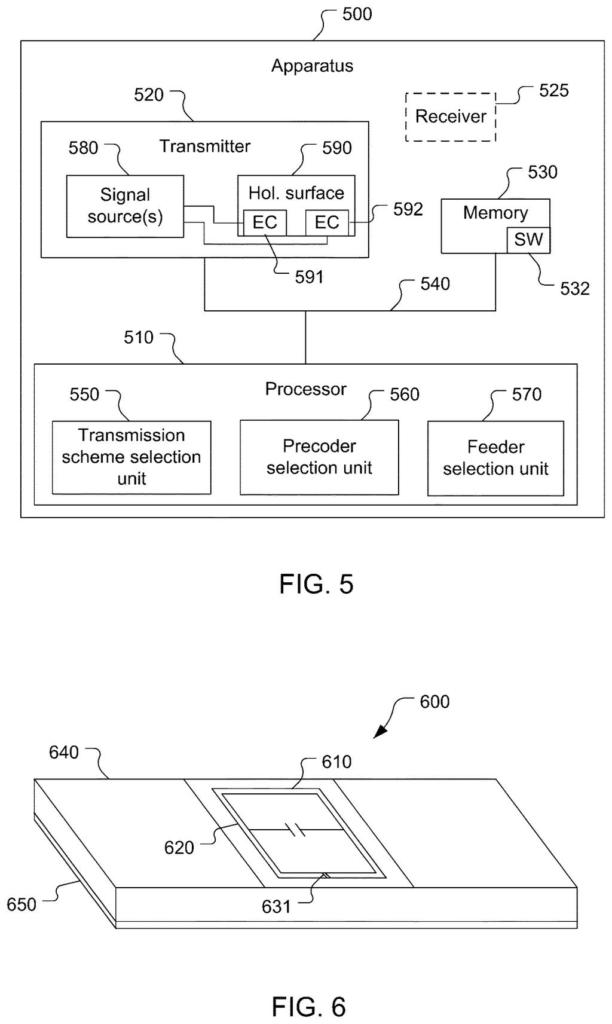
These panels are covered in tiny antenna elements, and the radio signal gets fed in from one or more entry points called feeders. Where the signal enters matters. Depending on which direction you are in, some of the tiny elements work well and others don't. So the system checks where you are, then chooses: send the signal from one feeder, or from several at once with their timing lined up.
The filing says the winning choice is whichever lights up more of the panel. That means a stronger beam pointed your way and fewer stray beams going in the wrong direction.
one or more holographic surfaces comprising a plurality of antenna elements; at least one signal source; and a plurality of energy couplers each coupled to one of the at least one signal source and each coupled to a respective location of the one or more holographic surfaces; …
Translation: The hardware setup uses special surfaces and energy couplers to beam data.
How the panel picks one feeder or several
The antenna in question is a holographic MIMO surface (a flat panel of tiny antenna elements that work together to steer a beam). A radio signal enters the panel at one or more feeders (the claims call them energy couplers) and travels along it like water through a pipe. Each element can be switched on or off, and only elements whose wave timing lines up actually radiate.
The processor first works out the target's direction. It can measure the device's own signal, use the device's report of its preferred signal path, or compare location estimates. Then it counts how many elements would be active under each option:
- Combination: several feeders send at once, each signal multiplied by a location-dependent codeword (a preset timing and strength adjustment).
- Single feeder: one feeder sends alone.
The option with more active elements wins. With two feeders at opposite ends, the filing picks the feeder on the side the target is toward. When feeders sit a multiple of half a wavelength apart, combining is chosen, and in the filing's two-feeder example the beam gain doubles compared with one feeder.
In one simulation, a single feeder created a stray beam at about 137 degrees when aimed at 60 degrees. Using the feeder at the other end avoided it.
… transmitting, based on the desired signal direction and a layout of a plurality of energy couplers relative to the one or more holographic surfaces, one or more transmit signals via the one or more holographic surfaces in the desired signal direction …
Translation: The device aims wireless signals precisely where they need to go.
Why Qualcomm's beam-aiming patent matters for 6G
If this ever reaches real hardware, the payoff for you would be a stronger, cleaner connection: more of the radio power goes toward you, and less goes toward empty space or other people's devices. The filing says panels like this can be low cost, small, light and low power, which matters for anything you might carry in your pocket.
The filing frames all of this around 6G and networks serving huge numbers of users, where precise beams matter most. It names both base stations and phones as places the technique could live, but it describes no product and no timeline. For Qualcomm, best known for phone radio chips, it is one more piece of groundwork for how future wireless gear could aim its signals.
That makes this Qualcomm's 554th filing in our Qualcomm coverage since May, which now spans work like shrinking video files and hiding faces in video.
The problem is real. Future networks are expected to serve enormous numbers of devices, and a beam that leaks in the wrong direction wastes power and crowds out other users. The filing's own simulation shows a stray beam at about 137 degrees when aiming at 60 degrees, and the fix removes it.
The fix is small, and that suits the problem. It is a rule for choosing between two ways of feeding a panel, based on simple counting of active elements. A phone or tower could even look the answer up in a table instead of calculating it each time.
Whether this touches your life depends on 6G arriving and on panels like this being used in it. The filing gives no timeline and no product, so treat it as a sensible bit of engineering for a network that does not exist yet.
Get our take in your Top Stories
Liked this breakdown? Add Patentlyze as a preferred source on Google, and our plain-English take shows up more often in your Top Stories the next time Qualcomm patent news breaks.
There are more where this came from
We read every patent application Big Tech publishes and send you the ones worth knowing. Plain English, free, every week.
The drawings
6 drawing sheets from US 2026/0341972 A1 · click any drawing to enlarge


Want this weekly breakdown for a company we don't cover? Patentlyze Pro →
Be the first to weigh in