
Google Files Patent to Let Your Phone Talk to Satellites Without Extra Antennas
Phones that can talk to satellites usually mean bulky hardware or holding the device up at the sky just right. Google's filing describes a phone that borrows an ordinary cell antenna, pairs it with a second one, and aims a satellite signal on its own.
What Google's shared-antenna phone idea does
You're hiking miles from the nearest cell tower, and your phone has no bars. To send a message by satellite, you'd normally have to aim the device at the right patch of sky and hope you guessed correctly.
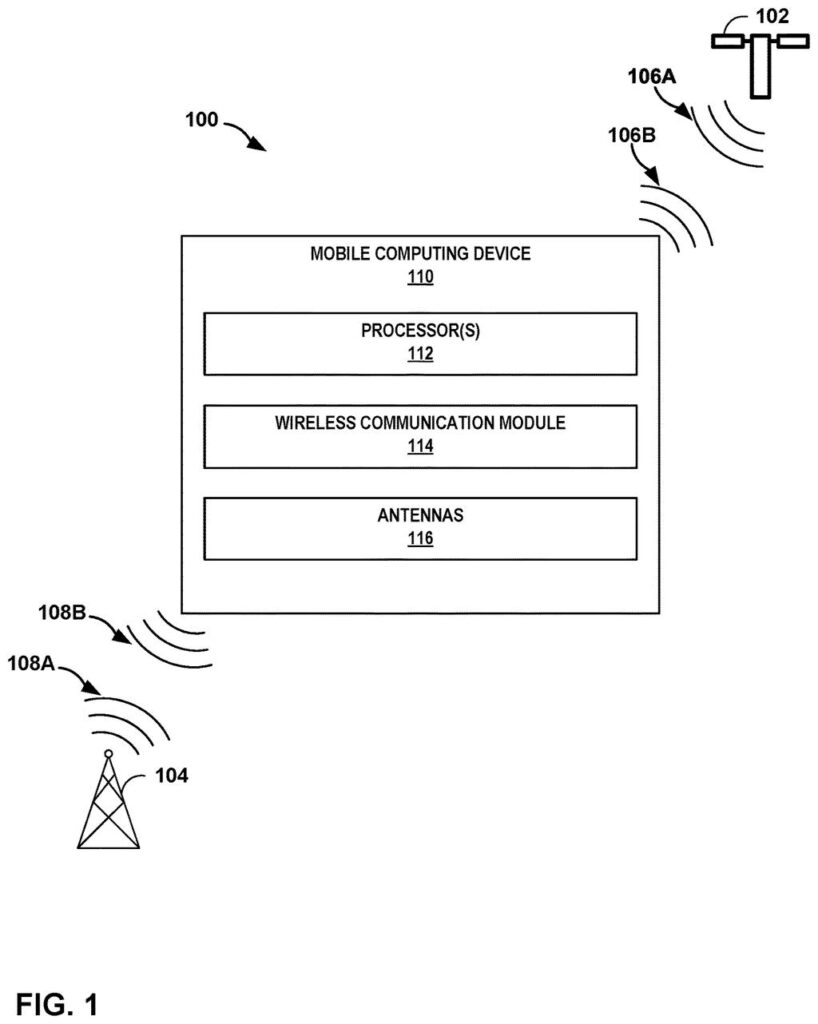
Google's patent application describes a way around that. Instead of adding a separate set of antennas just for satellites, which takes up space and adds cost, the phone would reuse an antenna it already has for regular cell service. When it's time to talk to a satellite, it pairs that antenna with a second one and steers the signal electronically toward the satellite.
The result, in theory, is a phone that handles both jobs without getting bulkier, and that doesn't need you to hold it in one precise position.
transmit, via a first antenna of the plurality of antennas and at a first time, a terrestrial communication signal; and transmit, via the plurality of antennas and at a second time, a non-terrestrial communication signal …
Translation: The phone switches between normal cell towers and satellites using the same built-in antennas.
How two antennas aim a satellite signal
The filing covers a device with several antennas and a processor that switches between two jobs. At one moment, it sends a regular cell signal (a terrestrial signal, meaning one that goes to a tower on the ground) out of a single antenna. At another moment, it sends a satellite signal (a non-terrestrial signal) by combining that same antenna with at least one other into a small group, forming a beam, which is a focused stream of radio energy pointed in one direction.
Steering works by timing. The same signal goes to both antennas, and delaying it slightly on one of them shifts the direction where the two waves reinforce each other. The delay comes from impedance tuners, circuit parts that adjust how a signal is fed into an antenna. In the filing's example graphs, different delays point the beam about 25 degrees to the right, about 25 degrees to the left, or straight ahead with no delay.
The filing also describes some narrower details:
- Aiming: the phone can check how strong the satellite's incoming signal is and what angle it came from, then use that to pick the angle for its outgoing beam.
- Spacing: the two antennas sit about half to eight-tenths of a signal wavelength apart. For the n255 satellite band (1645 MHz, an 18.22 cm wavelength), that works out to roughly 9.11 to 14.57 cm.
- Routing: a switch sends each signal generator's output to the right antenna, so two different cell signals can go out through two antennas at once when the phone isn't in satellite mode.
… transmitting the non-terrestrial communication signal comprises forming a beam using at least two antennas of the plurality of antennas, the at least two antennas including the first antenna.
Translation: Multiple internal antennas combine their signals to reach satellites in space.
Why this matters for satellite-ready phones
If you've ever been out of cell range, the appeal is simple: satellite connection built into a regular phone instead of a separate, bulkier gadget. The filing's own background says satellite-capable devices tend to be heavier and bulkier, with fewer everyday features. Reusing antennas already inside a phone could save internal space and keep manufacturing cost down.
Steering the beam electronically could also mean less fuss over how you hold the phone, since the filing says it may reduce or eliminate the need to adjust the device's orientation. Keep expectations modest, though. This is a patent application, and the examiner's first review rejected the claims as filed, which is routine at this stage and usually followed by amendments.
Google's 923rd filing in our Google coverage since May follows a private cloud search patent and a device-side ad targeting patent.
If this works as described, you'd notice it in two places: your phone stays the size it is, and you stop playing the point-at-the-sky game. Both matter most when you're far from help, which is when a clumsy setup costs the most.
The filing gives no numbers on how well the beam performs. It says nothing about how much range a phone gives up when its antennas switch between cell duty and satellite duty, and its example figures show only two antennas.
If those details hold up, you'd probably never think about any of this, which is how it should be. A phone that finds the satellite by itself is a feature you only notice when it's missing.
Get our take in your Top Stories
Liked this breakdown? Add Patentlyze as a preferred source on Google, and our plain-English take shows up more often in your Top Stories the next time Google patent news breaks.
There are more where this came from
We read every patent application Big Tech publishes and send you the ones worth knowing. Plain English, free, every week.
The drawings
8 drawing sheets from US 2026/0332240 A1 · click any drawing to enlarge


Want this weekly breakdown for a company we don't cover? Patentlyze Pro →
Be the first to weigh in